5 key takeaways from the World Bank annual meetings
In the wake of Jim Yong Kim's controversial reappointment — and amidst major questions about the future of multilateral cooperation — here's what people are talking about in Washington, D.C., this week.
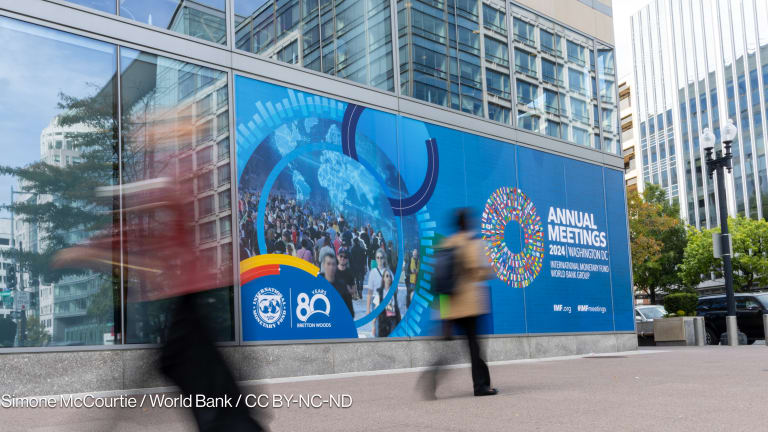
The World Bank’s annual meetings are in full swing with experts, policymakers and development professionals from around the world gathered in Washington, D.C., to discuss the future of global development. Devex has been attending the events and pounding the corridors to find out the hot topics people are talking about and what’s creating a buzz in the halls. Here are five key takeaways from the meetings so far: 1. Multilateral organizations are worried about the globalization backlash. More developing countries are in economic recession today than any time since the global economic crisis in 2009. The International Monetary Fund predicts global growth will be subpar at 3.1 percent in 2016, with only a slight increase to 3.4 percent predicted for 2017, and World Bank President Jim Yong Kim, speaking at a press conference on Thursday, referred to the global economy as “sluggish.” With that bleak backdrop, leaders of the world’s multilateral organizations have seen worrying signals from some countries that their faith in global cooperation is waning and being replaced by policies to protect national economic interests. That shift poses a challenge to multilateral organizations such as the World Bank, which rely on international cooperation between countries to achieve shared goals of increased prosperity and reduced inequality. IMF Managing Director Christine Lagarde warned economic stagnation could lead to a rise in protectionist ideas and “fragmentation” among developed country policymakers. “A retreat from globalization and multilateralism is a serious risk at a time when international cooperation and coordination are as critical as ever,” she said. 2. As technology transforms labor, countries must invest in people. The rise of automated technology poses a significant challenge to developing country labor markets, and the World Bank put that challenge front and center this week with some startling statistics. An imminent transformation in the job market means countries have to invest in their people, and Kim made that case to finance ministers and policymakers during a panel discussion this week. Finance and economic ministers from eight developing countries pointed to nutrition as a key part of the equation to drive productivity and inclusive growth. Gian Marco Grindatto, of Global Health Advocates, said this was a “powerful” new financial framing of the nutrition agenda which used to be seen in the more traditional development context of hunger and food security. He said the agenda portrays nutrition as a “tool for empowering economic development” and thus enables it to reach a broader spectrum of decision-makers than before. Grindatto credited Kim, who opened and closed the discussion, with redefining the nutrition debate. “We can’t walk into a future with increased automation and with a high rate of stunting and compete economically,” Kim said. 3. The World Bank is thinking big — but does it have the funds? Jim Kim wants the bank to play a bigger role on global issues such as climate change, forced displacement, and pandemic emergencies — and that will require “more strategic and flexible” financing mechanisms, according to the bank chief. The newly announced Global Concessional Financing Facility, which will make concessional financing available to middle-income countries that host refugees is one example of that more flexible approach. “We want to show that when countries provide great a service to the world in absorbing Syrian refugees, they should not become indebted,” Kim said Thursday. Kim added that he has been, “making the case for a capital increase” to support a broader role tackling global challenges, but he said that decision will ultimately be up to the bank’s governors. 4. Jim Kim answers to the board and his clients, even if staff aren't convinced. The topic of the president’s controversial reappointment to a second term was inevitably raised during Thursday’s press conference. In response, Kim pointed to his broad support from the bank’s governors — representatives from the bank’s 189 member countries who are responsible for appointing the institution’s chief. Kim acknowledged staff remain “uneasy” due to the pace and number of reforms he undertook during his first term as president, but he said “we are passed that now, and I am very pleased to be reappointed unanimously.” Rumored walkouts and protests by World Bank staff have yet to materialize, and this year’s meetings have proceeded with a relative sense of calm so far in Washington, D.C. 5. Everyone's buzzing about blockchain. Blockchain, the “distributed ledger” technology that underpins the digital currency bitcoin, has the potential to revolutionize the future of financial services, according to Don Tapscott, who spoke at the IMF on Thursday. As Devex recently reported, blockchain has applications for transparency, accountability and open governance because of its supposedly tamper-proof design, and is being lauded by some as the next big development technology. Innovation, technology and the need to make sure these forces work for the poor and not against them, have been common themes at the World Bank this week, where we’ve also heard some fascinating predictions about what might be on the horizon. According to inventor and technology expert Ray Kurzwell, who spoke during a panel on “Technology, Innovation, and Inclusive Growth,” our homes will soon be built using Lego-style bricks produced from digital printers, our children will replace failing organs with new ones grown in laboratories, and we will all be able to “reprogram biology away from disease and aging.” Read more international development news online, and subscribe to The Development Newswire to receive the latest from the world’s leading donors and decision-makers — emailed to you FREE every business day.
The World Bank’s annual meetings are in full swing with experts, policymakers and development professionals from around the world gathered in Washington, D.C., to discuss the future of global development. Devex has been attending the events and pounding the corridors to find out the hot topics people are talking about and what’s creating a buzz in the halls.
Here are five key takeaways from the meetings so far:
1. Multilateral organizations are worried about the globalization backlash.
This article is free to read - just register or sign in
Access news, newsletters, events and more.
Join usSign inPrinting articles to share with others is a breach of our terms and conditions and copyright policy. Please use the sharing options on the left side of the article. Devex Pro members may share up to 10 articles per month using the Pro share tool ( ).
Sophie Edwards is a Devex Contributing Reporter covering global education, water and sanitation, and innovative financing, along with other topics. She has previously worked for NGOs, and the World Bank, and spent a number of years as a journalist for a regional newspaper in the U.K. She has a master's degree from the Institute of Development Studies and a bachelor's from Cambridge University.