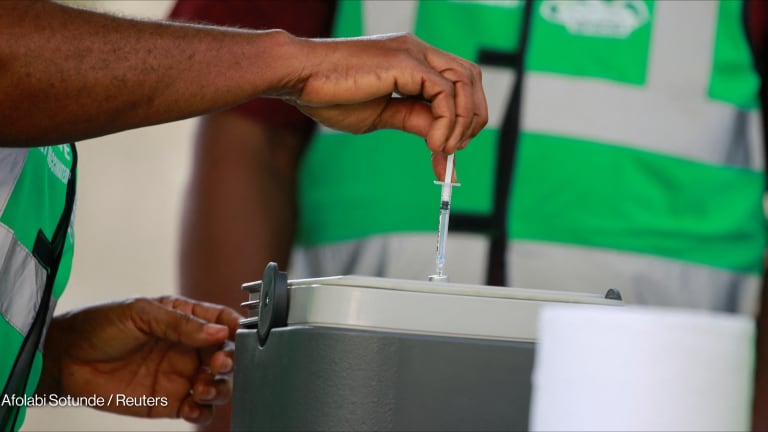

A new study aims to create guidance for the development of COVID-19 vaccination certificates in the Asia-Pacific region, where countries are increasingly considering these and similar instruments to open up travel, ease quarantine measures, and restart their economies.
Led by the Health Intervention and Technology Assessment Program, or HITAP, at Thailand’s Public Health Ministry and the National University of Singapore, it includes a survey that aims to gain the general public’s perspectives on vaccination certificates and mandates, as well as a survey targeted at key institutions and bodies in the public and private sectors working in health but also others such as those working in foreign affairs and transport.
“We know that vaccine certificates [touch] all aspects of our lives, and it's going to affect us equally or unevenly. … If the voice of the public and stakeholders are not incorporated, then the adherence to these policies will be very challenging,” said Sarin KC, a project associate for HITAP who is involved in conducting the study.
Vaccine certificates are often seen as a tool to show a person’s proof of vaccination, but it can also include other information such as if a person has recovered from COVID-19, or has tested negative for the coronavirus.
Preliminary results from the surveys, which are still ongoing, show significant interest in the use of vaccination certificates, as well as concerns amid the circulation of more transmissible COVID-19 variants, the variety of vaccines used in the region, the limited supply of doses, and the existing digital divide within countries.
Balancing benefits and concerns
The surveys are currently being implemented in nine countries in Asia: India, Indonesia, Japan, Laos, Malaysia, the Philippines, Singapore, South Korea, and Thailand. Members of the study team said that the responses received so far indicate interest in the use of vaccination certificates.
How 'vaccine passports' could exacerbate global inequities
Devex looks at how the clamor for so-called vaccine passports by higher-income countries would likely affect the global south.
“We are seeing the overwhelming sort of interest in using these instruments, because I think there is a sense that vaccination overall does make a place safer and able to return us to a sort of new normal,” said Aparna Ananthakrishnan, who is also a project associate at HITAP.
She said vaccination certificates are viewed as a means to rebuild the sectors hit hardest by the pandemic, such as the transportation, tourism, and hospitality industries. Team members are also finding that people are now more open to sharing their health status.
“It is only going to be a matter of time before things are forced to open up [from COVID-19 restrictions] in a way. So these certificates would sort of make that transition a little bit smoother by enabling safety of some kind,” Ananthakrishnan said.
However, preliminary results from the surveys also show that people understand the importance of continuing public health measures such as mask-wearing and social distancing.
A majority of respondents in both the general public and key stakeholder groups in the public and private sectors also said at least 60% of the population should be immunized before vaccination certificates are adopted and widely rolled out, KC said. This would ensure that the benefits of these instruments are not concentrated among a select few who can access vaccines, while also safeguarding the majority of people from imported infections among travelers who use their certificates to gain entry to countries.
Sign up for Devex CheckUp
The must-read weekly newsletter for exclusive global health news and insider insights.
Majority of them also said they want “risk-based” testing and quarantine strategies recognizing that each traveler will pose a different level of risk to the destination country.
Ananthakrishnan said defining what is “risk-based” is a challenge, given the changing epidemiology of outbreaks between and within countries, as well as the unavailability of certain COVID-19 vaccines in some nations. “It is a delicate balance to find ways for countries to open up their economies safely while also allowing cross-border travel,” Ananthakrishnan said, adding that the balance will depend on each country’s risk tolerance and based on their own contextual situations.
KC meanwhile said that while they “do not condone discrimination” that bases quarantine and testing policies on where travelers come from or the type of COVID-19 vaccine they received, providing distinctions on the level of risk and applying the relevant policy “is essential if these instruments are to really be a ‘safe passage into the new normal’”.
“The consequences of not doing so can be costly,” both in terms of finances and human lives, he added.
In both surveys, public health topped respondents’ lists of concerns around vaccination certificates. The general public was also concerned with ethics and equity. Vaccine access remains a challenge for populations in the Asia-Pacific region, and the use of digital certificates may also be an issue for those with no access to smartphones or similar electronic devices.
For key members of the public and private sectors, meanwhile, implementation was the second-biggest concern, including how countries can verify the authenticity of certificates and whether they should include a traveler’s proof of vaccination or if COVID-19 test results would be a better measure. The Philippines has already seen reports of fake COVID-19 test results, and the types of vaccination cards issued to fully inoculated individuals vary by city.
Another issue is language. In some places, proof of vaccination is issued in the local language, hindering use internationally.
More vaccines, more questions?
A wide variety of COVID-19 vaccines are approved and used in the Asia-Pacific region. This allows greater access for more members of the population and helps reduce COVID-19 deaths, said Ananthakrishnan. But this can pose challenges for vaccination certificates, as some countries may only recognize certain vaccines.
The European Union’s digital COVID-19 travel pass, launched in July, excluded the AstraZeneca vaccine manufactured by the Serum Institute of India, as it lacks regulatory approval from the European Medicines Agency. Several European countries, however, currently recognize the vaccine as proof of immunity.
“If the voice of the public and stakeholders are not incorporated, then the adherence to these policies will be very challenging.”
— Sarin KC, project associate, HITAPIssues also exist within countries, too. In Singapore, individuals who received the Sinovac vaccine — which is mostly given in private clinics — had to take a COVID-19 test to be allowed into certain social events and venues. The country also excluded those who received the Chinese-made vaccine from its national vaccination tally. But last month, the country’s Health Ministry said it will recognize all vaccines that have a World Health Organization emergency use listing.
Ananthakrishnan said discussions on vaccination certificates are “extremely dynamic” and the study team continues to monitor new developments.
Countries such as Thailand, for instance, have given the go-ahead to mix and match COVID-19 vaccines, allowing those who received a Sinovac vaccine as a first dose to receive a second dose from a different manufacturer. The country is also among the first globally to give booster shots.
“I think both of those things have implications on how these vaccine certificates will go forward. Will countries recognize when combination vaccines are being offered to people? What does it mean to be fully vaccinated? Would that be someone with two doses? Would that be someone with three doses? Or would one, like in the Johnson & Johnson [vaccine], be sufficient? So I think that this is a space for us to continue monitoring … not just on vaccine certificates alone, but also as part of our broader project on COVID-19 vaccines,” Ananthakrishnan said.
About the author

Jenny Lei Ravelo@JennyLeiRavelo
Jenny Lei Ravelo is a Devex Senior Reporter based in Manila. She covers global health, with a particular focus on the World Health Organization, and other development and humanitarian aid trends in Asia Pacific. Prior to Devex, she wrote for ABS-CBN, one of the largest broadcasting networks in the Philippines, and was a copy editor for various international scientific journals. She received her journalism degree from the University of Santo Tomas.