
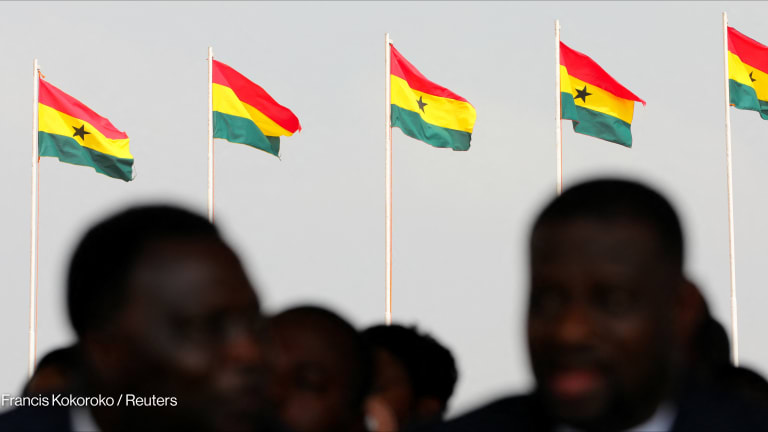
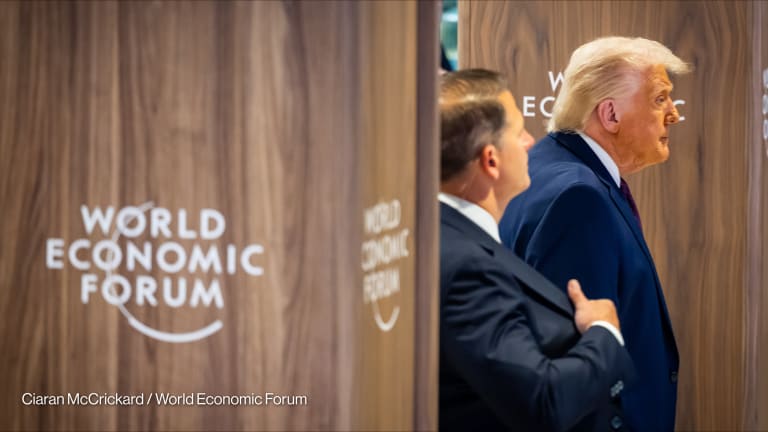
The leader of the Accra Reset initiative — the ambitious African-led drive to localize development leadership — has announced new steps to strengthen the movement. At the World Economic Forum on Thursday, Ghanaian President John Dramani Mahama announced the launch of a global secretariat, a high-level panel on global health reform, and a “Guardians’ Circle” of supporters — a group of former prime ministers and presidents described as the “moral stewards” of the movement. Mahama also outlined plans to move billions of dollars of African money from investments abroad back onto the continent to help pay for the movement’s ambitions. “Our world as we know it is at an inflection point,” said Mahama, speaking to a packed room of development experts, African political leaders, and about 100 others at Davos’ Grandhotel Belvédère on Thursday. “Africa intends to be at the table in determining what the new global order will look like. Africa must pull itself up by its own bootstraps.” It’s the latest milestone for the reset, which was officially launched at the United Nations General Assembly in September 2025. “The Accra Reset is no longer an idea. It is now a sovereignty movement.” --— John Dramani Mahama, president of Ghana Spearheaded by Mahama, the Accra Reset aims to break from the old way of doing development, and shift toward a system that reduces aid dependency — especially as the world of foreign assistance collapses. “In my quiet moments as I try to find solutions, here’s what I’ve learned. Crisis creates clarity,” said Mahama. “The clarity is that we must build our own capacity.” To date, Ghana, Nigeria, Egypt, Kenya, Mauritius, Togo, the Democratic Republic of Congo, Brazil, and Barbados have joined the effort, according to a spokesperson from the Guardians’ Circle. Several other countries are in the process of membership, and additional nations will be announced at the African Union Summit next month. Helen Clark, the former prime minister of New Zealand and one of the founding members of the Guardians’ Circle, told Devex she was optimistic that the movement could make real progress in its goal of African-led cooperation. “There have been attempts before to define the principles of cooperation, and it ends up on paper in a bin somewhere,” she said. “This time, President Mahama’s got the bit between his teeth, and he’ll bring others in behind to really redefine the way that cooperation works.” A first focus on global health The initial phase of the Accra Reset is intended to focus on global health — a response to foreign assistance for the sector falling by 21% between 2024 and 2025. Through the newly created High-Level Panel on the Reform of the Global Health Architecture and its Governance, four co-chairs and a technical secretariat will explore ways to link health commodities and technologies with domestic and regional production, work that will continue until 2027. That panel will be co-chaired by Peter Piot, a professor, microbiologist, and founding executive director of UNAIDS; Elhadj As Sy, the board chair of the Kofi Annan Foundation; Budi Gunadi Sadikin, Indonesia’s minister for health; and Nísia Trindade Lima, the former minister of health in Brazil. Ghana will host a technical secretariat for the work alongside a “Global North partner,” though that nation has yet to be announced. “This initiative is about how to reimagine development cooperation in the wake of defunding, and the tumbling, of [official development assistance],” said Yemi Osinbajo, former vice president of Nigeria, speaking at the Belvédère. “And the whole idea is to find ways of rethinking how to fund development.” Slashing the capital trap One way of doing that is through a “sovereign prosperity spheres platform,” Mahama explained, which will attempt to create linkages between Africa’s sovereign wealth funds — government-owned investment vehicles that use surplus revenue to grow countries’ wealth — and development aims. There are currently 36 sovereign wealth funds and 16 public pension funds on the African continent, according to the latest data from the U.N. Trade and Development agency — and cumulatively, they manage assets of more than $400 billion. By linking those funds with the aims of the Accra Reset, the member countries hope to invest money into regional health manufacturing, critical minerals processing, bioinnovation value chains, and cross-border market integration in both the Great Lakes and Nile Basin regions. The Alliance of African Multilateral Financial Institutions, a collective of African-owned and controlled financial institutions, has committed to mobilizing $10 billion toward the platform, Mahama said. The hope is that through the partnership, 15% of African sovereign wealth currently invested outside of the continent will be brought back home. “What we need to be doing now is to accept that we’re not capital-scarce, or capital-trapped,” said Samaila Zubairu, the chief executive officer of the Africa Finance Corporation. “We need to be looking at how we ensure capital flows [go] from where they are now to where we need them the most.” A formula for change At the Belvédère, Sania Nishtar, the CEO of Gavi, the Vaccine Alliance, and Priya Basu, the executive head of the World Bank’s Pandemic Fund, spoke of their organizations’ commitments to the cause, and Naveen Rao, the senior vice president of the health initiative at The Rockefeller Foundation, said they would be convening a “community of practice” to bring the Accra Reset countries together. That group, Rao added, would exist to “define the problems, and more importantly, come up with the solutions” to the world’s global health challenges. The Global Fund to Fight AIDS, Tuberculosis and Malaria — which invests $5 billion every year to combat those health challenges — will also be "sharpening its focus on domestic financing, value for money, integrated systems, and regional approaches to procurement and manufacturing” in its next grant cycle, a Global Fund spokesperson told Devex. “We see this as an opportunity to work together to accelerate progress on health, and accelerate a path to self-reliance,” said Peter Sands, the executive director of The Global Fund, speaking from a stage on Thursday. “We are revamping and changing a whole set of our policies and the way we work with countries to help make this happen.” While health is the first priority for the Accra Reset, it’s not the last, said Mahama. At Davos, the president outlined several other initiatives the group is steering toward, including a so-called South-South Policy Exchange between Accra Reset countries, India, Indonesia, South Korea, and Singapore. The policy exchange in India will focus on manufacturing, technology and “long-term value creation,” Mahama said, while the one in Indonesia will focus on the processing of lithium, phosphate, and nickel. Exchanges with South Korea and Singapore revolve around digital public infrastructure and artificial intelligence, he added. All of those commitments, Mahama said, are part of the “Belvédère Commitments” — and at the African Union summit next month, the team will seek formal political endorsement. The Guardians’ Circle All of that work will be buoyed by 13 presidents, prime ministers, and key political leaders, including New Zealand’s Helen Clark. The former United Nations Development Programme chief is one of a dozen former heads of state that have joined the ranks of the Guardians’ Circle, along with former chair of the African Union Commission, Nkosazana Dlamini-Zuma. “Basically, we will be champions [for the movement],” Clark told Devex, adding that the Guardians’ Circle is an “explicit, public, global support” force for the Accra Reset movement. In addition to Clark and Dlamini-Zuma, the list of guardians includes Olusegun Obasanjo, the former president of Nigeria; Ellen Johnson Sirleaf, the former president of Liberia; Joyce Banda, the former president of Malawi; Ameenah Gurib-Fakim, the former president of Mauritius; Jakaya Kikwete, the former president of Tanzania; John Agyekum Kufuor, the former president of Ghana; Gro Harlem Brundtland, the former prime minister of Norway, Hailemariam Desalegn, the former prime minister of Ethiopia; Romano Prodi, the former prime minister of Italy; Gordon Brown, the former prime minister of the United Kingdom; P.J. Patterson, the former prime minister of Jamaica. “The Accra Reset is no longer an idea,” Mahama said. “It is now a sovereignty movement.”


The leader of the Accra Reset initiative — the ambitious African-led drive to localize development leadership — has announced new steps to strengthen the movement.
At the World Economic Forum on Thursday, Ghanaian President John Dramani Mahama announced the launch of a global secretariat, a high-level panel on global health reform, and a “Guardians’ Circle” of supporters — a group of former prime ministers and presidents described as the “moral stewards” of the movement.
Mahama also outlined plans to move billions of dollars of African money from investments abroad back onto the continent to help pay for the movement’s ambitions.
Printing articles to share with others is a breach of our terms and conditions and copyright policy. Please use the sharing options on the left side of the article. Devex Pro members may share up to 10 articles per month using the Pro share tool ( ).
About the author

Elissa Miolene
Elissa Miolene covers U.S. foreign assistance from Washington, D.C. She previously covered education at The San Jose Mercury News, and has written for The Wall Street Journal, the San Francisco Chronicle, and other news outlets across the world. Before shifting to journalism, Elissa led communications for aid agencies in the United States, East Africa, and South Asia.
Search for articles


Most Read
- 1
- 2
- 3
- 4
- 5