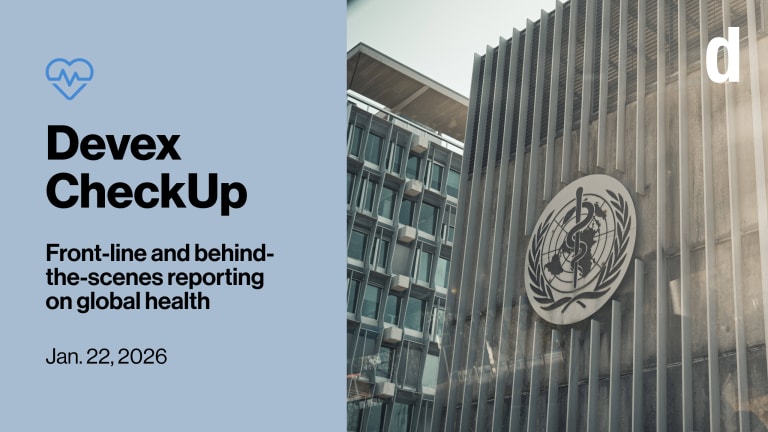
Can the US formally withdraw from WHO without paying its debts?
Paying what’s owed to the organization is one of the conditions of its withdrawal.
The United States expects to officially withdraw from the World Health Organization on Thursday after serving the required one-year notice period — a key condition for leaving the global health body, which it joined in 1948. But the country has yet to meet the other condition for withdrawal — paying what’s owed to the organization: $260 million in dues for 2024 and 2025. When the U.S. joined WHO, Congress stipulated that the country must pay what’s owed to the agency for the current fiscal year to withdraw. That creates legal questions around withdrawal — which would be an unprecedented event. “President Trump has not abided by that requirement. As such, in my view, he is in violation of a federal law,” said professor Lawrence Gostin, founding director of the O’Neill Institute for National and Global Health Law. Gostin added that the joint congressional resolution to join WHO also didn’t specify who can make the decision to withdraw. “I believe that since Congress enabled the U.S. to join WHO, it should be Congress who decides whether to withdraw,” Gostin said. As a director of the WHO Collaborating Center on National and Global Health Law, Gostin said he tried to bring a lawsuit against the president on those two points, but advocates and lawyers advised that it wasn’t clear whether there would be standing to move forward with a lawsuit. “That means Trump will get away with his lawless and reckless action because it has not been challenged either in Congress or the courts,” Gostin said. “There is almost no chance that Congress will push back. The Democrats would have pushed for it, and still would, but they would never get the Republicans on board.” Exiting an org that has no withdrawal clause Steve Solomon, WHO principal legal officer, said at a press conference last week that the question of whether the conditions of withdrawal have been met will be discussed at the WHO executive board meeting in February and by countries at the World Health Assembly — WHO’s decision-making body — in Geneva in May. “When exactly will U.S. withdrawal from WHO be effective?” he asked. “This is a very important question, and there may be differences of view among member states on the answer to this question.” The WHO Constitution, a treaty that establishes WHO, doesn’t have a withdrawal clause, which was a deliberate move by the 1946 drafters, Solomon said. The U.N. Charter also doesn’t include a withdrawal clause. “They saw how a truly universal organization would make the world safer, so they did not include a withdrawal clause,” he said. According to a report from WHO Director-General Tedros Adhanom Ghebreyesus published on Tuesday, “it would appear that the Health Assembly has not to date expressly recognized a general unilateral right of withdrawal on notice alone.” But his report also acknowledged that, compared to other countries, the U.S. is uniquely positioned in that it ratified WHO’s Constitution subject to legislative provisions in a joint resolution of the U.S. Congress. That resolution noted that: “in the absence of any provision in the World Health Organization Constitution for withdrawal from the Organization, the United States reserves its right to withdraw from the Organization on a one-year notice: PROVIDED, HOWEVER, that the financial obligations of the United States to the Organization shall be met in full for the Organization’s current fiscal year.” In 1948, it was put before the World Health Assembly whether they would recognize the validity of the U.S.’ ratification of the constitution with that language included — and they did. And so now, even if the Trump administration has considered itself withdrawn on Thursday, the world’s countries are tasked with deciding whether the conditions are met. “These questions of withdrawal, the questions of the condition and the promise and the agreement reached between the U.S. and the World Health Assembly — these are issues that are reserved for member states. They're not issues that WHO staff can decide,” Solomon said. And specifically, there are two technical questions for countries to consider: • Within the case of the Trump administration’s withdrawal, what’s considered the “current fiscal year” — the year the notice of withdrawal was received from the U.S. or the year the withdrawal is set to take effect? Or some other formulation? • Whether the language about paying the organization what’s owed is a condition that must be met before the “right to withdraw from the organization on a one-year notice.” The U.S. has outstanding arrears for 2024, and has not met its financial obligations for 2025 nor 2026. The World Health Assembly asked that WHO’s executive board also submit a report with recommendations, ahead of its convening in May. But there are also questions as to whether the U.S. is willing to pay what’s owed. Dr. Judd Walson, professor and Robert E. Black Chair in International Health at Johns Hopkins Bloomberg School of Public Health, said that U.S. payments to WHO are often delayed. “My understanding is that payments are often very many months, to even a year, late,” he said. The U.S. was the top donor to WHO, contributing $1.284 billion during the 2022–2023 biennium — or 15.6% of WHO’s total revenue. The loss of the U.S. funding has left WHO in a financial lurch. Patrick Cronin, coordinator for human resources management, HR policy, and internal justice at WHO, said that by June, the number of WHO global staff will have been reduced by 22% compared to January 2025. “The senior management is reduced by half. The middle management department is reduced by half,” Tedros said. But he added WHO has also raised about 75% of the budget they need for the 2026-2027 biennium. “It’s not about money. Money can be adjusted,” he added. “I’m not saying money doesn’t matter, but what matters most is solidarity, cooperation.” In the wake of the Trump administration’s announcement, Argentina also notified WHO of its intent to withdraw. But this case is different. Tedros’ report noted the grounds on which the drafters of WHO’s Constitution envisaged unilateral withdrawal “does not apply to the situation in respect to Argentina.” The country didn’t have the same legislative conditions for withdrawal when it joined. The report stated that “unless the Health Assembly were to decide to adopt a different approach to this issue than it has taken on previous occasions, the conclusion may be drawn that the purported notification of withdrawal by Argentina should not be accepted as effective.” And in the meantime, there are questions around how WHO should practically engage with the U.S. and Argentina. For that, the executive board might provide interim guidance ahead of May. A turn to bilateralism The U.S. withdrawal from WHO has been criticized as a move that will weaken global health security and threaten the health of the world’s population. Last week, Tedros pleaded with the U.S. not to leave the organization. “There are many things that are done through WHO that benefit the U.S. — and only the WHO does, especially the health security issues,” he said. “The U.S. cannot be safe without working with WHO.” But the U.S. government is amid a colossal shift in how it manages global health under its new “America First” strategy. As part of severing ties with multilateralism, it’s signing bilateral health agreements with countries. Those agreements include data-sharing agreements. After signing the agreement with Kenya, Dr. Ouma Oluga, the principal secretary in the state department for medical services at the nation’s Ministry of Health, speculated that, given the U.S. WHO withdrawal, the Americans are finding other ways to get data from countries. When a country is a member of WHO, it has access to information that’s not public, Walson said. “For example,” Walson said, “if you have an Ebola outbreak in a country, do you really just want the number of cases, or do you actually want to know: Who had Ebola? Where do they live? How did we do the contact tracing around that household? How did we ensure that all their contacts were quarantined?” But there are concerns among populations around what data is shared and how it's used under U.S. bilateral agreements. For example, there’s concern that it could include private patient data, or that data could be used to gain military advantage, political influence, or for economic reasons, Walson said. And this could fall in contrast to the commitments WHO makes around data. “WHO remains very committed to using data for global population health reasons only. It protects private health data that they have access to. They have agreements with member states about how that can be used or not used — shared and not shared,” Walson said. Walson said one area where impacts of the WHO withdrawal might be seen most urgently is humanitarian crises, which can have massive health consequences. “We’re going to very readily see that as these populations move into countries that we aren’t on good terms with, or don’t have good diplomatic relationships with, it’s gonna be very hard for us to negotiate access to data, etc., and therefore, our inability to see what’s happening will impact our ability to have any impact there,” Walson said. Given that Trump’s executive order was issued a year ago, a seismic shift isn’t expected after formalities are set in place. “In Trump's executive order, he directed US public health agencies not to cooperate with WHO and also withheld all funding. For all practical purposes, the official withdrawal will have little or no effect,” Gostin said. Walson said many people within the U.S. government, at an individual level, “voice incredible concern and incredible displeasure.” “There’s no question that while the Trump administration as a whole will signal this as a huge success — the people within the administration, many of them, are concerned,” Walson said. Walson said it’s his understanding WHO remains open to Americans on an individual basis, working across the technocratic areas of WHO. For example, as an American citizen, he sits on several of WHO steering committees and working groups. “The American flag is still flying outside the building,” he said. The void The U.S. joined WHO in the wake of World War II. “In view of the long history of effective international cooperation in the field of health which spares us the haunting fear of devastating epidemics of cholera and plague, we can look to the World Health Organization with hope and expectation,” U.S. President Harry Truman said at that time. While the multilateral organization is set up to be independent, impartial, with all member states having an equal voice, the U.S. played an outsized role. Following World War II, Soviet Union countries sent notices of withdrawal from WHO in 1949 — and then formally stated their intention to rejoin in 1955. But the World Health Assembly did not consider these as formal withdrawals — just that these countries were inactive. But during that time, the U.S. stepped into the void, Walson said. “It’s like propping open a door with your foot — we really got ourselves in and stayed there until now.” “There’s no question that the U.S. wielded an outsized political influence within the organization,” Walson added. But now, there’s a repositioning with other countries stepping into the void the U.S. created. “It’s likely that we will see fairly significant differences in the priorities and the approaches that WHO will take — not overtly or directly — because of the way that these countries openly operate,” he said. “I think those actors will have much more influence in the workings of WHO moving forward.” Final adieu? Would a future American administration be able to easily rejoin WHO — and would they want to? “Having talked with close officials of the Biden administration, the consensus view is that there would be no urgency in rejoining,” Gostin said. “That view is held because Biden reversed the decision to withdraw on his first day in office. But White House staff do not think the president was rewarded for that decision by way of meaningful reforms from WHO leadership.” But Gostin said if an administration were to move forward — he does think rejoining would be legally easy. “Since Trump withdrew through a unilateral executive order, I have little doubt that a Democratic President could rejoin through an Executive Order, unless Congress pushed back, which is doubtful,” Gostin said. He also said he believes the U.S. could rejoin without paying past dues. “I say that because it is in WHO's clear interests to have the US as a member. I do not believe that the [director general] would condition reentry upon paying past bills. But I hope there will be a commitment on the part of the US to stay up to date on its required assessments,” Gostin said. When Soviet Union countries began engaging again with WHO in the 1950s, the World Health Assembly decided they would pay a “token payment” for the years they weren’t active in the organization.
The United States expects to officially withdraw from the World Health Organization on Thursday after serving the required one-year notice period — a key condition for leaving the global health body, which it joined in 1948.
But the country has yet to meet the other condition for withdrawal — paying what’s owed to the organization: $260 million in dues for 2024 and 2025. When the U.S. joined WHO, Congress stipulated that the country must pay what’s owed to the agency for the current fiscal year to withdraw.
That creates legal questions around withdrawal — which would be an unprecedented event.
This story is forDevex Promembers
Unlock this story now with a 15-day free trial of Devex Pro.
With a Devex Pro subscription you'll get access to deeper analysis and exclusive insights from our reporters and analysts.
Start my free trialRequest a group subscription Printing articles to share with others is a breach of our terms and conditions and copyright policy. Please use the sharing options on the left side of the article. Devex Pro members may share up to 10 articles per month using the Pro share tool ( ).
Sara Jerving is a Senior Reporter at Devex, where she covers global health. Her work has appeared in The New York Times, the Los Angeles Times, The Wall Street Journal, VICE News, and Bloomberg News among others. Sara holds a master's degree from Columbia University Graduate School of Journalism where she was a Lorana Sullivan fellow. She was a finalist for One World Media's Digital Media Award in 2021; a finalist for the Livingston Award for Young Journalists in 2018; and she was part of a VICE News Tonight on HBO team that received an Emmy nomination in 2018. She received the Philip Greer Memorial Award from Columbia University Graduate School of Journalism in 2014.