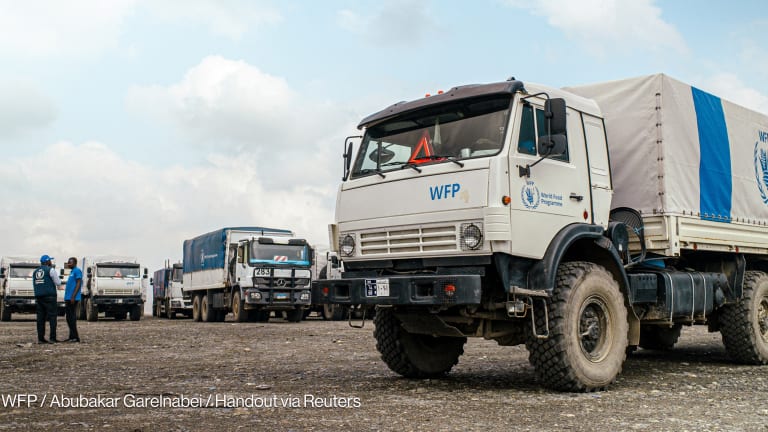
Deep dive: Food security and strains on the humanitarian infrastructure
In this special edition of Newswire, we asked: Is the modern humanitarian system equipped to address rising hunger and malnutrition? Plus, WFP’s funding woes, and the debate over famine declarations.
By Teresa Welsh // 16 August 2023Devex offices are closed this week for summer break. Instead of our regular Newswire, we are bringing you deep dives into some of this year's key development topics. Today, I look at how equipped the modern humanitarian system is to address rising hunger and malnutrition. If you’ve been following my coverage here at Devex and my weekly newsletter, Devex Dish, you’ll know that it’s been a tough year for global hunger and malnutrition targets. Levels were already on the rise for several years — but lingering effects of the pandemic and now the war in Ukraine mean the most vulnerable suffer the most. This year’s United Nations State of Food Insecurity and Nutrition in the World report brought the latest bleak numbers: In 2022, between 691 million and 783 million people were hungry, or 122 million more than in 2019 before the pandemic. Globally, 2.4 billion people, or 29.6% of the population, did not have regular access to food. Of those, an estimated 900 million faced severe food insecurity. All of this points to a wider strain on the humanitarian system, as the breadth of crises prevents real progress on Sustainable Development Goal 2 of eliminating hunger. Donor governments are increasingly strapped as their money is needed in ever more places. Low-income countries are being hard hit by inflation as well as deflation, with many currencies getting ever weaker against the U.S. dollar, meaning food import prices continue to rise. High debt levels mean governments have little fiscal space for social safety net programs. There are also bigger questions about the humanitarian-development nexus, which was supposed to seamlessly integrate the two sectors. While it began as a good idea aimed at increasing efficiency and reducing costs, the framework has failed to deliver in an era of proliferating humanitarian disasters. Protracted crises have blurred the line between urgent humanitarian and longer-term development work as organizations with different mandates work together on overlapping challenges amid tightening funds, including when it comes to food security. Read: SDG hunger goal slumps further behind 2030 target in key UN food report Plus: Is the humanitarian-development nexus still working? (Pro) + A Devex Pro membership brings you essential analysis, data-driven funding insights, and access to the world’s largest global development job board. Experience these perks by signing up to our 15-day free trial. A deadly funding gap “Next, we start cutting geographical areas and whole populations. And these are decisions that we take that impact millions of people.” --— John Aylieff, regional director for Asia and the Pacific, World Food Programme The world’s largest humanitarian organization, the World Food Programme, is having a difficult time responding to lower funding levels and multiplying crises. Under the leadership of former Executive Director David Beasley, WFP last year raised $14.2 billion, more than double the $6 billion in 2017, the year he took office. But part of the windfall was from the United States, which under some additional spending provisions because of the war in Ukraine, gave a record $7.3 billion — far more than the $3.8 billion it gave the year prior. There is some talk that an additional Ukraine supplemental bill could include some funding for food security, but nothing is guaranteed. So in the meantime, WFP is faced with some heartbreaking choices. The agency aims to feed 150 million of the estimated 345 million people facing acute hunger this year in 79 countries and to do so, it needs to raise about $23 billion. Instead, it is on track to raise less than half of that. As a result, WFP is cutting rations and recipients in countries around the world, in decisions staff describe as excruciating. (Or as Beasley used to say, taking from the hungry to feed the starving.) WFP has three coping mechanisms when funding for a crisis isn’t enough to meet needs. The agency first looks for efficiencies in its own operations and lets staff go while consolidating logistics costs with partners. Second, it looks toward reducing rations. “Next, we start cutting geographical areas and whole populations. And these are decisions that we take that impact millions of people,” Aylieff told me earlier this year. This is quite a welcome for new Executive Director Cindy McCain, who took over the agency in April and was promptly faced with not only funding shortages but a humanitarian emergency in Sudan — not to mention an escalating civil war and a scandal over wide-scale theft in Ethiopia. Read: Inside WFP's preparations for severe funding cuts Act quickly There has been some tepid good news out of Somalia this year as the global response to impending famine seems to have staved off the worst. But the situation sparked quite a bit of conversation over the modern famine declaration architecture and whether it’s still fit for purpose. Some argue that the way a famine is declared is too slow and too complex, leading to unnecessary deaths. The United Nations’ technical body that officially evaluates famine levels earlier this year resisted classifying the situation in Somalia as famine, although it had been saying one is likely. There are concerns that waiting to declare famine is delaying the large-scale humanitarian response needed and will lead to avoidable deaths. Studies show that the last time Somalia experienced famine in 2011, half of the 260,000 victims had already died by the time famine was declared. A group of prominent relief organizations has called for reform of a high-level United Nations task force on famine prevention, arguing its current structure doesn’t allow it to act quickly enough to prevent mass starvation in places such as Somalia. They say the system takes too long to develop plans and mobilize a response that could avert deaths. They’ve engaged with the first U.N. famine relief coordinator, Reena Ghelani, who hopes that the role will help demonstrate to people that there is a solution to food crises — and that the U.N. plays a central role in any solutions. “The root causes — if we don’t address them, we are not going to get out of this cycle. So it’s still about the big picture issues,” Ghelani told me earlier this year after she took up her post, pointing to conflict, climate, and economics. “The U.N. can be the facilitator of bringing these different groups together.” Read: Are slow famine declarations costing lives? (Pro) ICYMI: First UN famine coordinator pushes to eradicate starvation (Pro) A rare opportunity The malnutrition treatment community has had its eye on results in 2023, after a record-breaking year in 2022. If you don’t follow this, a quick primer: Financing for starving children to be treated with ready-to-use therapeutic foods, or RUTFs, comes through emergency humanitarian budgets. This means that those involved generally have little visibility into how many resources they’ll have available to feed dying children. It’s not that the system doesn’t know what to do to make this happen — it’s just that there’s never enough money. But last year, a mind-blowing half a billion dollars was pledged for RUTFs, and that money has quickly shown results. “We just proved it out in the last year. We had an increased amount of funding and we doubled the amount of RUTF procurement and the implemented programs went up 35%, and they’re on track to go up to double. It’s huge. And we did that in one year,” says Maria Kasparian, executive director of Edesia, a nonprofit RUTF manufacturer. Both those who make RUTFs and those who deliver them warmly greeted the long-awaited updated World Health Organization guidelines for how to treat malnutrition. The incredibly technical medical document is a dense read but makes some important updates in the way malnutrition treatment is delivered. While money is one issue preventing treatment from saving vulnerable children, lack of coordination is another. Turf wars and inefficiencies have long hindered scaling treatment, slowing the work needed to prevent the deaths of millions of children. NGOs are now urging USAID to push the U.N. agencies responsible for transforming the money into lives saved to overcome yearslong disagreements between UNICEF and WFP that threaten to stymie the rare shot at progress. “I think USAID does acknowledge it and I think they have a role to play. I don’t think they have fully played that role yet, but I think they can and should,” Kasparian says. Read: • What the new malnutrition guidelines mean for implementers and producers (Pro) • Reform of the UN famine task force needed to save lives, NGOs say. • USAID has power to push UN for malnutrition treatment reform, NGOs say (Pro) + Catch up on our coverage of the transformation of the global food system. Sign up to Newswire for an inside look at the biggest stories in global development.
Devex offices are closed this week for summer break. Instead of our regular Newswire, we are bringing you deep dives into some of this year's key development topics. Today, I look at how equipped the modern humanitarian system is to address rising hunger and malnutrition.
If you’ve been following my coverage here at Devex and my weekly newsletter, Devex Dish, you’ll know that it’s been a tough year for global hunger and malnutrition targets. Levels were already on the rise for several years — but lingering effects of the pandemic and now the war in Ukraine mean the most vulnerable suffer the most.
This year’s United Nations State of Food Insecurity and Nutrition in the World report brought the latest bleak numbers: In 2022, between 691 million and 783 million people were hungry, or 122 million more than in 2019 before the pandemic. Globally, 2.4 billion people, or 29.6% of the population, did not have regular access to food. Of those, an estimated 900 million faced severe food insecurity.
This article is free to read - just register or sign in
Access news, newsletters, events and more.
Join usSign inPrinting articles to share with others is a breach of our terms and conditions and copyright policy. Please use the sharing options on the left side of the article. Devex Pro members may share up to 10 articles per month using the Pro share tool ( ).
Teresa Welsh is a Senior Reporter at Devex. She has reported from more than 10 countries and is currently based in Washington, D.C. Her coverage focuses on Latin America; U.S. foreign assistance policy; fragile states; food systems and nutrition; and refugees and migration. Prior to joining Devex, Teresa worked at McClatchy's Washington Bureau and covered foreign affairs for U.S. News and World Report. She was a reporter in Colombia, where she previously lived teaching English. Teresa earned bachelor of arts degrees in journalism and Latin American studies from the University of Wisconsin.