• News
    • Latest news
    • News search
    • Health
    • Finance
    • Food
    • Career news
    • Content series
    • Focus areas
    • Try Devex Pro
  • Jobs
    • Job search
    • Post a job
    • Employer search
    • CV Writing
    • Upcoming career events
    • Try Career Account
  • Funding
    • Funding search
    • Funding news
  • Talent
    • Candidate search
    • Devex Talent Solutions
  • Events
    • Upcoming and past events
    • Partner on an event
  • Post a job
  • About
      • About us
      • Membership
      • Newsletters
      • Advertising partnerships
      • Devex Talent Solutions
      • Contact us
Join DevexSign in
Join DevexSign in

News

  • Latest news
  • News search
  • Health
  • Finance
  • Food
  • Career news
  • Content series
  • Focus areas
  • Try Devex Pro

Jobs

  • Job search
  • Post a job
  • Employer search
  • CV Writing
  • Upcoming career events
  • Try Career Account

Funding

  • Funding search
  • Funding news

Talent

  • Candidate search
  • Devex Talent Solutions

Events

  • Upcoming and past events
  • Partner on an event
Post a job

About

  • About us
  • Membership
  • Newsletters
  • Advertising partnerships
  • Devex Talent Solutions
  • Contact us
  • My Devex
  • Update my profile % complete
  • Account & privacy settings
  • My saved jobs
  • Manage newsletters
  • Support
  • Sign out
Latest newsNews searchHealthFinanceFoodCareer newsContent seriesFocus areasTry Devex Pro
    • News
    • Education

    Despite school closures, extreme heat flies under radar for education

    How many children are missing out on school because of closures due to extreme heat?

    By Diego Arguedas Ortiz // 03 June 2024
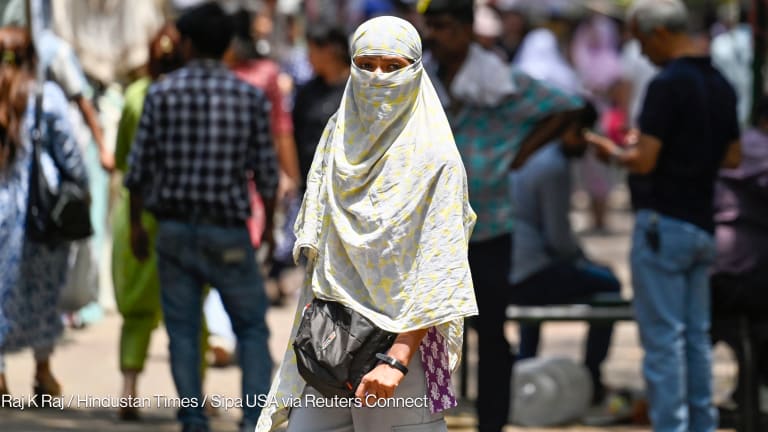
    Over 210 million children lost crucial school days in just April and May of 2024 due to school closures from extreme heat, a Devex analysis has found. The true scale of this climate change-driven disruption to education is likely even greater, as there is little official data or research on how often schools shut down because of extreme temperatures. Climate change impacts are rapidly eroding hard-won learning gains and widening education gaps between and within nations. With heat waves already becoming more frequent and intense due to climate change, addressing this threat is critical to safeguarding the fundamental right to education for hundreds of millions of the world’s most vulnerable children. With 2.4 billion children estimated worldwide in 2023 and over 4 billion children projected to be born over the next 30 years, having an education system that can cope with heat, storms, and floods becomes a central issue for governments. Students and teachers in eastern Pakistan found themselves experiencing the impacts of extreme heat firsthand, as the regional government of Punjab announced school closures due to a heat wave at the end of May. “To manage the students in so much heat is very difficult,” Javaria Usman, a teacher in Lahore, Pakistan’s second biggest city, told Devex. As she talks on the phone, just a few days after the announcement, the temperature reads 44 degrees Celsius in Lahore. Even before schools were officially closed, students were less focused and attentive in class — while many of them did not arrive at all, she said. “In this heat wave, parents are also very careful about the students,” Usman, who is also a mother of two, explained. “They do not want their children to become ill due to the heat.” Her pupils are among millions in Pakistan and around the world who lost crucial school days due to heat in the past two months. Lost schooling Education systems just recovering from the losses related to the COVID-19 lockdowns now have to consider high temperatures as a new risk, widening the education gap globally and within countries. Extreme heat is increasing on every continent due to the human burning of fossil fuels and other activities that cause man-made climate change. “This is disastrous for learning,” explained Shwetlena Sabarwal, a lead economist at the World Bank’s education team. In May, her team published a report on the impact of climate change on education, which concluded that climate impacts are eroding education gains. Bangladesh, for example, risks losing gains in education as millions of school children missed two weeks of school due to heat. “The majority of [children] are on the tipping point,” said Shumon Sengupta, country director at Save the Children Bangladesh, adding that the government’s work on enrolment can be lost. “A slight disruption will get them out of school and get them out of schools for good,” Sengupta explained. “This applies in particular to girls.” An unaccounted number of students are also facing reduced hours. Cambodia ordered all public schools to reduce two hours off their regular school days due to high temperatures, and similar instructions were given in some parts of Mexico, where many schools moved to online teaching. What the data does (or doesn’t) show There is no official data on how often and how many schools close because of high temperatures. As part of a World Bank report, Sabarwal’s team looked at how many children were impacted by school closures due to heat globally, but could not reach an overall number. “[I]t is telling that we were not able to find official data on how often schools are shutting down due to heat,” she said. This impression is shared by other experts. “The impact of heat on education is still under-researched and not well monitored,” Sarah Beardmore, who leads climate Initiatives at the Global Partnership for Education, told Devex. Given this lack of data, Devex went through media reports and releases from international organizations to get a more comprehensive view of the number of children who have missed at least a day of school due to heat-related closures in April and May. With no official data on children impacted by school closures, this analysis focused on countries or regions where schools shut completely. It then compiled the number of children enrolled in school from the latest official data available. This does not account for children out of school. The review found that heat-driven closures or early holidays were implemented nationwide in the Philippines — which has more than 26 million children in education — and South Sudan, with 2,3 million; most of Bangladesh, with 34 million; Pakistan’s most populous province, Punjab, with 21,7 million; and parts of Mexico, with 3.5 million. Meanwhile, many Indian states announced full closures, including Andhra Pradesh, Chhattisgarh, Haryana, Jammu, Kerala, Maharashtra, Odisha, Punjab, Rajasthan, Telangana, Tripura and West Bengal, and the territories of Chandigarh and Delhi. Collectively, these states have over 123.4 million students between preprimary, primary, and secondary education. This review uses figures from 2021-2022 and has not included partial closures reported in India, meaning the number of children in India missing school is likely higher. This means that at least 210.9 million of the world’s 2.4 billion children, or almost one-tenth, lost school days due to extreme heat in just two months this year. Beyond closures — the impact of heat on learning Closures are only part of the problem when it comes to extreme heat and education. Heat kills and can cause health issues such as heat exhaustion and heatstroke — and can lead to worse learning outcomes. “Even if the school doesn’t close, you’re sitting in a hot classroom and we know that cognition is worse past a certain temperature,” Caitlin M. Prentice, a postdoctoral researcher in the Department of Psychology at the University of Oslo, explained. She is part of a team that analyzed dozens of studies published by other scientists, looking for clues on how climate change impacts education. In an article published in Nature, they found that climate change is fundamentally altering schooling around the world; and in the case of heat, the impacts went beyond locked classrooms. For instance, researchers in China and South Korea found that students fared worse in university entrance exams on hotter days. In India, extreme heat impacted nutrition, which in turn leads to learning losses. In five studies analyzed by the World Bank team, student performance declined from 2% to 12% for each 1°C increase in classroom temperature. “All these studies sort of add pieces in a puzzle, which confirmed the broad message that heat is affecting education outcomes,” said Francis Vergunst, an associate professor in psychological and social difficulties at the University of Oslo, who co-authored the Nature article with Prentice. The risks are higher for those in lower-income homes, as they are more likely to live in hotter houses, with worse access to water and electricity. Students from lower-income families also live further away from the school and must walk under the burning sun. Sengupta, from Save the Children, said that he visited schools in late May, after Bangladesh ordered a reopening, and found them still unbearable. “It was so difficult for me to even sit there,” he recounted. “And imagine these girls and boys from poor economic backgrounds, who have come probably to the classroom in [an] empty stomach.” Teachers are also struggling with the heat; 77% of public school teachers in Manila, Philippines, declared classroom temperatures intolerable in a recent survey. Flying under the radar Governments might not be monitoring school closures partly because they don’t think high temperatures are a make-or-break issue for education, Sabarwal suggested. For the World Bank study, her team surveyed 94 policymakers from 28 low- and middle-income countries to understand how they perceived the issue. Only just over half believe that hotter temperatures inhibit learning, while six out of 10 placed protection of learning from climate change among the bottom three priorities in their country — out of a set of 10 priorities. There is also next to no academic research on school closures due to heat. “I can’t think of a single paper that looked at school closures and heat,” said University of Oslo’s Prentice, whose team analyzed 43 studies, including 12 on heat, although she cautions her review was not systematic. This might also be part of a wider issue: That education remains a low priority in the climate agenda — at least if one follows the money. Adapting the education sector will require funding. But education made up less than 1.3% of climate-related official development assistance in 2020. Money is already creating wide gaps. High-income countries were spending almost $8,500 per student in 2021, while low-income countries this figure was only $54. In many lower- and middle-income countries, education spending declined with the COVID-19 pandemic. Pathways forward Addressing the impact of heat on education is particularly urgent as today’s average 4-year-old will experience between two to seven times more heat waves in her life compared to people born in 1960. With this outlook, where should a policymaker start? Both Sabarwal and Beardmore say that the first step is management. Identify schools at risk of extreme heat and keep a database of heat-related closures. Link schools with early warning systems and create a tailored strategy of action. With this information, emergency actions can be taken to reduce temperature in the most vulnerable schools. These solutions can go from expensive air conditioning units to more low-tech approaches, such as roof paint. A project in Indonesia documented a drop from 36 C to 33 C temperature drop by painting classrooms’ roofs white. Using local materials with modern technology can also help — as in this pilot school designed by a local award-winning architect in Burkina Faso, which was able to keep students cool under high temperatures without using air conditioning. “Take actions such as raising [the] roof to improve ventilation, insulate ceilings to reduce heat gain inside the rooms, have a wide overhang for shading, using bamboo screens to enhance natural ventilation and lightweight materials, plant trees around schools and ensure adequate airflow,” Beardmore urged. To tackle this, a $70 million pilot project aiming to build climate-resilient and green schools, led by GPE and the Green Climate Fund, was announced last December at climate conference COP 28. Sabarwal and Beardmore both argue that governments must ensure learning in case schools can’t cope with heat or other climate impacts. Remote learning is not necessarily the solution, however, according to Beardmore: “There is no ‘one-size-fits-all’ solution for remote learning,” she explained, stressing that cost and lack of planning are key factors that can hinder learning remotely. Instead, schools could prepare textbooks for children to take home, provide cash grants or identify alternative locations for learning that are cooler; and prepare reenrolment drives after any closure. “The best thing to do would be to limit climate change as much as possible, reduce emissions as fast as possible, and stop new oil developments,” Prentice said. “But given the schools can’t really act on that, [it’s] finding cooling technologies linked to renewable energy when possible.”

    Related Stories

    Experts warn of spike in heat deaths as countries backpedal on climate
    Experts warn of spike in heat deaths as countries backpedal on climate
    How bilingual instruction is boosting learning in Senegal
    How bilingual instruction is boosting learning in Senegal
    Why AI can’t transform classrooms until it learns local languages
    Why AI can’t transform classrooms until it learns local languages
    US aid cuts yank Nepal’s girls out of school and into child marriage
    US aid cuts yank Nepal’s girls out of school and into child marriage

    Over 210 million children lost crucial school days in just April and May of 2024 due to school closures from extreme heat, a Devex analysis has found. The true scale of this climate change-driven disruption to education is likely even greater, as there is little official data or research on how often schools shut down because of extreme temperatures.

    Climate change impacts are rapidly eroding hard-won learning gains and widening education gaps between and within nations. With heat waves already becoming more frequent and intense due to climate change, addressing this threat is critical to safeguarding the fundamental right to education for hundreds of millions of the world’s most vulnerable children.

    With 2.4 billion children estimated worldwide in 2023 and over 4 billion children projected to be born over the next 30 years, having an education system that can cope with heat, storms, and floods becomes a central issue for governments.

    This article is free to read - just register or sign in

    Access news, newsletters, events and more.

    Join usSign in
    • Careers & Education
    • Democracy, Human Rights & Governance
    • World Bank Group
    Printing articles to share with others is a breach of our terms and conditions and copyright policy. Please use the sharing options on the left side of the article. Devex Pro members may share up to 10 articles per month using the Pro share tool ( ).

    About the author

    • Diego Arguedas Ortiz

      Diego Arguedas Ortiz

      Diego Arguedas Ortiz is a climate journalist from Costa Rica. He has covered climate change since 2013 and is currently the associate director of the Oxford Climate Journalism Network, a program at the Reuters Institute for the Study of Journalism, Oxford University. His work has appeared in BBC Future, MIT Technology Review, Vice, BBC Culture, and Anthropocene, among other outlets. In 2015, he led the creation of Ojo al Clima, Central America's first climate news outlet, where he stayed as editor until 2019. His work includes six U.N. Climate Conferences, the Panama Papers international collaboration in 2016, and on-the-ground reporting from a dozen countries.

    Search for articles
    Related Stories

    Climate ChangeRelated Stories - Experts warn of spike in heat deaths as countries backpedal on climate

    Experts warn of spike in heat deaths as countries backpedal on climate

    EducationRelated Stories - How bilingual instruction is boosting learning in Senegal

    How bilingual instruction is boosting learning in Senegal

    EducationRelated Stories - Why AI can’t transform classrooms until it learns local languages

    Why AI can’t transform classrooms until it learns local languages

    The Aid ReportRelated Stories - US aid cuts yank Nepal’s girls out of school and into child marriage

    US aid cuts yank Nepal’s girls out of school and into child marriage

    Most Read

    • 1
      Why NTDs are a prime investment for philanthropy
    • 2
      The silent, growing CKD epidemic signals action is needed today
    • 3
      Trump withdraws, defunds dozens of international orgs and treaties
    • 4
      Why are 3.4 billion people still offline?
    • 5
      Why capital without knowledge-sharing won't solve the NCD crisis
    • News
    • Jobs
    • Funding
    • Talent
    • Events

    Devex is the media platform for the global development community.

    A social enterprise, we connect and inform over 1.3 million development, health, humanitarian, and sustainability professionals through news, business intelligence, and funding & career opportunities so you can do more good for more people. We invite you to join us.

    • About us
    • Membership
    • Newsletters
    • Advertising partnerships
    • Devex Talent Solutions
    • Post a job
    • Careers at Devex
    • Contact us
    © Copyright 2000 - 2026 Devex|User Agreement|Privacy Statement