Devex Dish: Data backs school lunch programs, but uptake is meager
In this week's edition: Although the benefits of school feeding programs are stark, investment in the safety net program remains low in Africa; Plus, WFP suspends operations in Sudan, and how to shockproof food systems.
By Teresa Welsh // 19 April 2023Although the benefits of school feeding programs are stark — $1 returns $20 through human capital and the local economy — investment in the safety net program remains low in Africa, Madalitso Wills Kateta reports for Devex. A cost-benefit analysis of school feeding programs also found that an investment of $11 billion annually would result in a return of $156 billion through increased school attendance. But only 27% of African children have access to school meals. "My parents were not harvesting enough food because our crops were usually affected by drought, and this meant I had to remain at home," 17-year-old Marai Nkhoma told Devex in an interview. She lives in the southern Malawi district of Balaka and had to miss classes because there wasn’t enough food at home. She’s now in secondary school, but had to remain home to take care of domestic chores as her parents went around in search of menial jobs to feed their five-member family. In Malawi, the data reflects the benefits of school feeding programs for children. The World Food Programme, in collaboration with the government, has been supporting the programs in the most food-insecure districts in the country since 1999. A 2019 evaluation of the program found that school meals reduced absenteeism by 5%. It has also resulted in a sharp reduction in dropout rates for girls, from 15.6% to 5.2%. In an effort to increase the number of countries supporting school feeding programs, UNESCO and its partners have recently included a school feeding coverage indicator as part of the official monitoring framework of Sustainable Development Goal 4, which guarantees "inclusive and equitable education" for all. Read: School feeding investment in Africa remains low despite high returns Mourning colleagues WFP has suspended operations in Sudan after three of its workers were killed in violence that has erupted across the country. Cindy McCain, who has been at the helm of the agency for less than two weeks, made the announcement on Saturday. Two other employees were injured when violence broke out in Kabkabiya, North Darfur. McCain said a WFP-managed U.N. Humanitarian Air Service aircraft was “significantly damaged” by gunfire on Saturday at the airport in Khartoum, which affects WFP’s ability to move aid workers and aid within the country. In a tweet, McCain urged the battling parties to reach an agreement that protected humanitarian workers. Many other organizations have also been forced to suspend operations. Read: Aid groups suspend operations amid violence in Sudan Food security as national security Before starting Gro Intelligence, a company that uses artificial intelligence to forecast global agricultural trends, Sara Menker was a trader on Wall Street. But she never wanted to limit these predictions to people who could pay a high price for them. “One thing that's been at the center of the way we built this company is to make knowledge inclusive,” she said during last week’s Global Inclusive Growth Summit. “To make sure that we're not actually making it more accessible to just a few traders in the world, and that’s that. I was a trader. If I wanted that, I would have started a hedge fund powered by data. And that life would have been easy.” My colleague Catherine Cheney tells me that Menker explained how Gro Intelligence, in partnership with groups including the Bill & Melinda Gates Foundation and the Rockefeller Foundation, is working with governments and other public institutions. It hasn’t been easy for the company to figure out how to make this work as a business, especially as private sector partners question why the company is sharing its data so widely, and governments ask why the company is working with corporations and hedge funds. But the crisis in Ukraine was a turning point for Gro Intelligence’s work with the global development community. “It was only at the beginning of last year that we really stepped into the public sector world in a really big way,” Menker said. “There was a dearth of data. And a series of crises. And food security became a national security matter. And a lot of governments were not in a place where those questions could be answered.” Reform reasoning The International Food Policy Research Institute’s 2023 Global Food Policy Report lays out the evidence behind a set of the most useful approaches to address the barrage of shocks that have been rippling through the food system. In an op-ed for Devex, IFPRI Director General Johan Swinnen and senior research fellow Katrina Kosec sum up what’s called for by the findings: • Improving early warning and early action systems. • Building responsive and flexible social protection interventions. • Empowering women amid crisis. • Investing in infrastructure and policies that address the root causes of migration and support forced migrants. It’s report season, so we also have another look at a flagship publication for you, from Food and Agriculture Organization Chief Economist Máximo Torero Cullen. He writes for Devex about the concerning gender discrimination against women who work in food systems — even as a significantly larger share of working women in sub-Saharan Africa and South Asia are engaged in agri-food systems than working men. “However, while tolerating lower land productivity, women have lower ownership rates, less secure tenure, fewer production assets and less access to credit and regulatory rights, and lower wages than men, and for them to occupy a more vulnerable and exhausting role is not just unfair but unaffordable,” Torero writes. Opinion: We must build food system resilience before the next crisis Opinion: Food systems must work better for the women working in them Number munching $114.7 million --— That’s the amount of money the World Bank spent on climate projects in the agriculture, fishing, and forestry sector — the most it spent on projects that fall under one sector. An analysis from my colleague Miguel Antonio Tamonan, exclusively for Devex Pro members, shows that the World Bank awarded over 8,900 climate-related contracts, worth a total $1.3 billion, between the fiscal years 2018 and 2022. Regionally, eastern and southern Africa, with $357.6 million, and East Asia and Pacific, with $339.8 million, received the most funding. Among countries, Kenya received the biggest chunk, worth $278.1 million — or 21.2% of the total. Read: How the World Bank disbursed $1.3B for climate funding (Pro) + Start your 15-day free trial of Devex Pro today to access all our exclusive reporting and analysis. Chew on this Poland and Hungary have placed an import ban on Ukrainian grain, claiming cheap imports are distorting their local markets. [BBC] One of the most effective ways to reduce global instability is to ensure food security, finds a new report from WFP USA. [WFP USA] Human-managed livestock systems must be part of the solution to environmental sustainability, according to an article in a peer-reviewed journal. [Animal Frontiers] Catherine Cheney contributed to the edition of Devex Dish.
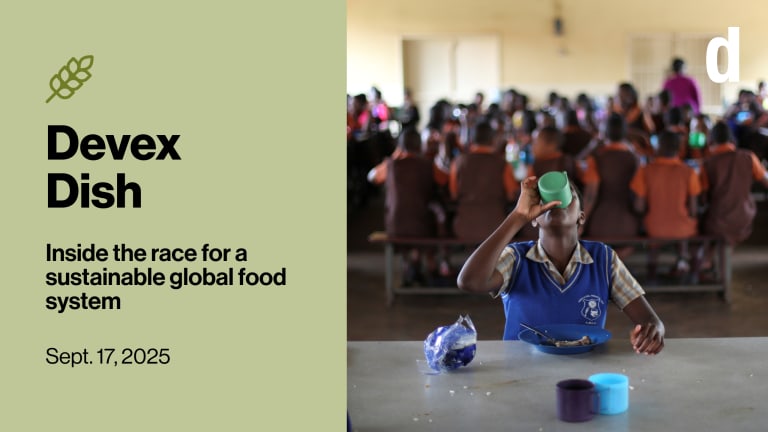
Although the benefits of school feeding programs are stark — $1 returns $20 through human capital and the local economy — investment in the safety net program remains low in Africa, Madalitso Wills Kateta reports for Devex. A cost-benefit analysis of school feeding programs also found that an investment of $11 billion annually would result in a return of $156 billion through increased school attendance.
But only 27% of African children have access to school meals.
"My parents were not harvesting enough food because our crops were usually affected by drought, and this meant I had to remain at home," 17-year-old Marai Nkhoma told Devex in an interview. She lives in the southern Malawi district of Balaka and had to miss classes because there wasn’t enough food at home. She’s now in secondary school, but had to remain home to take care of domestic chores as her parents went around in search of menial jobs to feed their five-member family.
This article is free to read - just register or sign in
Access news, newsletters, events and more.
Join usSign inPrinting articles to share with others is a breach of our terms and conditions and copyright policy. Please use the sharing options on the left side of the article. Devex Pro members may share up to 10 articles per month using the Pro share tool ( ).
Teresa Welsh is a Senior Reporter at Devex. She has reported from more than 10 countries and is currently based in Washington, D.C. Her coverage focuses on Latin America; U.S. foreign assistance policy; fragile states; food systems and nutrition; and refugees and migration. Prior to joining Devex, Teresa worked at McClatchy's Washington Bureau and covered foreign affairs for U.S. News and World Report. She was a reporter in Colombia, where she previously lived teaching English. Teresa earned bachelor of arts degrees in journalism and Latin American studies from the University of Wisconsin.