



Presented by Finance in Common
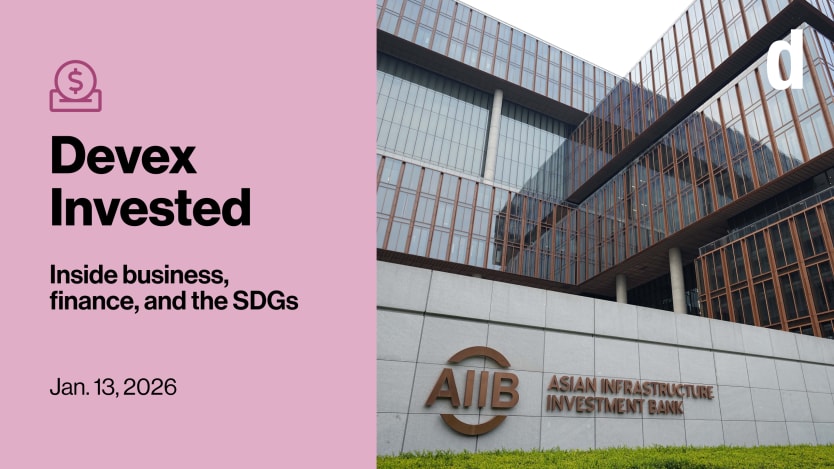
The Asian Infrastructure Investment Bank has updated its accountability and grievance mechanism, which some experts say has been a long time coming. AIIB’s existing system has been criticized for years for being largely inaccessible: Not a single complaint has been found eligible since AIIB began operations in 2016.
The new policy changes the rules governing how people impacted by AIIB investments can bring complaints to the bank’s project-affected people’s mechanism, referred to as PPM.
“The review process reflects AIIB’s deep commitment to being a listening and learning organization,” Hwee Tin Kng, the acting managing director of the complaints resolution, evaluation, and integrity unit at AIIB, tells my colleague Jesse Chase-Lubitz. “And the revised Policy is a demonstrable outcome of its belief in accountability being integral to sustainable development.”
Key changes: The old policy required complainants to first try finding resolution through a client-led process and then with AIIB management before it could work through the independent mechanism. The new framework tweaks that process: It includes a 45-day time limit for engagement with AIIB management, after which complainants can go to PPM, a move aimed at preventing cases from stalling. It also allows communities to bypass earlier steps if there is a risk of retaliation, but it’s unclear how that risk will be assessed. PPM will also in certain circumstances be allowed to play a limited oversight role to check if AIIB management follows through on promised fixes if a project is found to violate bank policies.
Not good enough? No other bank requires two levels of engagement before people can access an independent accountability mechanism, Radhika Goyal, a policy associate at the Accountability Counsel, a nonprofit legal office that helps people access accountability offices, tells Jesse. There are also concerns over how some of the changes will actually play out. The ultimate test of success to observers? Complaints actually being accepted and resolved.
“If in a year there are still no eligible cases, as community advocates, it will be hard for us to recommend to affected communities that AIIB offers a meaningful mechanism for redress or that its accountability channel is worth engaging with,” Goyal says.
Read: AIIB updates grievance rules, winning cautious civil society optimism
+ What’s at stake this year for private capital mobilization, debt, multilateral development banks, and impact investing’s role in development? This Thursday at 10 a.m. ET, together with UNDP’s Marcos Neto, ODI Global’s Frederique Dahan, and GSG Impact’s Elizabeth Boggs Davidsen, we’ll delve into the development finance trends to watch out for. Register here for the briefing.
Pen pals
AIIB’s work to better engage civil society has been recognized, with organizations writing to outgoing president, Jin Liqun, in December to acknowledge their appreciation for the “space you have helped create for dialogue between AIIB and civil society.”
In the letter, Rayyan Hassan, executive director of the NGO Forum on ADB — a network of Asian civil society groups promoting accountability, transparency, and people-centered development in Asian Development Bank and AIIB projects — praised numerous dialogues and exchanges. He also wrote that “there remains a long way to go before engagement can be considered fully ‘meaningful’ for communities on the frontline of AIIB-backed projects.”
The letter also asked the outgoing bank president to recommend that civil society engagement “be recognised as a core pillar of the Bank’s governance culture” so it will continue past his leadership.
Jeffrey Hiday, AIIB’s director-general of the communications department, responded to that letter, saying, “We recognize the value that civil society engagement has brought to AIIB’s operations. As the Bank transitions to new leadership, we will take this legacy into consideration and explore ways to continue fostering constructive dialogue with stakeholders and CSOs,” including through deepening structured dialogue, strengthening institutional mechanisms, and continuing to listen and learn.
Art of the deal
U.S. congressional lawmakers reached a compromise on foreign assistance financing, releasing a new bill over the weekend that would provide roughly $50 billion in funding for fiscal year 2026, which began last October.
While that’s a 16% cut from what Congress approved last year, it’s far less than the nearly 50% cut proposed by President Donald Trump, and also a smaller reduction that a previous House of Representatives bill had suggested. The bill still needs to pass a vote in both the House and Senate and be signed into law by the president, but getting to this point was far from assured.
While the bill consolidates and eliminates some previous accounts, leaving questions about exactly what will be funded and where, and there are generally cuts across the board, both the U.S. International Development Finance Corporation and the U.S. Trade and Development Agency received funding equal to that of the prior year.
DFC is allocated $983.25 million. The Senate report accompanying the bill that lays out Congress’ intentions in more detail also calls on the agency’s CEO to prioritize filling inspector general vacancies and includes funding for at least three full-time staff for DFC’s Office of Accountability.
If the bill passes, the looming questions are whether the Trump administration will spend the allocated funds as Congress has directed, and whether the State Department will add the necessary capacity to implement the programs now under its purview.
Read: US lawmakers strike $50B foreign assistance deal, surpassing Trump’s plan
What’s the future of U.S. foreign aid? Our limited-edition Devex Pro Insider’s special Saturday newsletter, led by Senior Reporter Michael Igoe, delivers exclusive insights, analyses, and behind-the-scenes commentaries on the power brokers, key players, and influencers of the new foreign aid policy.
Not yet gone Pro? Start your 15-day free trial today to receive the latest edition straight in your inbox and also access all our exclusive content and events.
Sitting on the sidelines
Your next job?
Head of Project Economics
Asian Infrastructure Investment Bank
Beijing, China
An assessment of 2,000 companies suggests that the private sector is sitting on an untapped reservoir of climate finance. According to new research from the World Benchmarking Alliance, at least $1.3 trillion in investment could be mobilized for the clean energy transition using existing technologies and frameworks.
This sum represents roughly 30% of the total annual investment required to keep the world on a pathway to net-zero greenhouse gas emissions. Yet the vast majority of corporate giants are failing to pull the lever.
The analysis provides the first comprehensive, side-by-side evaluation of companies across all major sectors, representing a combined $48 trillion in revenue and more than half of global emissions. While the data shows that a leading group of firms across 19 industries is already successfully pivoting capital toward regenerative agriculture, green ammonia, and electrified transport, they remain the exception.
Currently, only 18% of the world’s most powerful companies are reducing their operational emissions fast enough to align with the 1.5 degrees Celsius goal.
Beyond the climate gap, the research highlights a systemic “blind spot” regarding nature. Despite 85% of companies now having board-level oversight of sustainability, only 9% actually quantify how biodiversity loss could threaten their operations or financial performance. This lack of risk assessment persists even in high-impact sectors such as mining and food, where only 14% of companies measure their dependence on the very ecosystem services that sustain their business models.
WBA Executive Director Gerbrand Haverkamp warns that the window for gradual change is closing, noting that progress is possible but hesitation remains a defining trait of the current corporate landscape.
What we’re reading
The U.S. House of Representatives passes an extension of the African Growth and Opportunity Act. [Devex]
The IMF and World Bank boards each met about Venezuela last week. [Bloomberg]
Which sectors received the most aid in 2024? [Devex Pro]
To solve Africa’s jobs crisis, measure music like manufacturing. [Devex Opinion]
Jesse Chase-Lubitz contributed to this edition of Devex Invested.
About the author

Adva Saldinger@AdvaSal
Adva Saldinger is a Senior Reporter at Devex where she covers development finance, as well as U.S. foreign aid policy. Adva explores the role the private sector and private capital play in development and authors the weekly Devex Invested newsletter bringing the latest news on the role of business and finance in addressing global challenges. A journalist with more than 10 years of experience, she has worked at several newspapers in the U.S. and lived in both Ghana and South Africa.
Search for articles



Most Read
- 1
- 2
- 3
- 4
- 5