Presented by Pivotal

A U.S.-funded program brought schooling to Nepalese girls. But with that money now cut off, child marriage looms in its place.
Also in today’s edition: We look at what’s in store for climate talks this year.
+ Are you seeking your first global development job or looking to make a career pivot this year? Join us tomorrow at 9 a.m. ET for a conversation on how to position yourself above the rest and apply with purpose. You’ll get key insights from top career coaches on clarity, structure, and a more sustainable approach to finding your next role. Register now.
Education interrupted
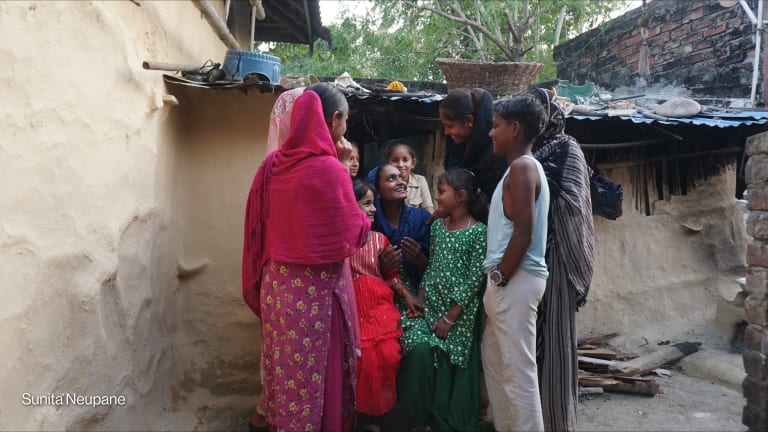
For one brief year, Apsana Khatun glimpsed a different future in Nepal. At 16, she had never set foot in a formal classroom. While her brothers went to private school, her days were spent cooking, hauling water, herding goats — and preparing a younger brother for the school she herself was never allowed to attend. What she wanted instead was an education.
“I have never dreamed,” she says. “If I had gone to school, maybe I would have had dreams. Dreams I could have held onto. But I don’t even know what those dreams would have been.”
That changed in January 2024, when the United States Agency for International Development launched its Equity and Inclusion in Education program, sending teachers directly to villages and enrolling girls in accelerated classes to make up for years of lost schooling. “I was so excited when I found out I could enroll in grade eight after just two years of schooling,” Khatun says.
In one year, she advanced to Grade 6. Then U.S. foreign aid cuts suspended the program in January 2025 and terminated it in April. Teachers stopped coming. Classes dissolved. The fragile bridge back to school vanished, writes Sunita Neupane for Devex.
“With these programs ending, dropout rates will soar, irregular attendance will rise, and child marriage will become an even bigger threat in villages like Khatun’s,” says Deepak Majhi, equity and inclusive education officer at local implementing organization Center for Education and Human Resource Development. With classes gone, Khatun’s mother has revived plans to marry off both her daughters. “I want school, friends, and real learning,” says her 14-year-old sister, Anjum. Khatun agrees: “We don’t know where destiny leads.”
Read: US aid cuts yank Nepal’s girls out of school and into child marriage
+ This story is part of The Aid Report, a Gates Foundation-funded, editorially independent initiative to track and document the on-the-ground impacts of the U.S. aid cuts with firsthand reporting and curated news coverage. We’ll be featuring The Aid Report in Newswire this week. You can also go to https://www.theaidreport.us for more information.
Eternal scapegoat
Deep cuts in foreign assistance by major donor countries such as the U.S., U.K., and Germany have taken place alongside a sharp rise in anti-migration sentiment in those countries. Are the two phenomena connected?
It’s complicated, many experts say, although some point to forces outside of immigration.
“My sense is that the aid cuts have been driven more by economic factors — post-financial crisis economic stagnation and post-Covid debt and inflation, combined with a general (incorrect, in my opinion) sense that aid is often wasted and inefficient,” Lee Crawfurd of the Center for Global Development tells Devex contributor Jessica Abrahams.
Yet immigration and development aren’t completely unrelated, either. They’re both hot-button political issues that can be seen as a manifestation of the “my country first” mentality embraced by populist right-wing parties across Europe and elsewhere. It’s notable that in the nation that’s perhaps most explicitly pursuing a “my country first” agenda — the United States — aid cuts have been the starkest.
Many donors have also tied aid to stemming migration. The European Union for example has moved to make aid conditional on recipient countries cooperating on the issue.
In the past, aid was “a really low salience issue” in the public realm, says Claire Kumar, a senior research fellow at the think tank ODI Global who has undertaken extensive research on the links between aid and migration in Europe. There wasn’t a lot of controversy over it and it wasn’t high up the political agenda.
“That has changed very significantly,” she says, because as concerns about migration grew, politicians started suggesting that aid could be used to curb migration. As a result, at least in the European context, “unfortunately now aid policy is inextricably linked to a very controversial policy arena.”
Read: How has migration shaped development policy? (Pro)
+ If you value our reporting, consider joining Devex Pro. You’ll get deeper funding insights and insider reporting, members-only briefings, and exclusive access to the stories and conversations shaping the future of global development — and you’ll help keep essential journalism open for others. Try it out today with a 15-day free trial.
Climate minus one
In the nearly one year since President Donald Trump’s return to office, the U.S. has pulled back from international climate diplomacy, forcing the rest of the world to figure out how to keep going without it. Multilateral cooperation limped on through the United Nations General Assembly and the 30th U.N. Climate Change Conference, or COP30, in Belém, Brazil, but with Europe focused elsewhere, pressure from lower-income countries to act on fossil fuels only intensified.
As 2026 begins, experts are taking stock — without much optimism. “I wouldn’t say I’m hopeful,” says Debbie Hillier, head of the Zurich Climate Resilience Alliance Program at Mercy Corps. “But it’s not a disaster.” The big unknowns: What happened to last year’s climate finance pledges, and whether new ones will stick, writes my colleague Jesse Chase-Lubitz.
Back in 2024, countries agreed to a hefty scale-up in funding — but details are thin. “We agreed to this $300 billion dollar a year goal by 2035. But how much of that is going to be public money, how much is going to be mobilized?” asks Joe Thwaites, international climate finance director at the Natural Resources Defense Council.
With public money uncertain, attention has turned to private finance — even as companies go quiet. “They’re walking a tightrope of not wanting to anger the U.S. government but wanting to carry on making strategically smart investments,” Thwaites says. All eyes now turn to COP31 in Turkey — and Colombia’s planned talks this April on phasing out fossil fuels.
Read: What you need to understand about climate and development in 2026 (Pro)
+ Join us for an expert-led Devex Pro event on Jan. 15 to explore the development finance trends to watch out for this year. Speakers include UNDP’s Marcos Neto, ODI Global’s Frederique Dahan, and GSG Impact’s Elizabeth Boggs Davidsen. Save your spot now.
Going it alone
As Jesse writes, many smaller countries are being forced to tackle climate change’s dire effects on their own. Côte d’Ivoire is doing just that.
“The country, home to some of West Africa’s most diverse ecosystems, faces mounting pressure from overfishing, pollution, and climate-related degradation,” write Jacques Assahoré Konan, the Ivorian minister of environment, and Blerta Cela, resident representative of the U.N. Development Programme, in a Devex opinion piece.
At the same time, “Côte d’Ivoire is stepping up efforts to protect its coastline, forests, and marine resources, aiming to place environmental policy at the center of its development model.”
A major component of that model is the Côte d’Ivoire Bleue program, which seeks to turn the Ivorian coastline into a model of sustainable economic management by reducing pollution, restoring coastal ecosystems and expanding marine protected areas.
To finance these efforts, the authors note that the government is turning to a mix of blue bonds, carbon credits, and public–private partnerships, with total investments projected at $378 million.
It’s an example of climate finance that Côte d’Ivoire hopes to extend beyond its shores.
At COP30 last year, Ivorian officials called for a rethinking of global climate finance, arguing that Africa — despite contributing least to global emissions — remains among the most vulnerable regions.
Opinion: Côte d’Ivoire’s bid to take a leading role in African climate investment
In other news
Israel has ordered Médecins Sans Frontières to cease operations in Gaza by March, following the group’s refusal to comply with new registration rules requiring the disclosure of Palestinian staff details and restrictions on public criticism of Israeli military conduct. [New York Times]
The Colombian government has deployed 30,000 soldiers and established emergency command posts along its 1,367-mile (2,200-kilometer) border with Venezuela to prepare for a projected influx of up to 1.7 million refugees following the capture of Venezuelan President Nicolás Maduro by U.S. forces. [Al Jazeera]
U.K.-based international disability charity Motivation has fast-tracked the closure of its office and moved to a decentralized model of independent regional hubs in Africa and India, citing a difficult financial climate. [Third Sector]
Sign up to Newswire for an inside look at the biggest stories in global development.
About the author

Helen Murphy
Helen is an award-winning journalist and Senior Editor at Devex, where she edits coverage on global development in the Americas. Based in Colombia, she previously covered war, politics, financial markets, and general news for Reuters, where she headed the bureau, and for Bloomberg in Colombia and Argentina, where she witnessed the financial meltdown. She started her career in London as a reporter for Euromoney Publications before moving to Hong Kong to work for a daily newspaper.