
Devex Newswire: At UN gathering on women’s rights, consensus trumps US power


Presented by RADIAN

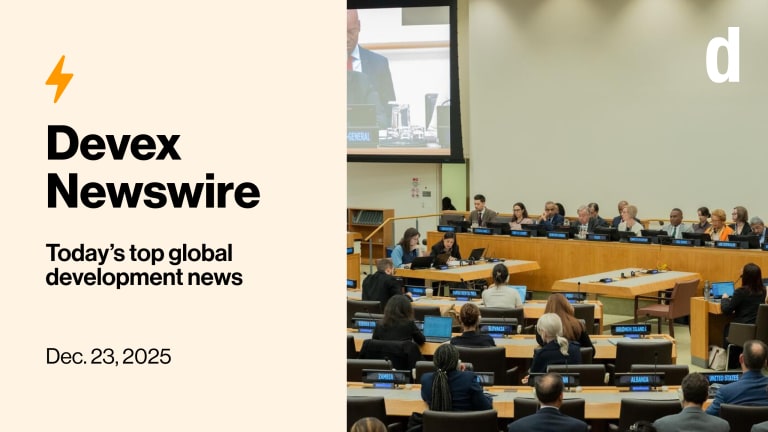
The United States suffered a big setback at the Commission on the Status of Women, or CSW, held at the United Nations headquarters in New York — and for some, it was nothing short of schadenfreude.
Also in today’s edition: The shake-up at the top of France’s development agency.
+ The IDB Group’s annual meeting starts today! We’re diving deep into the future of Latin American and Caribbean development. Look out for a special newsletter coming your way today featuring the top things on our radar.
Pushing forward
Applause, cheering, clapping, even tears of joy — not typically the reactions you’d associate with losing, but that depends on who the loser is, I suppose.
At the opening of CSW, that loser was the Trump administration, as U.N. delegates overcame intense U.S. opposition to adopt an outcome document charting the path forward for women’s rights.
The final tally: 37 in favor, six abstentions, and one, the U.S., against. The result: An eruption of celebration and glee at the General Assembly.
“The entire membership, whenever the U.S. was defeated, they clapped, they cheered,” recalls Jennifer Rauch, global advocacy officer for Fòs Feminista, a women’s health coalition that focuses on access to safe abortion. Rauch watched the vote from inside the General Assembly auditorium. “And when the vote finally went through, I had chills. I started crying, honestly. When the document was adopted by a vote, people were cheering — the whole room had a standing ovation.”
The U.S. wasn’t entirely standing alone. A group of 22 countries, including Egypt, Nigeria, Pakistan, and Saudi Arabia, backed U.S. efforts to press for a delay on the vote in an effort to secure more concessions, my colleague Colum Lynch writes.
But that wasn’t enough, and consensus — though not unanimity — won the day. “This shows the ability of the membership to make essential decisions in difficult circumstances and the commitment to move the gender equality agenda forward,” Christian Wenaweser, the ambassador of Liechtenstein to the U.N. and one of the two cofacilitators of the talks, tells Devex. “The reality today is that consensus and unanimity are not the same thing, so voting on the outcome was a necessary step and the result is probably as good as it gets for this year.”
Read: UN diplomats revel in US setback at women’s rights forum
Funding squeeze
The United Nations was already heading into financial trouble even before recent aid cuts from the U.S. and other donors. New figures show total U.N. income fell 1.9% in real terms in 2024, dropping to $68.3 billion from $69.6 billion in 2023 — the second straight year of decline, suggesting a steeper drop could still be ahead.
Most of the system still runs on voluntary funding. In 2024, 68.4% of U.N. income — $46.8 billion — came from voluntary contributions, including $41.4 billion in earmarked funding and $5.3 billion unearmarked. Mandatory assessed contributions accounted for $13.8 billion, while $5.3 billion came from other activities, writes Miguel Antonio Tamonan, Devex’s data analyst.
Among agencies, the World Food Programme remained the biggest, bringing in $10.4 billion, followed by UNICEF with $8.6 billion and the U.N. Secretariat with $7.6 billion.
The U.S. remained the U.N.’s biggest donor, providing $14.3 billion — 30.6% of total revenue. It was followed by Germany with $4.8 billion, the United Kingdom with $3.1 billion, and China with $2.4 billion.
Read: Inside the shrinking income of the United Nations (Pro)
+ Unlock a world of development expertise. Start your 15-day free trial of Devex Pro today and gain immediate access to in-depth analyses, insider intelligence, crucial funding data, exclusive event access, and much more. Discover all the exclusive content available to Pro members.
Remy nominations
For months, the French press has rumored that Rémy Rioux, the longtime head of the French development agency, AFD, would leave his post and was being considered to take over the country’s prestigious Court of Auditors. That second part turned out not to be in the cards — a month ago, someone else got that job.
But the first part was true: After 10 years, Rioux will be replaced by France’s ambassador to Morocco, Christophe Lecourtier, as long as his nomination is approved by the necessary parliamentary committee. The AFD said yesterday that Rioux would retain leadership of Finance in Common, a worldwide network of public development banks he created six years ago. Meanwhile, Africa Intelligence reports that Rioux is expected to be the new head of the French embassy in Côte d’Ivoire.
Conservation meets business
Hundreds of conservationists, scientists, investors, and development practitioners gathered at a sleek Nairobi hotel late last week for the Business of Conservation Conference, a convening that reflected how the field is being reshaped by new financing models and a growing emphasis on community leadership.
Attendees included Sania Salman, senior investment principal at the Mulago Foundation, David Obura, marine scientist and chair of the Intergovernmental Science-Policy Platform on Biodiversity and Ecosystem Services, and Doreen Robinson, deputy director of the ecosystems division at the U.N. Environment Programme.
“Development can only happen to a limited extent without stewardship of the natural environment,” Richard Vigne, executive director of the Africa Leadership University’s School of Wildlife Conservation — one of the conference organizers — told my colleague Ayenat Mersie.
One major shift people highlighted is the growing emphasis on community-led conservation, aka the idea that efforts are more likely to succeed when communities living alongside wildlife are treated as partners and benefit from protecting ecosystems.
That dynamic is especially visible when people and wildlife compete for the same resources. Elephants trampling crops can trigger retaliatory killings, said Alberto Borges of Space for Giants, noting that sometimes simple measures — such as strategically placed fencing — can deter animals. (Fun fact: Borges once accidentally discovered a new species of spider).
Others are experimenting with financial tools. In Zambia, WildCover is piloting insurance covering drought losses and wildlife damage, said Barbara Chesire, managing director of insurance innovator AB Entheos. Farmers with approved claims and prevention measures in place can receive payouts to their mobile money accounts in as little as 12 days. “Because people know they’ll receive a payout, we’re already seeing higher tolerance toward wildlife.”
And debt shall have no dominion
With aid shrinking and debt rising, African leaders are eyeing a once-niche tool to plug health financing gaps: debt-for-health swaps.
The Africa Centres for Disease Control and Prevention wants to help broker deals between indebted countries and creditors willing to cancel debt in exchange for domestic health spending, writes my colleague Sara Jerving.
“We are talking about increasing innovative domestic resources, but also bringing some funding that we didn’t explore in the past, like the debt swaps,” says Dr. Jean Kaseya, director-general of Africa CDC. “It’s a major area of focus for Africa CDC for more sustainable financing.”
The idea is straightforward, says Christoph Benn, a former executive at The Global Fund to Fight AIDS, Tuberculosis and Malaria who is now advising the agency: “[Kaseya] believed that this could be a good way for many African countries to address two big problems at the same time: You reduce the [debt] burden that many countries are suffering from, and you increase the domestic investments in health.”
Read: Africa CDC eyes debt swaps to plug health financing gaps (Pro)
+ Join us on March 20 for a Devex Pro Briefing with Donald Kaberuka, the African Union’s high representative for Financing the Union and former president of the African Development Bank, to discuss what a more resilient and effective global health architecture could look like, and what reforms may be needed to deliver better health outcomes in the decade ahead. Save your spot now.
In other news
France is set to provide 60 metric tons of humanitarian aid to Lebanon, including medical supplies and food, amid the country’s ongoing economic crisis. [Reuters]
Awareness of government aid cuts is making the public less likely to view global development as a priority, according to a GlobalGiving survey of 2,000 respondents from the U.K. and Germany. [The Independent]
Gaza food prices have surged, and basic staples have disappeared from shelves after Israel closed its border crossings, reversing weeks of modest food security gains made during the ceasefire, WFP warned. [Al Jazeera]
Sign up to Newswire for an inside look at the biggest stories in global development.
About the author

Helen Murphy
Helen is an award-winning journalist and Senior Editor at Devex, where she edits coverage on global development in the Americas. Based in Colombia, she previously covered war, politics, financial markets, and general news for Reuters, where she headed the bureau, and for Bloomberg in Colombia and Argentina, where she witnessed the financial meltdown. She started her career in London as a reporter for Euromoney Publications before moving to Hong Kong to work for a daily newspaper.
Search for articles


Most Read
- 1
- 2
- 3
- 4
- 5