


Presented by The Rockefeller Foundation
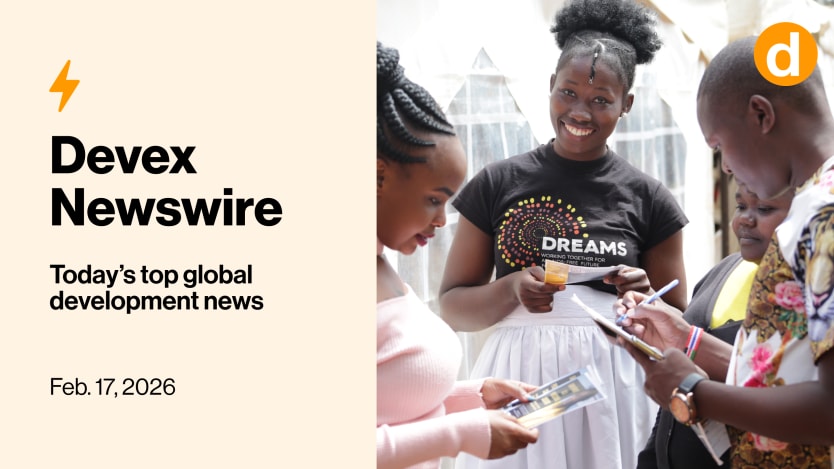
It was a lifeline for millions of adolescent girls and young women around the world. When it ended, so did many of their prospects.
Also in today’s edition: The schism between Oxfam GB and its former CEO devolves into more acrimony by the day.
DREAMS deferred
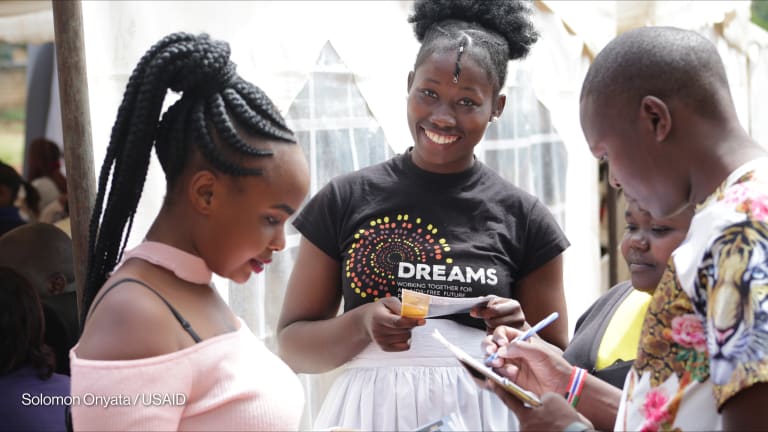
It was an ambitious endeavor — and it delivered. The U.S.-funded DREAMS program reached more than 2 million adolescent girls and young women across 15 countries, including 10 in sub-Saharan Africa. With an array of initiatives, it focused on HIV prevention, sexual and reproductive health, protection from physical and sexual violence, education, and economic empowerment.
It also had big-name — and big-dollar — support: PEPFAR, the U.S. global HIV initiative, had invested over $1.6 billion in DREAMS since its inception in 2014, in partnership with the Gates Foundation, Gilead Sciences, and others.
Nineteen-year-old Sharon Akoth, orphaned at age 12 and living in Kenya’s Kisumu County, was one of the beneficiaries. “It's through the DREAMS program that they gave me a school uniform, shoes, and they provided me with food, which I took home,” she says, noting that it also distributed menstrual hygiene products because few of the girls could afford to buy them.
Then the funding stopped. In Washington, D.C., the DREAMS termination was framed as a pragmatic trade-off: treatment and HIV testing could continue, even if prevention programs were scaled back, writes Victoria Amunga for Devex.
For Akoth, her own dreams of becoming a doctor were quickly derailed. Without the program, she dropped out of school and was forced to have sex with men to financially survive. She met a man, hoping he would help her buy sanitary towels and continue her education, but she became pregnant. When he learned of the pregnancy, she says, he left.
There is no movement in the U.S. government to revive the DREAMS program, according to a former State Department employee. Yet several of the administration’s stated priorities — including expanding access to new HIV treatments and reducing mother-to-child transmission — are unlikely to be met without the prevention and support systems DREAMS once provided.
“You’re not going to reach your HIV-related targets or policy goals if you ignore that certain populations are more vulnerable than other populations, or the cultural norms that play into that,” the former employee says.
Read: Life after DREAMS — Kenya’s girls navigate HIV risk without US support
📍 This story is part of The Aid Report, a Gates Foundation-funded, editorially independent initiative to track and document the on-the-ground impacts of the U.S. aid cuts with firsthand reporting and a verified, contributor-based data collection system. For more information and to read the stories, go to https://www.theaidreport.us.
Healthy returns
Beyond framing programs to help young women and girls as a moral imperative, there’s a financial incentive as well, according to a slew of health experts who wrote an opinion piece for Devex
“Investments in women’s, children’s, and adolescents’ health … are among the highest-return investments available to governments. Healthy women participate more fully in the workforce. Healthy children learn more effectively. Healthy adolescents become the skilled workers and innovators who will drive Africa’s demographic dividend,” argue Dr. Jean Kaseya, director-general of the Africa Centres for Disease Control and Prevention; Dr. Mohamed Yakub Janabi, the World Health Organization regional director for Africa; Diene Keita, executive director of the United Nations Population Fund; and Rajat Khosla, executive director of the Partnership for Maternal, Newborn and Child Health (I told you it was a slew of experts).
Ahead of the recent African Union Summit, they urged leaders to make the financial commitments that will yield solid returns on investment, noting that many countries remain below the commitment to allocate 15% of national budgets to health, while external funding is declining and fiscal pressures are intensifying.
They’re not naive to the fact that these investments require real trade-offs: among them, reallocating constrained budgets, strengthening domestic revenue, and demanding more accountability.
“But the alternative,” they write, “carries far greater costs: lost productivity, rising treatment expenditures, weakened resilience to crises, and preventable deaths that erode trust and undermine development.”
Opinion: Africa’s future depends on investing in women, children, adolescents
📜 My colleague Ayenat Mersie was on the ground at the African Union Summit in Addis Ababa and got the scoop on what took place. Stay tuned tomorrow for her special newsletter.
🗓️ And on Friday, Janabi, who recently assumed his position, will be joining us for a Devex Pro Briefing to discuss the evolving role of WHO’s Africa office, navigating aid cuts, and the path to sustainable health reform on the continent. Register now to send your questions and join the conversation.
Nasty breakup
The ugly tit-for-tat between Oxfam GB and its former CEO Halima Begum shows no signs of letting up. If anything, it’s getting uglier.
In an explosive three-page statement shared with Devex, Begum — who resigned from the charity in December amid allegations about her leadership and conduct — describes the staff complaints against her as “false, prejudiced and malicious” and says she felt “forced” to resign from the charity in December 2025.
She also accuses the charity of “brutally” dismissing and stigmatizing her and the charity’s former board chair of making her feel “humiliatingly infantilized.”
Oxfam GB hit back, saying the independent review into complaints had found “substantive and very serious concerns” relating to Begum’s conduct, decision-making, and leadership style, writes Devex contributor Susannah Birkwood.
The convoluted saga can be hard to follow, with serious accusations flying left and right — from charges of sexist behavior to antisemitism to an alleged payout offer. Begum says she recently filed a claim for constructive dismissal and victimization with an employment tribunal against Oxfam and several current and former trustees, including former chair Charles Gurassa. Oxfam says that it had not yet received Begum’s claim.
She targets Gurassa — also chair of The Guardian newspaper — in particular, accusing him of acting “in a sexist manner” toward her and a junior female colleague. Begum claims Gurassa “took umbrage” at this, and at Begum’s annual appraisal, he found fault with her conduct in a way she characterized as retaliatory.
A spokesperson for Gurassa did not respond to that specific claim, but calls Begum’s various allegations “completely spurious.”
Meanwhile, in a statement issued on Friday, Oxfam GB said the review found that the board had a responsibility to act to address Begum’s leadership behavior, which was having “serious, and negative consequences” on the organization.
It also confirmed that a previously announced review of Oxfam’s governance processes is underway.
Read: Ousted Oxfam CEO lambastes charity for ‘brutal’ dismissal (Pro)
🗝️ Not yet a Devex Pro member? Sign up with a 15-day free trial today and gain unlimited access to all our expert analyses and one-on-one briefings with sector leaders, funding data and opportunities from top donors, exclusive news content, and more.
Data mining
Health care has gone digital — albeit in fits and starts. In Africa, where the health sector was hit hard by U.S. cuts, digital public infrastructure, or DPI, could be a salve in a post-aid world.
DPI is a foundational system of interoperable digital services, which allows for the reuse, sharing, and mapping of real-time data. If locally owned, it also promises to be more cost-effective and sustainable, writes Devex contributor Catherine Davison.
So what does this mean in layman’s terms? Consider the fact that over 500 million Africans lack a formal ID, making it hard for them to access health care such as vaccines and receive government entitlements.
In 2023, the Institute for Health Measurement helped to establish Zambia’s electronic health record, which uses thumbprints to digitally identify patients, making their disease and treatment history instantly available as soon as they enter a hospital, ensuring they receive faster care.
Or take Rwanda, where “immediately from birth, the vaccination registry at the Ministry of Health [is] connected with a civil registration at the local government,” says Sylvere Mugumya, who works on digital health with Rwanda’s Ministry of Health. “We have very minimal people who missed the doses, because we know them, we know where they are.”
Poorly governed DPI, however, risks exacerbating the digital divide and can be unsustainable if done in an ad hoc, siloed way.
But many donor-funded health interventions were ad hoc and siloed as well, so if done right, local DPI can plug the gaps.
“The last year has highlighted the fragility and dependency on the systems of a previous era,” says Garrett Mehl of WHO. DPI “does begin to create the potential for [countries] to gain the kind of financial sustainability that I think they’ve longed for.”
Read: Can digital public infrastructure reshape donor-reliant health systems? (Pro)
In other news
After the U.S. Congress pushed back on proposed foreign aid cuts, the U.K. is now set to make deeper proportional reductions to its aid budget than the U.S. [Center for Global Development]
Six months after declaring a public health emergency, Botswana faces major medicine shortages and strained hospitals as falling diamond revenues and years of mismanagement push its health system into crisis. [The Telegraph]
Japan mulls resuming official development assistance loans to Pakistan, which were halted in 2017, as the South Asian country’s economy signals improvement. [Nikkei Asia]
Sign up to Newswire for an inside look at the biggest stories in global development.
Printing articles to share with others is a breach of our terms and conditions and copyright policy. Please use the sharing options on the left side of the article. Devex Pro members may share up to 10 articles per month using the Pro share tool ( ).
About the author

Anna Gawel
Anna Gawel is the Managing Editor of Devex. She previously worked as the managing editor of The Washington Diplomat, the flagship publication of D.C.’s diplomatic community. She’s had hundreds of articles published on world affairs, U.S. foreign policy, politics, security, trade, travel and the arts on topics ranging from the impact of State Department budget cuts to Caribbean efforts to fight climate change. She was also a broadcast producer and digital editor at WTOP News and host of the Global 360 podcast. She holds a journalism degree from the University of Maryland in College Park.