Devex Pro Insider: Is Zipline the future of US global health assistance?
What a $150 million grant to a U.S. robotics company says about the State Department’s foreign aid takeover.
By Michael Igoe // 08 December 2025This is a free version of Devex Pro Insider from Senior Reporter Michael Igoe. Usually reserved for Pro members, we’re opening it up to all readers this week as a preview of what you’re missing. This limited-edition newsletter tackles some of the biggest questions about the future of U.S. foreign aid. Not yet a Devex Pro member? Get full access to our Pro newsletters, exclusive events, and expert analysis with a 15-day free trial of Devex Pro. You probably saw the news last week about the State Department’s $150 million grant to Zipline, which could triple the U.S. robotics company’s global health drone operations in Africa. Given the scarcity of information about what U.S. foreign aid will look like under the State Department’s control, the significance of this announcement seems to eclipse its dollar value. Don’t get me wrong: A major expansion of Zipline’s health supply chain operations in Africa is big news in its own right (more on that below). And from what the company’s Africa CEO, Caitlin Burton, tells me, Zipline’s global development ambitions include more countries and more sectors — such as agriculture. Did you know you can transport livestock artificial insemination materials by drone? But let’s remember, the U.S. Agency for International Development managed a multibillion-dollar global health supply chain that operated in dozens of countries — and yes, we’re still trying to find out what the future holds for that massive component of U.S.-funded global health operations. The State Department has no comparable track record of managing complex foreign assistance projects at that scale. The other story here is about the State Department and the future of U.S. foreign assistance. For months, the justifications we’ve heard for dismantling USAID and relocating its remaining pieces to State’s Foggy Bottom headquarters have often been either speculative and nonspecific or simply inaccurate. Now, the leaders of President Donald Trump’s “America First” foreign aid strategy must move from demolition to construction. We’re in a new fiscal year and a new phase. That means following the money, even when not much money is flowing. Trump officials have billed the Zipline grant as an innovative “milestone-based” payment. That’s true, in a way, but it’s also telling what “milestone” means in this instance: The U.S. government will release funding to Zipline when the company signs contracts with other governments that commit to spending their own funds on its drone supply chain operations. It’s not pay for performance on achieving global health outcomes — though Zipline will happily share data on how they do this — but rather on turning partner governments into “customers,” as my colleague Sara Jerving recently reported. “We’re doing a seed investment, but the actual payment will come from the governments. Those governments won’t be aid recipients, but customers who recognize value,” said Jeff Graham, senior bureau official for the State Department’s Bureau of Global Health Security and Diplomacy, at a conference in Kigali last month. It’s not clear whether this Zipline announcement represents a one-off deal that materialized from the fog of USAID’s shutdown, or a real prototype of the State Department’s new foreign aid delivery model that will be replicated in health and other sectors. U.S. government officials have been on a tour of African countries, negotiating bilateral agreements aimed at restructuring U.S. global health support and shifting more funding responsibility to partner governments on a country-by-country basis. Those agreements are meant to be in place by the end of this month. Many experts have warned about the short timeline and the pressure it places on partner governments, which have watched the infrastructure of bilateral health assistance collapse over the last year. But the pressure is on the State Department, too. Its leaders spent the better part of this year terminating contracts and closing out projects. In their place, is the U.S. government coming to the negotiating table with funding for a handful of drone facilities, or a new approach to investing in global health systems that is better than the one it dismantled? ICYMI: State Dept grants $150M to Zipline to triple African drone operations Read: US has begun bilateral health negotiations with 16 African nations Plus: US health strategy aims to position African governments as customers Three more questions for Zipline The State Department’s deal with Zipline has generated a lot of buzz, and there was more in my interview with Burton than I was able to squeeze into our initial news article about the announcement. Here’s what else we discussed: Why should the U.S. government fund a private, for-profit company to expand its footprint overseas? Why can’t Zipline make these investments and scale up its operations on its own? This is all about serving public health systems in Africa, and Zipline is not trying to make a profit here. We price at cost. But if the cost of the capital expenditure, the cost of the infrastructure, isn't covered by somebody up front, two things happen: one is, we pass that cost on to the African government. It just gets amortized over time. So they pay much more over, let's say, a five-year period than they would if they were just paying for the service. So this is about saving money and making it more affordable for them. The other thing is, Zipline goes immediately into a financial hole, and it takes us five years to build back out of that, and that costs a lot. There’s a huge cost of that capital. It’s not a realistic or scalable model when you’re talking about going nationwide in very large countries like Nigeria, Kenya, and Côte d’Ivoire. Practically, if you want to see highly impactful technologies operating at scale in these countries, there needs to be a new kind of financing available, and that's the goal here. If I’m in one of these countries and Zipline suddenly starts scaling up its operations, what does that look like, and what does that mean for me? We have to develop what the national network looks like with the government, and so that requires a lot of work with national and subnational groups. We have to look at where their existing infrastructure is, where they have the greatest capacity gaps, where they have the greatest service interruptions, where they have the most vulnerable and unserved communities, and where the network makes sense based on the capacity of the system and where volumes are expected. Then we have to invest in land. We hire an entirely local team. We have a deployments team that’s responsible for installing the hubs. We have engineers that partner with the civil aviation authorities, and they map routes, and they get us integrated into airspace. We have an academy team that does all the technical training of all the new hires. We need to hire a lot of pharmacists, because you need certifications to handle medical inventory, and you need to be able to counsel health facilities when they order something that we don't actually have. We have to be able to maintain everything on site. We don’t fly people in to fix a system, and so there’s a lot of technical training that goes in to developing the team's capacity to run a system — there's management teams, there's finance, there’s everything, because we don't have any expats in the company, even for deployments, everything will be locally led in Africa. How do you reassure partner governments that Zipline is there to stay — that handing over large portions of their global health supply chain to an American robotics company is a wise thing to do? I think when you have struggled with things like preventable deaths of vulnerable people, women, and children, in very large numbers for a long time, you just get a little bit worn out. And if somebody says, ‘I can cut that in half for you or almost eliminate it for you,’ you're going to try it. And if it actually does that, it's going to become a very sticky thing. Because why would you stop doing that? The prior system couldn't do it. You could do as much health worker retraining as you want. You can refurb all the facilities you want. You can do all the patient education you want, but people go to facilities and have healthier pregnancies and survive childbirth when Zipline serves them, and they don’t go to facilities, and they don’t have healthier pregnancies, and they die at twice the rate in childbirth when we don’t serve them. We have that data. We feel a moral imperative to serve the public health systems in the countries that have adopted us. They’ve stuck their necks out. They adopted the technology. They tried it. It worked really well. They want to scale it even further, and we are deeply committed to delivering that. Mergers and acquisitions The other side of this equation is the State Department’s ability to deliver a new model of global health and global development assistance. The department’s leaders are shifting a lot of responsibility onto partner governments and private sector partners. But can the U.S. government uphold its own part of the bargain? I spoke with a recently retired State Department insider to try to get a better understanding of what the challenge of building — and buying — a new model of foreign assistance looks like to those responsible for spending the State Department’s money. For Mike Derrios, who retired as the department’s senior procurement executive and head of its Bureau of Global Acquisitions in October, the question of whether State can successfully manage the U.S. government’s roughly $50 billion foreign aid portfolio comes down to one thing: “capacity.” “You have to have the people to do the work. And my biggest concern is that capacity constraints are going to really be a factor,” Derrios told me. The vast majority of USAID’s 10,000 staff members have been terminated this year, along with nearly 1,500 State Department officials hit by a reduction in force in July. “They may not have enough people,” he said. “I am a little nervous that on all sides — the support side and the program side — that there just may not be enough.” A survey released this week by the American Foreign Service Association puts some eye-popping numbers behind that concern, as my colleague Elissa Miolene reports. Eighty-six percent of over 2,000 foreign service officers surveyed in August and September say the upheaval of the past year has undermined their ability to advance U.S. diplomatic priorities, and 98% report poor morale. Seventy-eight percent of respondents said they are operating under reduced budgets, while 64% noted key projects and initiatives were being delayed or suspended. And 61% are also managing “significantly heavier workloads” due to staffing losses, while 46% reported “new obstacles” while negotiating with foreign counterparts. As a result, nearly 1 in 10 foreign service officers plan to leave the workforce this year, nearly double the historic attrition rate, the survey found. Derrios pulled back the curtain for me on some of the initial transition planning that followed Secretary of State Marco Rubio’s March announcement that the State Department would take over parts of USAID and the rest of the agency would be disbanded. In response, the department created a transition working group — of which Derrios was part — which went into “overdrive” to “work through the mechanics” of taking over U.S. foreign aid. That was complicated by the fact that State and USAID had different business models. In some cases, for example, USAID’s acquisitions workforce was funded through congressional appropriations, while parts of the State Department were funded by fees collected on transactions. “So now we’re going to ingest this work in — how is my office going to be funded to support it?” Derrios said. After the structural dismantling of USAID and cancellation of nearly 85% of its projects, the State Department had only one fiscal quarter in 2025 to manage the remaining U.S. foreign aid programs. That means the 2026 fiscal year, which began on Oct. 1, is when the department’s ability to plan, deliver, and oversee foreign aid funding will truly be put to the test, Derrios said. “You're going to see a full cycle,” he said, while noting that the fiscal year will be “truncated” by the recently ended government shutdown, which could “exacerbate the learning curve” for State Department officials tasked with picking up the pieces of USAID. He added that he expects to see an “uptick” in foreign aid spending by the State Department soon — but that the way it spends money will be different from USAID’s approach. And State Department officials have not been shy about their desire to work with different kinds of partners (see: Zipline). Derrios said: “I think what you're seeing is the department wanting to bring more of a business mentality to foreign aid, and you can see that in the ‘America First’ global health strategy.” Read: Foreign service in crisis as 1 in 4 officers pushed out, AFSA warns Background read: Remaining USAID programs now under State Department, 5,200 programs canceled + The Trump effect: Explore our dedicated page to catch up on all the latest news, in-depth analysis, and exclusive insights on how the Trump administration’s policies are reshaping U.S. aid and global development.
This is a free version of Devex Pro Insider from Senior Reporter Michael Igoe. Usually reserved for Pro members, we’re opening it up to all readers this week as a preview of what you’re missing. This limited-edition newsletter tackles some of the biggest questions about the future of U.S. foreign aid. Not yet a Devex Pro member? Get full access to our Pro newsletters, exclusive events, and expert analysis with a 15-day free trial of Devex Pro.
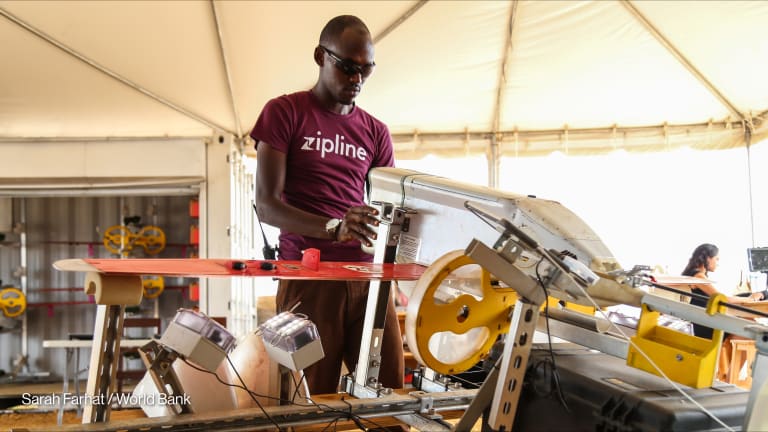
You probably saw the news last week about the State Department’s $150 million grant to Zipline, which could triple the U.S. robotics company’s global health drone operations in Africa.
Given the scarcity of information about what U.S. foreign aid will look like under the State Department’s control, the significance of this announcement seems to eclipse its dollar value.
This article is free to read - just register or sign in
Access news, newsletters, events and more.
Join usSign inPrinting articles to share with others is a breach of our terms and conditions and copyright policy. Please use the sharing options on the left side of the article. Devex Pro members may share up to 10 articles per month using the Pro share tool ( ).
Michael Igoe is a Senior Reporter with Devex, based in Washington, D.C. He covers U.S. foreign aid, global health, climate change, and development finance. Prior to joining Devex, Michael researched water management and climate change adaptation in post-Soviet Central Asia, where he also wrote for EurasiaNet. Michael earned his bachelor's degree from Bowdoin College, where he majored in Russian, and his master’s degree from the University of Montana, where he studied international conservation and development.