
DOGE 'breaks into' the US Institute of Peace
The U.S. Institute of Peace seems to be the first nonprofit that the Department of Government Efficiency has attempted to breach.
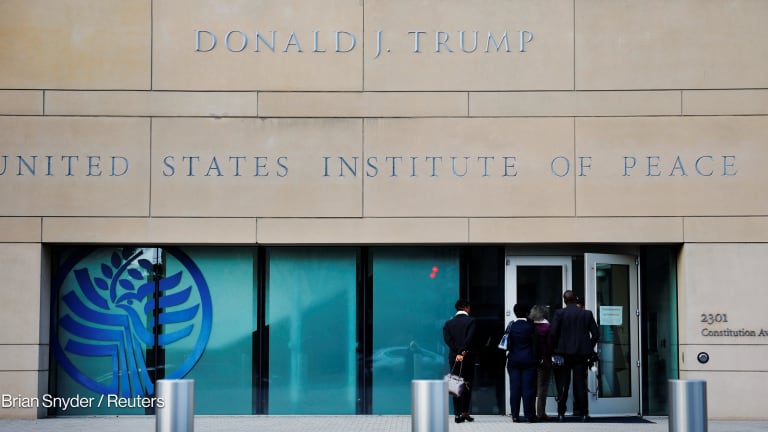
By Elissa Miolene // 18 March 2025The Department of Government Efficiency has taken over the U.S. Institute of Peace — with staff from the budget-slashing agency “breaking into” the nonprofit’s offices on Monday afternoon, according to a statement from USIP’s acting president and CEO, George Moose. “DOGE has broken into our building,” read the one-line statement, which was shared with Devex around 5 p.m. Monday. No further information was given, but several hours later, DOGE posted on X a letter from three of USIP’s board members stating they were removing Moose from his position as president and that Kenneth Jackson — USAID’s assistant to the administrator for management and resources — had taken his place. “Mr. Moose denied lawful access to Kenneth Jackson, the Acting USIP President (as approved by the USIP Board),” DOGE stated on X, the social media platform owned by the man who leads DOGE: billionaire Elon Musk. “The only unlawful individual was Mr. Moose, who refused to comply, and even tried to fire USIP’s private security team when said security team went to give access to Mr. Jackson,” the statement added, noting that D.C. police “arrived onsite and escorted Mr. Jackson into the building.” Moose’s firing, however, is in direct opposition to the text of the U.S. Institute of Peace Act, which states that USIP board members must be confirmed by the Senate, and that their term cannot begin until they are officially sworn into that role. The act also states that the board — which consists of 15 members — is the one who can appoint the president. But by Monday night, USIP’s staff were locked out of their laptops. And as of 10 p.m., DOGE was still in the organization’s office. Though USIP is an independent nonprofit — not a U.S. government agency — it was one of three international aid organizations targeted by U.S. President Donald Trump last month. On Feb. 19, Trump called the USIP, the U.S. African Development Foundation, and the Inter-American Foundation “unnecessary” in an executive order, forcing each entity to reduce their operations, staff, and footprint to the “minimum presence and function required by law.” Within days, DOGE staff attempted to speed up that process — and in less than two weeks, the IAF was dismantled. USADF came next: Soon after Trump’s executive order was signed, four DOGE staffers — and the acting deputy director of USAID, Peter Marocco — tried to gain access to the agency’s financial and personnel systems. Failing that, the group attempted to enter USADF’s physical offices, ultimately doing so after bringing a federal marshal in tow. And while USADF’s president has tried to slow that pace by suing DOGE, the dismantling has continued all the same. “Defendants have made clear their intentions: ignore statutory requirements, pretend that leadership of the agency does not exist, and shutter USADF,” reads a court filing from March 6, which was prepared by the team representing USADF’s presidency. “That is precisely what they did to USADF’s sister agency, the Inter-American Foundation (IAF).” Many thought USIP — which is registered as a 501c3 created by Congress and founded under former Republican President Ronald Reagan — would be spared. But less than a month after Trump’s executive order was released, DOGE has made its way into USIP’s offices too. It seems to be the first time DOGE has targeted a nonprofit organization, despite repeated attempts by USIP to differentiate itself as such. “As an independent, non-profit organization established by Congress, USIP remains committed to the cooperation and comity with the Trump Administration it has exhibited in its work with seven administrations since its founding under President Ronald Reagan,” the group said in a statement late last week. Since its founding in 1984, USIP has described itself as a nonpartisan, independent entity, one focused on protecting American interests by preventing violence and promoting peace. USIP has a Senate-confirmed board of directors, the organization’s website states, which consists of the U.S. secretary of state, secretary of defense, and president of the National Defense University — the three officials who signed the letter, posted on X by DOGE, removing Moose from USIP Monday. But in recent years, USIP has come under fire from some on the Republican side of the aisle. Last September, Tim Meisburger — the current assistant to the administrator at USAID’s Bureau for Humanitarian Assistance — wrote a report titled “The U.S. Institute of Peace is Politicized and Unaccountable” for the Heritage Foundation, the conservative think tank responsible for Project 2025. In his report, Meisburger accused USIP of being “neither nonpartisan nor bipartisan,” and recommended Congress withhold funding for the organization until “hearings can be held to examine political bias.” It’s unclear whether DOGE’s actions are legal, especially given the fact that USIP is the sole owner of its building, has independent budget authority, and manages all security and maintenance of its Washington, D.C., grounds. DOGE’s actions seem to go directly against the fine print of the U.S. Institute of Peace Act: The president of the institute, for example, must be a “nonvoting ex officio member of the Board,” the act states. Later on Monday, the Associated Press reported that 11 board members were “lawfully removed” from USIP, according to White House spokesperson Anna Kelly. “George [Moose] is actually a career bureaucrat who wants to be unaccountable to the American people,” Kelly posted on X Monday. “The Trump Administration won’t let him.” In the U.S. Institute of Peace Act, board members cannot be removed unless at least eight voting members recommend doing so — or if the board receives a recommendation from a majority of members in the committees on foreign affairs, education, and labor in both the House and the Senate. Today isn’t the first time USIP was visited by DOGE staff: Just four days ago, several members of the team arrived “unannounced,” bringing two agents from the Federal Bureau of Investigation in tow. “They were met at the door by the Institute’s outside counsel who informed them of USIP’s private and independent status as a non-executive branch agency,” said USIP’s director of communications, Gonzo Gallegos, in a statement on March 14. “Following that discussion, the DOGE representatives departed.” The organization had already been in communication with DOGE, according to an earlier statement by Gallegos: On March 5, USIP said it had responded to Trump’s executive order with “timely information about its statutory requirements.” But like the USADF and IAF, at this stage, it doesn’t seem like that was enough.
The Department of Government Efficiency has taken over the U.S. Institute of Peace — with staff from the budget-slashing agency “breaking into” the nonprofit’s offices on Monday afternoon, according to a statement from USIP’s acting president and CEO, George Moose.
“DOGE has broken into our building,” read the one-line statement, which was shared with Devex around 5 p.m. Monday. No further information was given, but several hours later, DOGE posted on X a letter from three of USIP’s board members stating they were removing Moose from his position as president and that Kenneth Jackson — USAID’s assistant to the administrator for management and resources — had taken his place.
“Mr. Moose denied lawful access to Kenneth Jackson, the Acting USIP President (as approved by the USIP Board),” DOGE stated on X, the social media platform owned by the man who leads DOGE: billionaire Elon Musk.
This article is free to read - just register or sign in
Access news, newsletters, events and more.
Join usSign inPrinting articles to share with others is a breach of our terms and conditions and copyright policy. Please use the sharing options on the left side of the article. Devex Pro members may share up to 10 articles per month using the Pro share tool ( ).
Elissa Miolene reports on USAID and the U.S. government at Devex. She previously covered education at The San Jose Mercury News, and has written for outlets like The Wall Street Journal, San Francisco Chronicle, Washingtonian magazine, among others. Before shifting to journalism, Elissa led communications for humanitarian agencies in the United States, East Africa, and South Asia.