
Exclusive: McCain to lead World Food Programme
U.N. Secretary General António Guterres will name Cindy McCain to lead the World Food Programme.
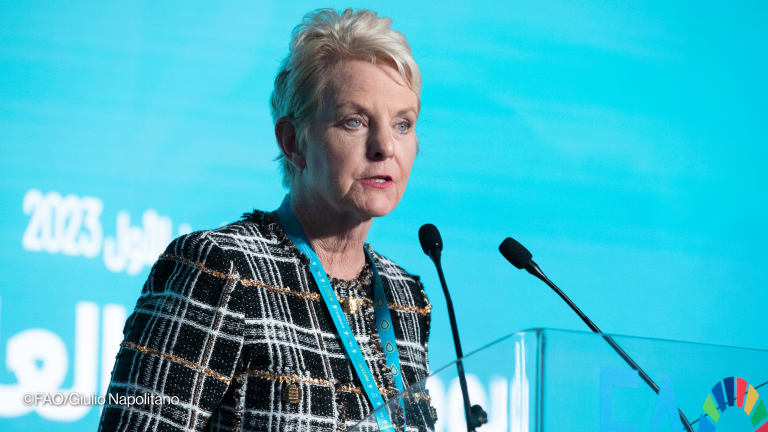
By Colum Lynch, Teresa Welsh // 23 February 2023Cindy McCain, the U.S. ambassador to the United Nations food agencies in Rome, has been chosen to lead the World Food Programme over the next five years, replacing David Beasley when he steps down in April, according to three well-placed diplomatic sources. U.N. Secretary-General António Guterres is expected to inform the food agency’s 36-member state executive board when it convenes in Rome on Monday for its first annual meeting. He is not likely to publicly announce the decision before later next week. The appointment, which begins April 5, places Washington D.C. royalty at the head of a U.N. agency that depends heavily on United States financial support to carry out its global mission. McCain, the widow of the late Arizona Republican Senator John McCain, currently serves as U.S. ambassador to WFP, the Food and Agriculture Organization, and the International Fund for Agricultural Development. She was considered the top U.S. choice to lead the agency, which the Biden administration was eager to replace with its own candidate despite Beasley’s fundraising success as WFP chief. David Lane, who also previously served as U.S. ambassador to the Rome-based agencies, was also under consideration for the role, which is officially named by the U.N. secretary-general but heavily influenced by White House preferences. One WFP watcher privately expressed concern about McCain’s lack of experience running a sprawling international relief agency. But she has good relations with Democratic and Republican lawmakers, whose support for the agency will be crucial. "Ms. McCain brings a deep understanding of global affairs and humanitarian work after her years working with NGOs and lately in her diplomatic role. Her biggest challenge at WFP will be to lead change to strengthen and improve its vast management systems," Catherine Bertini, a former executive director of the World Food Programme, told Devex. The selection of WFP’s executive director is technically a joint appointment by the U.N. secretary-general and the director-general of FAO — which is headed by a former Chinese government agriculture minister, Qu Dongyu — in consultation with the agency’s member states executive board. But the board’s role is largely a formality. A fourth diplomatic source told Devex that FAO’s Chinese leader is likely to endorse the appointment, “all U.S.-China tension notwithstanding.” The U.N. secretary-general’s chief spokesperson, Stéphane Dujarric, declined to comment on the appointment. The WFP spokesperson in Washington and a spokesperson for McCain’s office at the U.S. mission in Rome both referred Devex to the secretary-general’s office when asked for comment. McCain is traveling and unavailable to comment, the U.S. mission spokesperson told Devex via email. WFP USA, which plays a vital role in fundraising for the agency and has benefited from Beasley’s personal relationships with private donors, also declined to comment. Rome-based WFP is the world’s largest humanitarian relief organization, employing 22,300 people and running operations in more than 120 countries and territories. McCain will enter the agency at a critical time, as the world faces an unprecedented food crisis driven by Russia’s invasion of Ukraine, other conflicts, and climate change. WFP has been forced to cut critical rations to vulnerable people in places such as Yemen and Myanmar for lack of funds, despite Beasley’s record-breaking fundraising. He was able to leverage his relationships with major donors, including the U.S., which is WFP’s largest contributor, to bring funding to a record $14.2 billion in 2022. McCain will be responsible for sustaining that level of financing for an agency still struggling to meet an ever-growing need. Acute food insecurity has more than doubled since 2019, with 349 million people affected. In her role as U.S. ambassador to the U.N. agencies in Rome, a position she’s held since November 2021, McCain has focused her diplomacy on urging other countries to do more financially to assist nations crippled by skyrocketing food prices amid a global economic downturn. In an interview with Devex last July, McCain said other donors must help mitigate the effects of Russia’s invasion of Ukraine on food prices. “We cannot rely on the United States to solely take the lead on these things, like we always do,” she said. “We need help from around the world now. And it’s an important time for us to not just suggest it, but somewhat demand it.”
Cindy McCain, the U.S. ambassador to the United Nations food agencies in Rome, has been chosen to lead the World Food Programme over the next five years, replacing David Beasley when he steps down in April, according to three well-placed diplomatic sources.
U.N. Secretary-General António Guterres is expected to inform the food agency’s 36-member state executive board when it convenes in Rome on Monday for its first annual meeting. He is not likely to publicly announce the decision before later next week.
The appointment, which begins April 5, places Washington D.C. royalty at the head of a U.N. agency that depends heavily on United States financial support to carry out its global mission.
This article is free to read - just register or sign in
Access news, newsletters, events and more.
Join usSign inPrinting articles to share with others is a breach of our terms and conditions and copyright policy. Please use the sharing options on the left side of the article. Devex Pro members may share up to 10 articles per month using the Pro share tool ( ).
Colum Lynch is an award-winning reporter and Senior Global Reporter for Devex. He covers the intersection of development, diplomacy, and humanitarian relief at the United Nations and beyond. Prior to Devex, Colum reported on foreign policy and national security for Foreign Policy Magazine and the Washington Post. Colum was awarded the 2011 National Magazine Award for digital reporting for his blog Turtle Bay. He has also won an award for groundbreaking reporting on the U.N.’s failure to protect civilians in Darfur.
Teresa Welsh is a Senior Reporter at Devex. She has reported from more than 10 countries and is currently based in Washington, D.C. Her coverage focuses on Latin America; U.S. foreign assistance policy; fragile states; food systems and nutrition; and refugees and migration. Prior to joining Devex, Teresa worked at McClatchy's Washington Bureau and covered foreign affairs for U.S. News and World Report. She was a reporter in Colombia, where she previously lived teaching English. Teresa earned bachelor of arts degrees in journalism and Latin American studies from the University of Wisconsin.