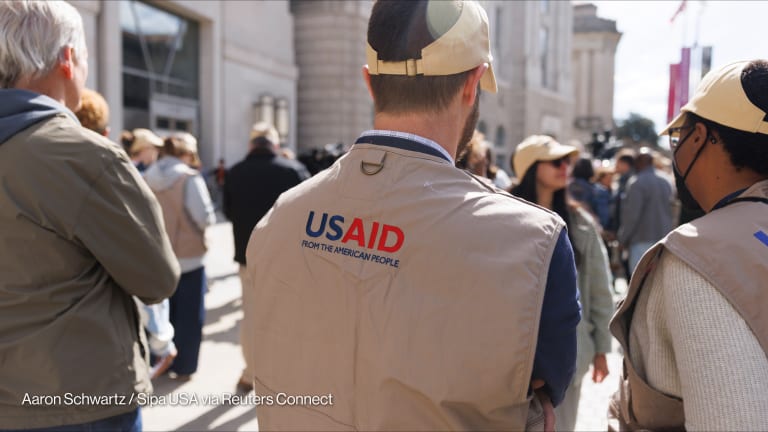
Fighting for billions: The legal battle to keep US foreign aid alive
Frozen programs, delayed payments, and billions at stake. The lawsuit that tested the limits of U.S. foreign aid continues, nearly one year after it began.
Late one February morning, Mitchell Warren waited for the Zoom call to begin. He was sitting in his Vermont home, surrounded by pink walls, packed bookshelves, and a South African artist’s rendition of Lover’s Plus, a condom brand Warren helped launch in the early 1990s. But this was 2025 — and like almost everyone in the global development sector, Warren felt like his world was on fire. In the three weeks since President Donald Trump took office, U.S. foreign aid had been suspended across the world. Warren’s organization, the AIDS Vaccine Advocacy Coalition, was left reeling, losing a third of its projected revenue and forcing it to lay off 15 staff. “I just remember sitting there looking at the newspaper headlines on the one hand, and my financial spreadsheets on the other,” said Warren, who has led AVAC, a New York City-based nonprofit, for the last two decades. “It was excruciating.” As the minutes passed, the small boxes on Warren’s screen filled with the members of AVAC’s board. They had gathered to weigh a decision that could define the organization for decades: whether to sue the Trump administration for its suspension of U.S. foreign aid. “People were saying: yes, we have to fight back. But what if there’s retribution?” Warren told Devex. “Is AVAC really up to this?” One board member suggested it might be better if the organization’s name wasn’t attached to the case, and if history didn’t record the battle as AVAC versus Trump. But for Warren, that was precisely the point. If AVAC wouldn’t put its name on the line, perhaps no one would. “Why not?” he said. Through a unanimous vote, the board decided to sue — and on Feb. 10, AVAC became the lead plaintiff in one of the largest foreign aid lawsuits in U.S. history. Over the next 11 months, that case would ricochet through the legal system, twice reach the Supreme Court, and force a fundamental constitutional question: Can the president refuse to spend money that Congress has already approved? “There are days where I think: Screw it. I'm done. This is hard,” said Warren. “But I am not going to give anybody that satisfaction.” Devex spoke with Warren — and other key players in the lawsuit — to understand how the legal fight affected the future of U.S. foreign aid, along with the people and programs that once depended on it. The beginning The first blow came on Jan. 20. On Trump’s first day in office, the president announced that foreign aid would be frozen for 90 days — and within the week, a stop-work order brought everything funded by U.S. foreign assistance to a halt. “The stop-work orders were kind of the proverbial ‘oh shit’ moment,” said Warren. “I remember sitting there, watching a bunch of the commentators on the news, and thinking: this is going to destroy an ecosystem that’s taken us decades to build.” But back in January, it wasn’t clear exactly what these moves — which affected some $30 billion in foreign assistance — actually meant. And as Warren scrambled in Vermont, AVAC’s partner organizations did the same. “When it was first announced, we were all thrown into a state of confusion,” said Rosemary Mburu, the head of the Nairobi-based advocacy organization WACI Health. “It was a very scary moment, and almost an unbelievable one.” WACI Health was pushing governments across Africa to invest domestic resources in the cause — but with a single email from Warren, that work came to a halt. The organization was forced to reorganize. Some employment contracts were canceled, while several other employees went from full to part-time work. During the early days of 2025, Mburu said, it felt like she was in survival mode. And back in Washington, Elisha Dunn-Georgiou — the president of the Global Health Council — was feeling the same. Within hours of the stop-work order, Dunn-Georgiou’s phone began lighting up with calls and emails from the nearly 150 organizations GHC represents. “Member organizations, [international aid groups], local partners, local governments were all like: Okay, let’s just obey this. Let’s be quiet, and let’s not raise any more attention to us than we need to, and we’ll just sail through,” said Dunn-Georgiou. “But at GHC, we were saying no. That is not the way you fight back on this.” The Global Health Council sued the Trump administration one day after AVAC, becoming the lead plaintiff along with six other organizations. That included many that were once USAID’s largest partners, including Chemonics International. By the time GHC filed its case, Chemonics had produced estimates suggesting that the freeze of its global health supply chain project — which halted the flow of nearly $500 million in medications — would lead to half a million deaths from HIV/AIDS alone. The crux of the case In both lawsuits, the central argument was the same: Congress, not the president, has power over federal spending. Because of that, they argued that Trump’s foreign aid freeze — and all that followed — was illegal. “At its core, it’s an impoundment case,” said David Super, a professor of law and economics at Georgetown University. The term impoundment refers to when a president declines to spend money appropriated by Congress. “And given how much impounding this administration has been doing, and in how many different areas, that makes it a pretty fundamental, and pretty essential, case.” After impoundment was pushed to a breaking point under former President Richard Nixon, Congress passed the Congressional Budget and Impoundment Control Act in 1974, limiting the executive branch’s ability to withhold appropriated funds. But throughout his reelection campaign, Trump pledged to do everything he could to challenge the act in court. “These issues have been discussed by constitutional scholars going back to the Nixon years,” said Ilya Shapiro, a director of constitutional studies at the Manhattan Institute, a conservative think tank in New York City. “But there is no solid jurisprudence on it, which is why it’s a live case.” The early wins and early losses At first, it almost seemed too simple. Three days after AVAC sued, District Court Judge Amir Ali ordered the government to restore funding for foreign aid programs and reverse any cancellations until the legal case played out. But one week later, nothing had changed. The Trump administration continued canceling contracts, arguing that the existing USAID statutes allowed the government to terminate programs. On Feb. 21, Ali again ordered the government to comply with his original order. And when that didn’t happen, he ordered the government to release millions of dollars in foreign assistance by midnight on Feb. 26 — giving them some 30 hours to do so. “No other litigant would have the bravery to slow walk compliance in the way that the government did,” said Nick Sansone, one of three attorneys from Public Citizen Litigation Group, the D.C.-based firm representing AVAC in the case. “So Judge Ali, I think, finally had to put his foot down.” Immediately, the government filed an emergency appeal with both the appellate court and the Supreme Court, the latter of which temporarily paused Ali’s order to pay. It was a preliminary move, one that would give the Supreme Court time to decide on Ali’s core order in the days to come. But within hours, the Trump administration began to cancel contracts en masse — ultimately slashing 10,000 projects across the world. The fallout Overnight, the aid sector was shattered. Even programs that had received waivers to continue providing lifesaving work were affected — and country by country, organizations were plunged into uncertainty once again. “Over the next few days, most of our time was spent trying to figure out what happened,” said Dunn-Georgiou. “People got cancellation notices, and then they got follow-ups saying, oh no, you got that in error. And then two days later, there was another cancellation notice.” For Dunn-Georgiou, it felt like sitting on Wall Street and watching the stock market crash. The frenzy of the cuts was overwhelming, and despite the carnage, there was nothing she could do to stop the blows. At that point, they seemed to be coming from all sides: while the plaintiffs pushed for Congress’ power of the purse, some Republican lawmakers began a campaign to discredit Ali himself — pushing for the judge’s impeachment, and stating his decisions in the case amounted to “high crimes and misdemeanors.” For Sansone, things shifted into an even higher gear. That meant sitting in his Washington, D.C. office and being glued to his computer screen: the emails were flying, he remembered, and his three-person team snapped into dividing, conquering, and writing their defense. They worked through the night to have a response filed by early afternoon, and one week later, the Supreme Court — which holds a super majority of conservative justices — ruled in the USAID partners’ favor, rejecting the Trump administration’s refusal to pay USAID partners in a 5-4 vote. “None of us thought we’d win,” said Warren, who called the moment “one of the most remarkable” across the entire year. “When that decision came back, I felt so vindicated.” After that, the goal post changed. Ali again ordered the Trump administration to pay its partners for all work completed before Feb. 13, 2025, when Ali first told the government to reverse the foreign aid freeze. But he also stated that the administration was barred from impounding congressionally appropriated foreign aid, and that the Trump administration was required to obligate the full amount appropriated by lawmakers for foreign assistance. The government, once again, appealed — and it would take five months before a higher court at the District of Columbia Circuit agreed with them. But in the meantime, the money finally began to flow, and organizations began to get paid. At one point, someone from a large nonprofit approached Warren to say thank you, adding that because of the lawsuit, his team had received a $10 million payment for this past work. It was a staggering sum, Warren recalled, especially compared to the little AVAC had left in its funding pipeline. “We weren’t just fighting for AVAC, and I think Elisha would say she wasn’t just fighting for the Global Health Council. We were fighting for foreign assistance,” said Warren, laughing. “But still, part of me wanted to say: can I get a commission here? Because you didn’t do anything.” Even so, both AVAC and GHC pushed on. Halfway through the month, the government said it had 10,000 payments outstanding. And as the year ticked on, that number dwindled downward as the government slowly repaid its debts. A change of the tides That fragile progress unraveled in August, when a three-judge panel in the U.S. Court of Appeals took on the Trump administration’s bid to challenge Ali. The court ruled that only the comptroller general — Congress’ top auditor of federal spending — could bring the case to court. At first, that seemed to block organizations such as AVAC and GHC from pushing forward their case. But by the end of the month, the full appeals court revisited that decision. They declined to halt the Trump administration from withholding foreign aid funds, but opened an avenue for the organizations to continue pursuing the district court. Ali ordered a new preliminary injunction, again mandating the government obligate congressionally appropriated funds. But on Aug. 29, the White House told Congress it planned to cancel nearly $5 billion in previously approved foreign aid funding through a “pocket rescission,” a legally murky tactic that pulls money so late in the fiscal year that lawmakers cannot block it before funds expire. “The lesson we’ve learned through all of this is that the administration moves with reckless abandon, while the courts move slowly and methodically,” said Warren. “And Congress moves not at all.” Ali reentered the fray, saying the move appeared to be the government’s latest attempt to bypass lawmakers. He directed the government to disburse $10.5 billion in expiring foreign aid funds, and within days, the case had landed back at the Supreme Court. By the end of the month, the justices sided with the Trump administration — blocking Ali’s order, and allowing $4 billion in foreign aid to expire. “I don’t think I’ve ever had as many emotions, including exhaustion, all come to bear at the same time,” Warren told Devex. “There have been hard times in my entire career, but [last year, it felt like] the decks have never been stacked as high against our ecosystem.” In her dissent, liberal-leaning Justice Elena Kagan wrote that the order had brought the court into “unchartered territory,” in large part because the government had asked the court to weigh in on an emergency basis. It’s something that the Trump administration did throughout all of 2025, and an approach that brought the government 21 full or partial wins during the last year alone. “We have had to consider this application on a short fuse — less than three weeks,” wrote Kagan. “We have done so with scant briefing, no oral argument, and no opportunity to deliberate in conference.” Because of that, the justices warned that their decision was “preliminary,” and “should not be read as a final determination on the merits.” Ultimately, the case would go on — and the arguments landed back at the district court. “The hardest part of this was realizing that the case won’t be the savior of things,” said Dunn-Georgiou. “We all went in with hope that there would be this injunction, and that would stop it, that would reverse it. But really soon, it became clear that this was going to be a long battle.” The road ahead While the litigation has moved through the courts, the real-world terrain shifted dramatically. The U.S. Agency for International Development has been largely dismantled, and what remains of its programming has been transferred to the State Department. The Trump administration is prioritizing private sector investment over traditional nonprofit groups, and bilateral trade deals over typical grants and contracts. “The situation on the ground has been fundamentally and profoundly altered, in spite of the litigation, and in spite of the partial victories that the plaintiffs have won,” said Laura Dickinson, a professor at the George Washington University School of Law. “And so even if [the organizations] win, it’s not clear what that would mean with respect to the work they were doing.” Still, Sansone said, the battle is far from over. Last year, the government processed 18,650 payments for work completed before Ali’s original order on Feb. 13, 2025, paying out nearly $2.3 billion since the lawsuit began. More than 90% of those funds went to those not suing the federal government. On Jan. 10, Ali denied the Trump administration’s latest attempt to dismiss the case, and it now awaits decisions in other legal challenges that could shape how the remaining disputes are resolved. Once that happens, some legal experts expect the case to wind its way back toward the Supreme Court, while others — like Sansone himself — refrained from passing judgment on what comes next. A lot could change in the months to come, Sansone said, both in terms of the legal landscape and the facts on the ground. “It didn't change foreign assistance, and it didn't restart programs. But you know, I still feel that we've won some important battles along the way,” said Warren. “And I still think: history is going to remember this.”
Late one February morning, Mitchell Warren waited for the Zoom call to begin.
He was sitting in his Vermont home, surrounded by pink walls, packed bookshelves, and a South African artist’s rendition of Lover’s Plus, a condom brand Warren helped launch in the early 1990s. But this was 2025 — and like almost everyone in the global development sector, Warren felt like his world was on fire.
In the three weeks since President Donald Trump took office, U.S. foreign aid had been suspended across the world. Warren’s organization, the AIDS Vaccine Advocacy Coalition, was left reeling, losing a third of its projected revenue and forcing it to lay off 15 staff.
This story is forDevex Promembers
Unlock this story now with a 15-day free trial of Devex Pro.
With a Devex Pro subscription you'll get access to deeper analysis and exclusive insights from our reporters and analysts.
Start my free trialRequest a group subscription Printing articles to share with others is a breach of our terms and conditions and copyright policy. Please use the sharing options on the left side of the article. Devex Pro members may share up to 10 articles per month using the Pro share tool ( ).
Elissa Miolene covers U.S. foreign assistance from Washington, D.C. She previously covered education at The San Jose Mercury News, and has written for The Wall Street Journal, the San Francisco Chronicle, and other news outlets across the world. Before shifting to journalism, Elissa led communications for aid agencies in the United States, East Africa, and South Asia.