• News
    • Latest news
    • News search
    • Health
    • Finance
    • Food
    • Career news
    • Content series
    • Focus areas
    • Try Devex Pro
  • Jobs
    • Job search
    • Post a job
    • Employer search
    • CV Writing
    • Upcoming career events
    • Try Career Account
  • Funding
    • Funding search
    • Funding news
  • Talent
    • Candidate search
    • Devex Talent Solutions
  • Events
    • Upcoming and past events
    • Partner on an event
  • Post a job
  • About
      • About us
      • Membership
      • Newsletters
      • Advertising partnerships
      • Devex Talent Solutions
      • Contact us
Join DevexSign in
Join DevexSign in

News

  • Latest news
  • News search
  • Health
  • Finance
  • Food
  • Career news
  • Content series
  • Focus areas
  • Try Devex Pro

Jobs

  • Job search
  • Post a job
  • Employer search
  • CV Writing
  • Upcoming career events
  • Try Career Account

Funding

  • Funding search
  • Funding news

Talent

  • Candidate search
  • Devex Talent Solutions

Events

  • Upcoming and past events
  • Partner on an event
Post a job

About

  • About us
  • Membership
  • Newsletters
  • Advertising partnerships
  • Devex Talent Solutions
  • Contact us
  • My Devex
  • Update my profile % complete
  • Account & privacy settings
  • My saved jobs
  • Manage newsletters
  • Support
  • Sign out
Latest newsNews searchHealthFinanceFoodCareer newsContent seriesFocus areasTry Devex Pro
    • News
    • 78th World Health Assembly

    Former UN relief chief says world body's reforms lack vision

    Martin Griffith blasts U.S.-backed aid plan for Gaza as "absolutely egregious."

    By Colum Lynch // 27 May 2025
    Martin Griffiths, the former United Nations emergency relief coordinator, is concerned that the world body is going about its latest reform initiative in the wrong way, prioritizing numerical downsizing targets over forging a clear vision for the future that demonstrates its usefulness. “The U.N. system gets mired in mandates, and it gets mired in competition. We all know that,” Griffiths said in an interview with Devex on the sidelines of the World Health Assembly in Geneva, Switzerland. But he said the current quest for savings is just “about cuts. That’s not about reform. I think that’s wrong.” The remarks come less than two weeks after U.N. Secretary-General António Guterres unveiled his UN80 reform plan, which calls for the elimination of 20% of jobs in key U.N. departments, moving back-office staff from New York and Geneva to cheaper cities, abolishing departments, merging U.N. agencies, and reducing the number of mandates, or tasks, it is obliged to carry out. Asked if billionaire Elon Musk’s dismantling of the U.S. aid sector might give it the shock it needed to institute needed reform, Griffiths pushed back. “Do you want to bully your child in order to change them?” he asked. “Of course not. It’s against our humanity.” “There's obvious efficiencies to be done by sharing back offices, by sharing maybe fundraising, by sharing geographical desks between agencies, and in Geneva,” he said. Proposals to merge agencies, like the International Organization for Migration and the U.N. High Commissioner for Refugees, are “fine but it's not the solution. I think because it will increase efficiencies, I'm not sure it will yet increase effectiveness,” he said. “The organizing principle of change now is not about back offices,” Griffiths added. “It's about listening to the people and letting them tell us what to do.” The Trump administration’s imposition of billions of dollars in cuts on foreign aid — and a White House budget proposal aimed at eliminating more than 85% of funding to the U.N. — represents perhaps the greatest threat to the U.N.’s financial sustainability since its creation in 1945. Thousands of jobs have already been eliminated at key U.N. humanitarian agencies, including UNAIDS, the World Health Organization, and the International Organization for Migration. More are expected as the world body approaches key budget negotiations over U.N. peacekeeping and the regular budget. In an attempt to accommodate the United States, Secretary-General Guterres and the heads of key U.N. agencies have begun implementing cuts. Griffiths said he has “a passionate view that the new reset, the new vision, should be all about localization.” The humanitarian community, he added, “needs to demonstrate our relevance. That way lies multilateralism. That way lies care for people who need it.” Griffiths voiced particular alarm over a U.S. and Israeli-backed plan to contract a private, newly established outfit, the Gaza Humanitarian Foundation, which would coordinate the distribution of aid in Gaza, primarily in the south, in a handful of “secure distribution sites.” Security would be provided by private security contractors. The organization has asked the U.N. and private relief agencies to channel assistance through their hubs. The plan — which mirrors a proposal Israel has privately floated, according to U.N. officials and humanitarian aid specialists — has been sharply criticized by the U.N. and other private NGOs as a vehicle for forcing the mass relocation of Palestinian civilians from northern Gaza. “I don’t want to mince words,” Griffiths said, suggesting the secured base would effectively serve as a kind of military fortress. “It’s absolutely egregious.” Griffiths compared the foundation’s plan to a previous effort — backed by the U.S. military — to supply food, medicines, and other goods via a floating pier on the Gazan shore. That ended in failure, with rough seas destroying the pier, ships running aground, and more than 60 U.S. personnel injured. One soldier was killed. “One of my principal objections is [that] you cannot gain trust between the deliverers of aid and the recipients on a military base,” he said. “It's kind of that simple. Anybody who’s been on humanitarian front-line operations knows that without trust, it doesn’t work, because you’re often drawing people into danger in order to get assistance; you’re putting your own staff in danger.” The U.N., on the other hand, has a plan to massively ramp up humanitarian aid in Gaza if it is allowed to do so by the Israeli authorities, he noted. The plan, which is available on the U.N. website, is designed to provide aid across the entire Gaza Strip and includes a monitoring system to address Israeli concerns about diversion of food to Hamas. The U.N. has more than 160,000 pallets of aid, enough to fill 8,900 trucks, a vast network of aid workers, and distribution sites. The plan, Griffiths said, is a good example of why the U.N. is “relevant.” In contrast, he said, “the [Gaza] Humanitarian Foundation here in Geneva is not even promising to deliver to half the people [in Gaza].”

    Related Stories

    The split screen of the Gaza Humanitarian Foundation
    The split screen of the Gaza Humanitarian Foundation
    After weeks of tension, UN leaders talk to controversial Gaza aid group
    After weeks of tension, UN leaders talk to controversial Gaza aid group
    Devex Newswire: Controversial aid organization goes looking for new staff
    Devex Newswire: Controversial aid organization goes looking for new staff
    UNAIDS faces uncertain future amid UN reform push
    UNAIDS faces uncertain future amid UN reform push

    Martin Griffiths, the former United Nations emergency relief coordinator, is concerned that the world body is going about its latest reform initiative in the wrong way, prioritizing numerical downsizing targets over forging a clear vision for the future that demonstrates its usefulness.

    “The U.N. system gets mired in mandates, and it gets mired in competition. We all know that,” Griffiths said in an interview with Devex on the sidelines of the World Health Assembly in Geneva, Switzerland. But he said the current quest for savings is just “about cuts. That’s not about reform. I think that’s wrong.”

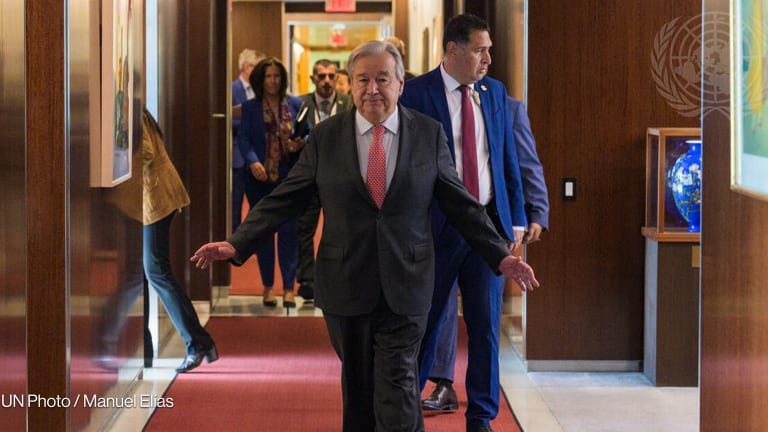
    The remarks come less than two weeks after U.N. Secretary-General António Guterres unveiled his UN80 reform plan, which calls for the elimination of 20% of jobs in key U.N. departments, moving back-office staff from New York and Geneva to cheaper cities, abolishing departments, merging U.N. agencies, and reducing the number of mandates, or tasks, it is obliged to carry out.

    This article is free to read - just register or sign in

    Access news, newsletters, events and more.

    Join usSign in

    Read more:

    ► Trump and the future of the UN (Pro)

    ► How different US administrations funded the UN system (Pro)

    ► UN chief outlines 'painful' survival plan for world body

    • Humanitarian Aid
    • Funding
    Printing articles to share with others is a breach of our terms and conditions and copyright policy. Please use the sharing options on the left side of the article. Devex Pro members may share up to 10 articles per month using the Pro share tool ( ).

    About the author

    • Colum Lynch

      Colum Lynch

      Colum Lynch is an award-winning reporter and Senior Global Reporter for Devex. He covers the intersection of development, diplomacy, and humanitarian relief at the United Nations and beyond. Prior to Devex, Colum reported on foreign policy and national security for Foreign Policy Magazine and the Washington Post. Colum was awarded the 2011 National Magazine Award for digital reporting for his blog Turtle Bay. He has also won an award for groundbreaking reporting on the U.N.’s failure to protect civilians in Darfur.

    Search for articles

    Related Stories

    HumanitarianRelated Stories - The split screen of the Gaza Humanitarian Foundation

    The split screen of the Gaza Humanitarian Foundation

    HumanitarianRelated Stories - After weeks of tension, UN leaders talk to controversial Gaza aid group

    After weeks of tension, UN leaders talk to controversial Gaza aid group

    Devex NewswireRelated Stories - Devex Newswire: Controversial aid organization goes looking for new staff

    Devex Newswire: Controversial aid organization goes looking for new staff

    Global healthRelated Stories - UNAIDS faces uncertain future amid UN reform push

    UNAIDS faces uncertain future amid UN reform push

    Most Read

    • 1
      Building stronger primary care to tackle NCDs and mental health
    • 2
      Investing in opportunity: How venture capital powers social impact
    • 3
      Meet the innovators closing persistent gaps in women's health
    • 4
      Future forward: Closing infrastructure gaps for climate innovation
    • 5
      Invest in diagnostics to win the health fight
    • News
    • Jobs
    • Funding
    • Talent
    • Events

    Devex is the media platform for the global development community.

    A social enterprise, we connect and inform over 1.3 million development, health, humanitarian, and sustainability professionals through news, business intelligence, and funding & career opportunities so you can do more good for more people. We invite you to join us.

    • About us
    • Membership
    • Newsletters
    • Advertising partnerships
    • Devex Talent Solutions
    • Post a job
    • Careers at Devex
    • Contact us
    © Copyright 2000 - 2025 Devex|User Agreement|Privacy Statement