
Africa’s long reliance on foreign aid has come at the expense of its own industrial and human capital development — and a shift toward investment and self-reliance is urgently needed, according to policymakers and development leaders speaking at a Devex Impact House event last week. The discussion on the sidelines of the World Bank-International Monetary Fund annual meetings explored how African governments and their partners can move from short-term aid models to investment-driven growth that builds local expertise, strengthens governance, and connects projects with finance. Africa’s dependence on aid has come at a steep cost to its own development, said Hippolyte Fofack, former chief economist at the African Export-Import Bank. “It’s important to stress that the aid industry, which was supposed to be a short-term palliative, has to a certain extent, become an entrenched culture of dependency,” he said. To illustrate that cost, he pointed to the health sector. “If you take one example in the whole sector and look at the data, 95% of malaria-related [deaths] are in Africa, but Africa is not [producing] a single malaria drug or undertaking any research,” he said. He added that donor programs typically purchase medicines from pharmaceutical companies outside the continent, fueling growth in foreign industries while preventing Africa from building its own manufacturing base. Fofack said the current aid model also fails to generate employment in recipient countries, citing a recent review that suggested that 80% of USAID contractors were “essentially Americans.” While good for the United States, this “essentially [exports] jobs that should have been within the African continent or the aid recipient countries, where… unemployment rates are at Great Depression levels, more than 30% in most.” He added that continuing this approach would only deepen dependence rather than build self-sustaining growth. “Risk and opportunity are two sides of the same coin,” Fofack said. But historically, Africa has shouldered the risk while outsourcing the opportunity — and that needs to change, he argued. Creating the conditions for investment Aid and investment are distinct concepts and should be treated as such, said former Tunisian Prime Minister Mehdi Jomaa. “Investment has its logic,” he said, adding that governments should focus on developing projects that are “investable and bankable” rather than seeking funds out of need. He argued that the private sector has an essential role to play across many areas, including infrastructure and climate projects, but stressed that this does not diminish the importance of public leadership. Aid, Jomaa said, can still be useful in the early stages of project preparation — helping countries build technical capacity, conduct feasibility studies, and design projects that attract investors. The public sector, he added, must ensure stability and provide a clear policy framework that gives investors confidence. Its “crucial role,” he said, is to offer “a clear vision, giving visibility, offering the right environment, security, political stability, but as well stability in the financial framework, giving transparency and clear role.” When governments do that, he said, “it’s not so difficult” to attract financing for “well prepared, feasible, bankable and investable projects.” For Fofack, the main barrier to investment is not a shortage of capital but a shortage of technical capacity. “It’s quite clear that we’ve not built a critical mass of top-tier expertise in engineering, in manufacturing, in management,” he said, arguing that this has limited countries’ ability to design and deliver investment-ready projects. Many of the few that do move forward, he added, are carried out by foreign contractors at high cost. “Before the adjustment era, we had an operation research department, a ministry of planning, which were very critical in terms of optimizations, drawing, mathematical modeling to actually prepare this project, costing and funding,” he said. Rebuilding that kind of in-house expertise, he added, is essential for governments to move from planning to implementation. Enoh T. Ebong, former director of the U.S. Trade and Development Agency, agreed that African governments need stronger regulatory and institutional foundations to make an investment-led model viable. She said countries cannot rely on private finance alone without the laws, negotiating capacity, and infrastructure needed to sustain it. Ebong said U.S. development finance institutions can help bridge the gap between project preparation and investment. “I would point out ... the U.S. International Development Finance Corporation ... the Millennium Challenge Corporation ... [and] the U.S. Trade and Development Agency,” she said. “These are agencies that are focused on ... building pipelines ... providing financing ... focusing on the environment and hard infrastructure, but I do think that they all need to be at the right scale.” While recognizing the limitations of aid, she cautioned against discarding it altogether. “We have to be aware that at the same time, there are situations of real exigency that I don’t know get fully addressed in an investment-first environment and private sector focus,” she said.


Africa’s long reliance on foreign aid has come at the expense of its own industrial and human capital development — and a shift toward investment and self-reliance is urgently needed, according to policymakers and development leaders speaking at a Devex Impact House event last week.
The discussion on the sidelines of the World Bank-International Monetary Fund annual meetings explored how African governments and their partners can move from short-term aid models to investment-driven growth that builds local expertise, strengthens governance, and connects projects with finance.
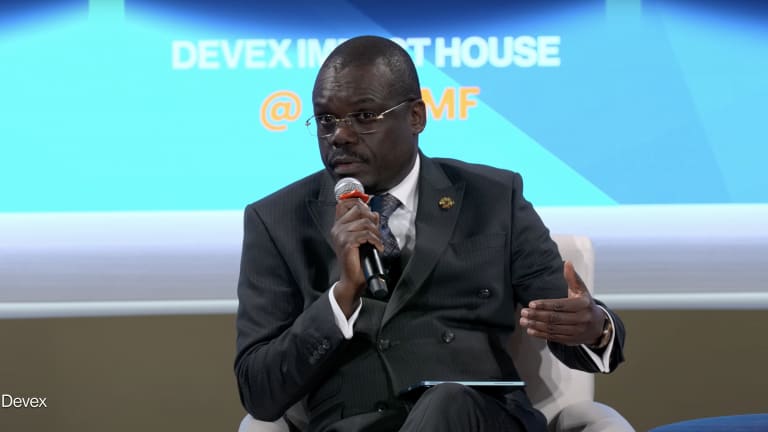
Africa’s dependence on aid has come at a steep cost to its own development, said Hippolyte Fofack, former chief economist at the African Export-Import Bank.
Printing articles to share with others is a breach of our terms and conditions and copyright policy. Please use the sharing options on the left side of the article. Devex Pro members may share up to 10 articles per month using the Pro share tool ( ).
About the author

Ayenat Mersie
Ayenat Mersie is a Global Development Reporter for Devex. Previously, she worked as a freelance journalist for publications such as National Geographic and Foreign Policy and as an East Africa correspondent for Reuters.
Search for articles


Most Read
- 1
- 2
- 3
- 4
- 5