
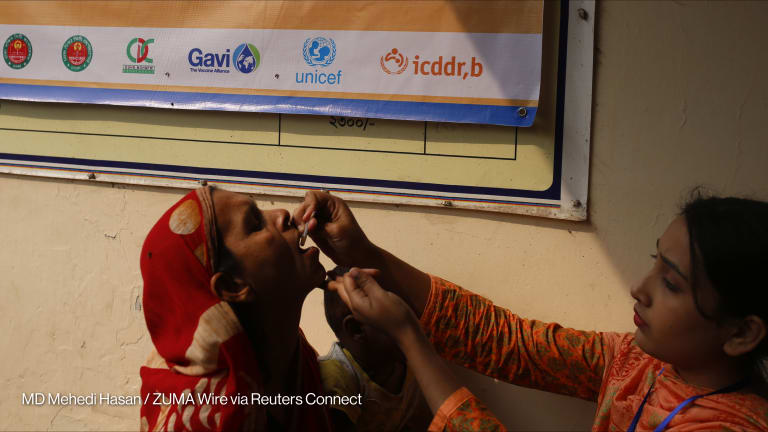
The announcement by the United States that it’s cutting support to Gavi, the Vaccine Alliance’s work to vaccinate children in lower-income countries, put a damper on the organization’s high-level pledging event last week in Brussels, Belgium. The U.S. provides the organization with about 13% of its funding — some $300 million annually. “We are very hopeful that they will come back,” Dr. Sania Nishtar, Gavi’s chief executive officer, said during a Devex event on the sidelines of the Fourth International Conference on Financing for Development, or FfD4, in Sevilla, Spain. Under the Biden administration, the U.S. pledged to provide at least $1.58 billion to support Gavi’s work from 2026 through 2030. “We are very desirous of a relationship with the United States,” Nishtar told Devex President and Editor-in-Chief Raj Kumar, adding that during his first administration, U.S. President Donald Trump increased the country’s contribution to Gavi. The U.S. Congress appropriated $300 million for the organization in this year’s appropriation. “We look forward to the administration executing that — implementing that,” Nishtar said. The country’s withdrawal creates a “significant hole,” Nishtar said, but added that Gavi still has the support of donors that commit more than the U.S. And the organization still managed to raise $9 billion of its goal of $11.9 billion for the coming five years of work amid a year where foreign aid funding has been massively slashed with “one brush stroke,” Nishtar said. And so while the organization fell short of its goal during the pledging event last week — it still sees this as a victory. “We feel great because this is such a difficult context,” Nishtar said. “We are really very humbled with the outcome.” She added that there are still countries yet to pledge because they were “in particular political moments in budgetary cycles” in the lead-up to the pledging event that prevented them from doing so. “There still is a road ahead. There still is a journey ahead towards the $11.9 [billion],” she said. During the U.S. announcement, vaccine-skeptic U.S. Secretary of Health and Human Services Robert F. Kennedy, Jr. called into question vaccine safety, which Gavi rebuked. “Amongst all the countermeasures, vaccines are amongst the safest because [of] the regulatory system that is in place to exercise oversight, the quality assurance mechanisms that the world has put in place to ensure their safety,” Nishtar said. “Those are without any question.” She told Kumar her organization has been on a “wide-ranging” reform journey deeply rooted in “the way we engage with countries and the manner in which we run the secretariat.” It’s called the “Gavi leap,” which focuses on areas such as placing more resources at the decision-making discretion of countries, “radically simplifying” the way countries access Gavi funds, creating “bespoke” solutions for countries, and reducing duplication and fragmentation with other partners on the ground. Gavi isn’t a charity, she said, countries co-pay toward their immunization programs and when they reach certain levels of economic development, they exit from Gavi support. While the organization started with 78 countries, 19 have graduated. Two of these countries, India and Indonesia, have now evolved to become Gavi donors — the organization raised $50 million from both countries during its replenishment. The president of Ghana said his country aims to become a donor as well. “There’s a sea change on the ground, because they want to celebrate their self-reliance. They want to invest in social policy that is beyond that framework of being the recipients of assistance,” she said. “It's about addressing the inefficiencies that exist at the country level as well, the hemorrhages and the leakages from the system,” she added. And while it’s not always easy, it’s about choosing priorities. Many countries are grappling with debt, “crippling” interest payments, and hyperinflation — “a toxic combination,” she said. But she said many countries still take their co-financing obligations to funding vaccines seriously despite these challenges and her organization is actually “grappling with the demand” of countries for vaccines. For example, African countries are in competition to scale up the rollout of the new malaria vaccines. “They realize that this is one of the best investments they can make in the health of their children,” she said. “Countries are very smart. They know where to invest, and there's tangible proof of that.” And while there is a tendency to hone in on the problems, there’s also a need to celebrate the wins, she said. “What I see is Gavi present at the last mile,” she said. “You may just have a dirt road winding up to a dusty hill. You may have no cell phone connectivity, no water, no sanitation, no amenities of modern living, perhaps not even a school or a health facility, but you will have a mobile outpost, and you will have the community aware of what immunization is.” She added that her organization’s replenishment is “a tremendous reaffirmation of the confidence in these things that the world has built together.” “There are things in the world that also work,” she added.


The announcement by the United States that it’s cutting support to Gavi, the Vaccine Alliance’s work to vaccinate children in lower-income countries, put a damper on the organization’s high-level pledging event last week in Brussels, Belgium. The U.S. provides the organization with about 13% of its funding — some $300 million annually.
“We are very hopeful that they will come back,” Dr. Sania Nishtar, Gavi’s chief executive officer, said during a Devex event on the sidelines of the Fourth International Conference on Financing for Development, or FfD4, in Sevilla, Spain.
Under the Biden administration, the U.S. pledged to provide at least $1.58 billion to support Gavi’s work from 2026 through 2030.
Printing articles to share with others is a breach of our terms and conditions and copyright policy. Please use the sharing options on the left side of the article. Devex Pro members may share up to 10 articles per month using the Pro share tool ( ).
About the author

Sara Jervingsarajerving
Sara Jerving is a Senior Reporter at Devex, where she covers global health. Her work has appeared in The New York Times, the Los Angeles Times, The Wall Street Journal, VICE News, and Bloomberg News among others. Sara holds a master's degree from Columbia University Graduate School of Journalism where she was a Lorana Sullivan fellow. She was a finalist for One World Media's Digital Media Award in 2021; a finalist for the Livingston Award for Young Journalists in 2018; and she was part of a VICE News Tonight on HBO team that received an Emmy nomination in 2018. She received the Philip Greer Memorial Award from Columbia University Graduate School of Journalism in 2014.
Search for articles



Most Read
- 1
- 2
- 3
- 4
- 5