



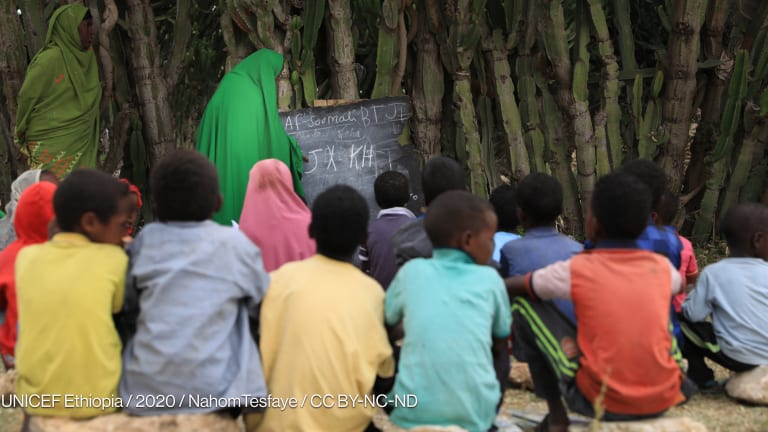
Campaigners reacted with disappointment after this week’s Global Education Summit fell short of raising the $5 billion in financing that is said to be needed to help remedy the schooling crisis amid the COVID-19 pandemic.
NGO leaders said the U.K. government, which hosted the event alongside Kenya, had to shoulder responsibility for the failure Thursday, arguing that the nation had undermined its leadership position by cutting its aid budget and numerous education programs with it.
Donations amounted to around $4 billion for a five-year funding cycle for the Global Partnership for Education, or GPE, despite world leaders repeatedly citing the importance of education for youngsters across the world and acknowledging how many had been forced out of school over the past year and a half.
“This is the first time in history that the host of a major education finance summit has simultaneously cut their overall funding for global education.”
— Rose Caldwell, chief executive, Plan International UK“We know that COVID has set back progress further and faster than anyone could have possibly predicted at the time,” U.K. Foreign Secretary Dominic Raab told the conference. “We know that 1.6 billion children and young people were out of education at the height of those school closures during the pandemic. There’s a real risk that as many as 24 million children will never return to school. ... We just cannot allow that to happen.”
But NGOs lined up to take aim at the U.K. government after the summit concluded.
“In missing GPE’s fundraising target of ‘at least US $5 billion’ by a margin of $1 billion, the UK has failed in its duty as co-host. Although other major economies must also take responsibility for a collective lack of ambition in financing GPE, ultimate culpability lies with Prime Minister Boris Johnson and his Government,” said Aaron Oxley, executive director at RESULTS UK, in a statement.
“This is the first time in history that the host of a major education finance summit has simultaneously cut their overall funding for global education,” said Rose Caldwell, chief executive at Plan International UK. She said despite his stated commitment to girls’ education, it was “little surprise” that Johnson had “struggled to inspire other governments.”
The United Kingdom’s five-year, £430 million pledge, made at a summit of the G-7 group of nations in June, was criticized at the time as a “smoke and mirrors” commitment over a lack of transparency around the funding. Education programs were not spared in the country’s aid cuts, and neither were other relevant areas such as sexual and reproductive health programs, which are seen as essential to helping girls access education.
Despite the summit raising funds for a five-year period, the United States committed $305 million for just three years — also falling short of expectations. Advocates said the pledge amounted to a cut.
UK cuts education aid even as its global summit approaches
The U.K. government is heavily promoting the Global Education Summit it is hosting. But education has not escaped the country's aid budget cuts, and Devex has learned of new program reductions.
“In the middle of an unprecedented global education crisis during COVID-19, this shortfall is unconscionable,” said Joanne Carter, executive director at the RESULTS Educational Fund. “When millions of the world’s kids may never return to school due to the pandemic, the [U.S. President Joe] Biden administration missed the chance to show new global leadership on education.”
“After all the rhetoric from leaders about the importance of investing in education, this is a decidedly underwhelming result,” said Edwin Ikhuoria, Africa executive director at the ONE Campaign, in a statement.
He continued: “Although these commitments will help secure the futures of many more children, the reality is that we’re around $1 billion short of the original target. Unfortunately, the report card for leaders after the summit tells an all-too-familiar story — they must do better.”
About the author

William Worley@willrworley
Will Worley is the Climate Correspondent for Devex, covering the intersection of development and climate change. He previously worked as UK Correspondent, reporting on the FCDO and British aid policy during a time of seismic reforms. Will’s extensive reporting on the UK aid cuts saw him shortlisted for ‘Specialist Journalist of the Year’ in 2021 by the British Journalism Awards. He can be reached at william.worley@devex.com.
Search for articles


Most Read
- 1
- 2
- 3
- 4
- 5