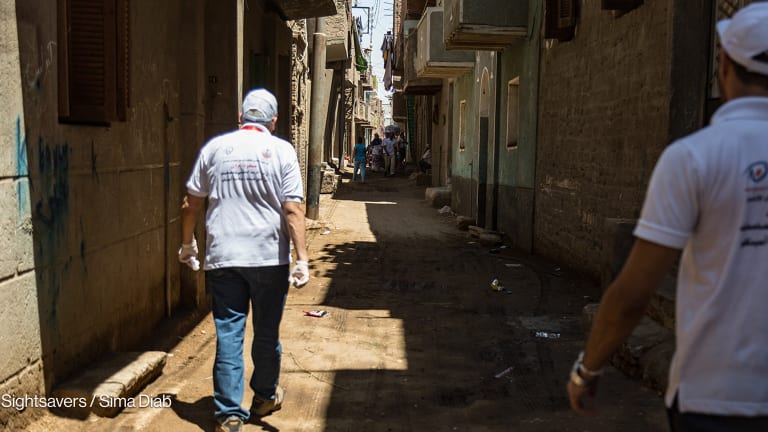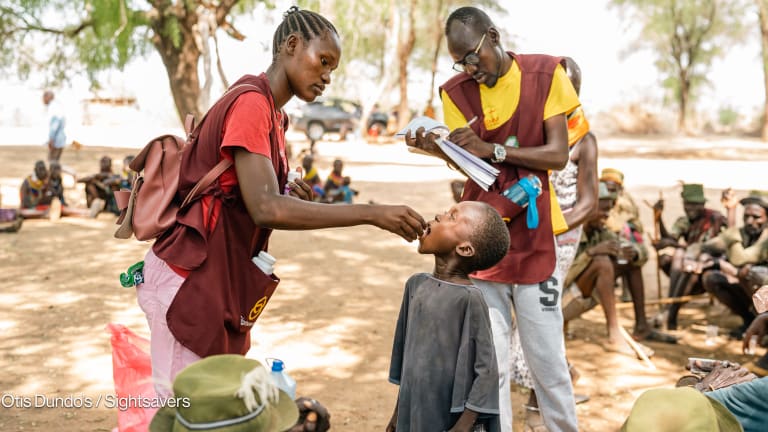



As the broader global health community searches for more effective models of implementation, Ethiopia’s journey toward trachoma elimination offers a clear example of what works.
Today, more than 66 million Ethiopians live in areas that warrant intervention from trachoma — one of 21 neglected tropical diseases, or NTDs, and the world’s leading infectious cause of blindness. Even so, Ethiopia has made remarkable progress, reducing the at-risk population from a peak of 100 million in areas where trachoma has ever been endemic, as reported by the Ministry of Health to the joint ITI/WHO GET2020 database.
This progress against trachoma is the result of a Ministry of Health-led public-private partnership that channels global resources toward a unified national strategy.
This effort reflects a broader learning: Public-private partnerships achieve their greatest impact when they operate within country-led, interconnected ecosystems. These systems unite diverse players around a clearly defined goal — one that is led, owned, and measured by national governments and shaped by a global technical framework.
Collaboration is guided by shared purpose and data. Each organization contributes its comparative strengths while staying aligned to local priorities. This approach strengthens coordination, creates space for private sector efficiency, and ensures long-term sustainability.
The global effort to eliminate trachoma exemplifies this model in action. Pfizer’s antibiotic donation program, international nongovernmental organization, or INGO, Orbis International’s eye health initiatives, and the health ministry’s leadership all maintain distinct public-private partnerships. Yet their efforts are deeply coordinated, mutually reinforcing, and united by one objective: to eliminate trachoma as a public health problem by 2030.
Leadership, coordination, and resilience amid challenges
Ethiopia’s progress shows what can happen when public-private partnerships are successfully embedded in a country-driven ecosystem. The health ministry leads a robust national strategy on NTDs, aligned with the World Health Organization’s 2030 road map for NTDs and the surgery, antibiotics, facial cleanliness, and environmental improvement, or SAFE, framework. Platforms such as the National Trachoma Task Force and the Ethiopia Trachoma Advisory Group unite government, regional health bureaus, and partners to ensure every intervention is guided by data and grounded in community needs.
Even amid conflict, COVID-19, and shifting donor landscapes, Ethiopia’s program has endured. Strong national commitment, data-driven decision making, and a supportive partner network have made it possible. Local innovations, such as distributing an additional round of antibiotics annually to children in hyperendemic areas, demonstrate how country ownership drives adaptation. Today, 35.8 million people in Ethiopia are living in trachoma-free communities that no longer require mass drug administration, or MDA — a testament to the effectiveness of this ecosystem approach.

A collaborative ecosystem for sustainable impact
Behind this progress is a network of contributors working in complementary roles. Pfizer has donated more than 1 billion doses of the antibiotic essential to breaking transmission in Ethiopia. The INGO manager of that donation, the International Trachoma Initiative of the Task Force of Global Health, or ITI, provides end-to-end drug stewardship — from forecasting to delivery to the port of entry — ensuring safe, equitable, and efficient use.
In 2024, ITI coordinated the delivery of over 8 million antibiotic doses to Orbis alone for MDA. In specific areas of Ethiopia, Orbis, in turn, partners with the health ministry to deliver treatments, strengthen eye health systems, and train local professionals. Many other organizations further complement that work with service delivery in other regions, bridging funding or operational gaps, and driving water, sanitation, and hygiene, or WASH, and other social and behavioral change interventions.
This collaboration goes far beyond exchanging resources. It’s a process of co-planning, capacity building, and problem-solving. Ethiopia’s trachoma community operates on trust, shared data, and clearly defined roles. When logistical, financial, or operational challenges arise, partners mobilize quickly to ensure no district is left behind, guided by the national NTD strategic plan and National Trachoma Task Force. This was demonstrated during the COVID-19 pandemic by proactively developing standard operating procedures, or SOPs, for house-to-house MDAs to ensure program continuity as well as impact.
Holistic integration: The key to lasting elimination
Trachoma elimination requires a holistic approach, much like maintaining overall health. Focusing on a single intervention — antibiotics, surgery, or sanitation — will not solve the problem alone. Success depends on the integration of multiple components: effective medical treatment, strong logistics, improved WASH systems, and committed local leadership. Only by working together as a unified effort can trachoma truly be eliminated.
That integrated approach is what has delivered results, helping reduce the number of people at risk of trachoma globally by over 93% in the past 23 years. This model shows what is necessary for private sector partners to move beyond traditional philanthropy to achieve sustainable impact. Alignment with country-led priorities and embedment within an ecosystem of accountability are not enhancements but rather what create the conditions to realize the full value of private sector expertise in helping to deliver long-lasting solutions for public health.
A new way forward in global health
The lesson is clear: No single organization, not even two, can eliminate a public health problem alone. Progress requires committed government leadership, partners who collaborate and adapt, and informed communities who believe in the goal. Together, these elements form a resilient ecosystem capable of both tackling one challenge and protecting health more broadly.
If more global health efforts embrace this model, then Ethiopia’s progress won’t only mark the end of one disease. It will mark the beginning of a new way of working in global health — one where public-private partnerships are reimagined as interconnected parts of a living ecosystem built to deliver impact that endures.
Visit Escape the Neglect — a series exploring the extraordinary progress that countries are making in eliminating neglected tropical diseases, or NTDs, and showcasing promising opportunities to build on recent wins.
This content is produced in partnership with our Escape the Neglect series. Click here to learn more.
About the authors

Alemayehu Sisay
Dr. Alemayehu Sisay, country director of Orbis International in Ethiopia, has over 20 years of experience in clinical and public health practices in Ethiopia and globally. Sisay is a senior ophthalmologist and one of the world’s leading trachoma experts, with several peer-reviewed articles on the disease and an appointment to the World Health Organization Regional Office for Africa’s Trachoma Elimination Dossier Review Group.
Julie Jenson
As a director on Pfizer’s global health investments team, Julie partners with global health stakeholders to donate medicines and vaccines for long-standing humanitarian programs and respond to emergencies and disasters. She is also active on industry and educational boards, including the board of Orbis International, and past chair of the Partnership for Quality Medical Donations, or PQMD. Julie holds a master’s in Public Health from Columbia University and a bachelor’s degree in Supply Chain Management from Michigan State University. She is a certified supply chain management professional.