• News
    • Latest news
    • News search
    • Health
    • Finance
    • Food
    • Career news
    • Content series
    • Focus areas
    • Try Devex Pro
  • Jobs
    • Job search
    • Post a job
    • Employer search
    • CV Writing
    • Upcoming career events
    • Try Career Account
  • Funding
    • Funding search
    • Funding news
  • Talent
    • Candidate search
    • Devex Talent Solutions
  • Events
    • Upcoming and past events
    • Partner on an event
  • Post a job
  • About
      • About us
      • Membership
      • Newsletters
      • Advertising partnerships
      • Devex Talent Solutions
      • Contact us
Join DevexSign in
Join DevexSign in

News

  • Latest news
  • News search
  • Health
  • Finance
  • Food
  • Career news
  • Content series
  • Focus areas
  • Try Devex Pro

Jobs

  • Job search
  • Post a job
  • Employer search
  • CV Writing
  • Upcoming career events
  • Try Career Account

Funding

  • Funding search
  • Funding news

Talent

  • Candidate search
  • Devex Talent Solutions

Events

  • Upcoming and past events
  • Partner on an event
Post a job

About

  • About us
  • Membership
  • Newsletters
  • Advertising partnerships
  • Devex Talent Solutions
  • Contact us
  • My Devex
  • Update my profile % complete
  • Account & privacy settings
  • My saved jobs
  • Manage newsletters
  • Support
  • Sign out
Latest newsNews searchHealthFinanceFoodCareer newsContent seriesFocus areasTry Devex Pro
    • Opinion
    • #PlanetWorth

    Inclusive governance and urban resilience: Challenges at the nexus of urbanization and climate change

    The development community is increasingly calling for "resilient" solutions, writes Jim Jarvie, Mercy Corps' network director of the Asian Cities Climate Change Resilience Network, in this guest column. But is this enough?

    By Jim Jarvie // 07 December 2015
    The developing world is urbanizing rapidly. However, this urban growth is leading to increased inequity and vulnerability, particularly for the marginalized poor. Climate change further compounds these problems. Asia showcases these challenges and highlights warnings to be heeded elsewhere. Urbanization is causing unprecedented and rapid change of ecological landscapes, social values and economic relations. Cities, in particular smaller cities with populations under 500,000, are frequently expanding into hazardous areas including coasts, deltas, floodplains, and river basins. It is clear that settling people in such places can be lethal and expensive. Cyclone Nargis killed over 138,000 people in Myanmar’s Ayeyarwady Delta in 2008. Typhoon Haiyan killed thousands in coastal Tacloban, Philippines, in 2013. In 2015 super Typhoon Chanhom led to the evacuation of millions of Chinese citizens and caused nearly $1 billion in economic losses. Yet across Asia this issue is largely unrecognized in long term national and municipal planning processes. Sustainable solutions are simply incompatible with the demands of short-term political and investment cycles, and decision makers trying to make a difference compete with powerful and sometimes contradictory sets of interests and values. Ultimately they clash with the people and systems creating the problems in the first place. The development community is increasingly calling for “resilient” solutions. This is not enough. Any effort to build resilience needs to be explicit about what structures and systems need to improve, who will benefit, and by whose authority it proceeds. If not addressed, current trajectories of urban inequality will increase. Some examples of urban improvement taking place under the rubric of urban improvement include: Jakarta, Indonesia, where city drainage is improved, but communities are displaced from sites they occupied for generations; the emerging Indian smart cities, that will divert investment from poorer, less competitive urban centers; and in Bangkok, Thailand, where the expansion of public transport infrastructure has lead to evictions among poor neighborhoods for a transport system whose cost of a single ticket can exceed 10 percent of the minimum wage of the workers building it. Too much of development dialogue tries to focus resilience building measures through project-based, technical approaches. This is mirrored in existing and emerging investment mechanisms for cities. These are generally funnelled through national ministries and without consultation with the citizens who will be impacted, and the others taking on debt. So what are the meaningful solutions? Measures to build urban resilience against climate change and other vulnerabilities need to include a clear call for inclusion and social justice. They need to be embedded in governance. Governance and investment processes should demonstrate inclusion and transparency. The challenge to do this in Asia is large. Democracy is in retreat. In 2015, among the few functioning democracies in the region, Thailand was taken over by a military regime that has silenced dissenting civil society. In Cambodia and India, legislation was passed restricting NGO capacity to operate and receive funds. There are few places where corruption and autocratic governance are not regular media fare, except perhaps where there is no free press. Where powerful elites control the levers of planning, investment and enforcement, the average citizen flounders with few rights and limited, if any, access to information. The space for public participation is closed. That these problems are becoming more explicitly discussed within the development community is a strong step forward toward making urban resilience building inclusive and just. The passing of Sustainable Development Goal 11 — to “ensure universal access to adequate, safe and affordable housing and basic services; to enhance inclusive and sustainable urbanization and capacity for participatory, integrated and sustainable human settlement planning and management; and to increase the number of communities adopting and implementing policies that embrace inclusion, resource efficiency, mitigation and adaptation strategies that enable resilience to climate change” — complements the text being developed toward HABITAT III, to be agreed in 2016. The question of how to move the process forward is being answered, in part, by initiatives in the region. Mercy Corps’ involvement in the regional Asian Cities Climate Change Resilience Network since 2008 has pointed some of the way forward. We have realized that resilience building projects should be part of processes enabling society at large to absorb shocks, learn and self-organize despite vulnerabilities and hazards. This, in turn, needs open access to information and shared learning processes involving government, civil society and the private sector. An understanding that investments and projects are milestones in broad and inclusive resilience-building processes is required, along with an acceptance that governance is the core of the challenge while technical solutions are relatively easy. Moving to long-term, resilient solutions will require a fundamental shift in government to serve its constituents rather than small elites. Likewise for some donors, development investment banks and NGOs, moving focus from short-term project cycles to long-term strategies, may be met with resistance. Yet as we have learned from Cyclone Nargis, Typhoon Haiyan and other catastrophic events, if we take no action we increasingly jeopardize the lives and assets of millions. Planet Worth is a global conversation in partnership with Abt Associates, Chemonics, HELVETAS, Tetra Tech, the U.N. Development Program and Zurich, exploring leading solutions in the fight against climate change, while highlighting the champions of climate adaptation amid emerging global challenges. Visit the campaign site and join the conversation using #PlanetWorth.

    Related Stories

    Inclusive finance is the lifeline we keep ignoring
    Inclusive finance is the lifeline we keep ignoring
    How to adapt digital development solutions to a +1.5°C world
    How to adapt digital development solutions to a +1.5°C world
    Opinion: Can a pro-innovation agrifood vision meet climate challenges?
    Opinion: Can a pro-innovation agrifood vision meet climate challenges?
    Opinion: Health at the crossroads — a call to action for global leaders
    Opinion: Health at the crossroads — a call to action for global leaders

    The developing world is urbanizing rapidly. However, this urban growth is leading to increased inequity and vulnerability, particularly for the marginalized poor. Climate change further compounds these problems.

    Asia showcases these challenges and highlights warnings to be heeded elsewhere.

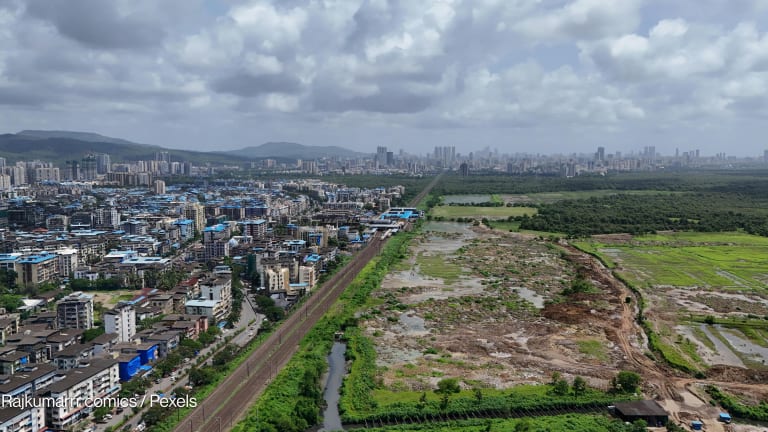
    Urbanization is causing unprecedented and rapid change of ecological landscapes, social values and economic relations. Cities, in particular smaller cities with populations under 500,000, are frequently expanding into hazardous areas including coasts, deltas, floodplains, and river basins. It is clear that settling people in such places can be lethal and expensive.

    This article is free to read - just register or sign in

    Access news, newsletters, events and more.

    Join usSign in
    • Environment & Natural Resources
    • Urban Development
    • Infrastructure
    • South Asia
    • Central Asia
    • East Asia and Pacific
    Printing articles to share with others is a breach of our terms and conditions and copyright policy. Please use the sharing options on the left side of the article. Devex Pro members may share up to 10 articles per month using the Pro share tool ( ).
    The views in this opinion piece do not necessarily reflect Devex's editorial views.

    About the author

    • Jim Jarvie

      Jim Jarvie

      Jim Jarvie is Mercy Corps’ network director transitioning the Asian Cities Climate Change Resilience Network to a practitioner-based membership platform. He previously led development of Mercy Corps’ global programs in climate change and environment, focusing on Southeast Asia. He is a biologist with 20 years of experience, previously working on natural resource management, conservation and conflict.

    Search for articles

    Related Stories

    Opinion: Development FinanceRelated Stories - Inclusive finance is the lifeline we keep ignoring

    Inclusive finance is the lifeline we keep ignoring

    Sponsored by Vodafone FoundationRelated Stories - How to adapt digital development solutions to a +1.5°C world

    How to adapt digital development solutions to a +1.5°C world

    Sponsored by CropLife InternationalRelated Stories - Opinion: Can a pro-innovation agrifood vision meet climate challenges?

    Opinion: Can a pro-innovation agrifood vision meet climate challenges?

    Sponsored by Takeda Pharmaceutical Company LimitedRelated Stories - Opinion: Health at the crossroads — a call to action for global leaders

    Opinion: Health at the crossroads — a call to action for global leaders

    Most Read

    • 1
      Invest in diagnostics to win the health fight
    • 2
      Exclusive: Former Iraqi president picked to lead UN Refugee Agency
    • 3
      Financing Asia’s transformation: How to plug the trillion-dollar gap
    • 4
      Future forward: Closing infrastructure gaps for climate innovation
    • 5
      Opinion: A blueprint for country ownership and transition
    • News
    • Jobs
    • Funding
    • Talent
    • Events

    Devex is the media platform for the global development community.

    A social enterprise, we connect and inform over 1.3 million development, health, humanitarian, and sustainability professionals through news, business intelligence, and funding & career opportunities so you can do more good for more people. We invite you to join us.

    • About us
    • Membership
    • Newsletters
    • Advertising partnerships
    • Devex Talent Solutions
    • Post a job
    • Careers at Devex
    • Contact us
    © Copyright 2000 - 2025 Devex|User Agreement|Privacy Statement