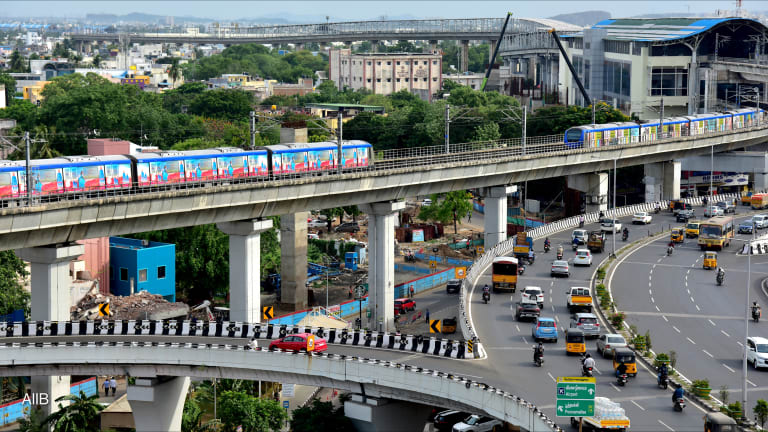


During the World Bank-IMF Spring Meetings, some civil society organizations called for the World Bank Group to stop supporting client countries with public-private partnerships. I would like to explain how we are involved in PPPs and why they can help countries make important advances toward the Sustainable Development Goals.
But first, some context: The World Bank Group — and our counterpart multilateral development banks — are fully committed to helping countries achieve the SDGs. The scale and ambition of these goals require new solutions, greater collaboration, and a global partnership that includes public authorities, civil society, communities, and the private sector — as a source of financing, innovation, and expertise.
Government budgets and aid alone cannot ensure that everyone gets access to sanitation, water, and electricity. To accomplish this, we must maximize finance for development from all possible sources, including the private sector, which can offer effective development solutions, not just financing.
While governments are in the driver’s seat in determining where they could use more assistance and how to go about it, we can help them build capacity to work with new partners and ensure that these efforts help their people most in need.
There are many ways that governments crowdsource ingenuity, management capacity, and financing from private firms, with PPPs being just one approach they can use. Fundamentally, PPPs represent a procurement technique that can be useful in some circumstances.
We think we can do more good by working with partners to ensure that well-designed PPPs help more people get better access to services.
In Senegal recently, a competitive auction under the group’s Scaling Solar program saw a winning bid of just 3.8 euro cents per kilowatt-hour. PPP will provide one of the cheapest sources of electricity in sub-Saharan Africa, showing how the energy price can be lowered significantly by taking a new approach. This is good for electricity consumers, good for the environment, and good for Senegal’s reputation as an investment destination. And it is an important step toward meeting the SDGs.
PPPs can involve the private sector in making public services more sustainable, as well as more efficient and cost-effective. In India’s Odisha state, an IFC-supported PPP has upgraded street lighting while cutting energy consumption by up to 80 percent, a win both for the environment and strapped municipal budgets. In the West Bank, an IFC-structured PPP has transformed how the government deals with solid waste — eliminating burning and dumping, closing 19 unsanitary landfills, and recovering materials for recycling. This project will reduce greenhouse gas emissions by over 13,000 tons by 2021 and provide 840,000 people with better services in a cleaner environment.
However, PPP procurement needs to be well-prepared and well-executed, and recent auditor reports from the European Commission and the United Kingdom have illustrated problems in some cases. For example, some lacked proper scrutiny about whether a PPP or public procurement was the better choice. There have been issues in structuring and managing some contracts.
For our part, the World Bank Group can distill valuable lessons and best practices quickly, then share this knowledge, enabling our clients to learn from each other. Working with development partners, we have also developed tools to help governments, citizens, CSOs, and investors make informed decisions about infrastructure programs in general, including PPPs.
Last week we issued the Procuring Infrastructure PPPs 2018 report, covering 135 countries. It acknowledges gaps between best practice and current reality. Take disclosure, for example, disclosing the infrastructure pipeline — the basis for choosing to use PPP procurement, the PPP contract, and contract performance — builds trust and accountability. Yet only 14 percent of countries disclose contract performance. The World Bank Group is helping change that: In just the past few months, we have worked with Ghana, Honduras, and Nigeria to build their PPP disclosure portals.
Another concern is the fiscal impact of PPPs, including contingent liabilities. To help on this front, we have worked with the International Monetary Fund to develop the PPP Fiscal Risk Assessment Model as an important decision-making tool.
Government capacity is also a key issue. Together with partners, we have developed a rigorous PPP certification course, which over 1,100 people have passed since its release 18 months ago. And we have collaborated on a project preparation platform, Source, to help collate information on over 180 potential infrastructure projects in 44 countries.
The World Bank Group promotes project standardization wherever feasible. This can make a big difference — simple checklists dramatically reduced mistakes in the airline industry from the 1980s onwards. There is scope to take a similar approach with infrastructure project preparation.
Much more can be done. Governance and capacity challenges affect all public services, whether delivered publicly or with private sector involvement. This is not about who provides a service, but who can best reach people with quality, affordable services. By working together — governments, citizens, the development community, CSOs, the private sector, and lenders — we can accelerate expansion and improvement in services. Again, here the aim is that countries achieve the SDGs for 2030. Time is short and the needs are great.
As Senegal’s solar plant comes online, a mother will switch on a light to help her daughter with homework — with a solar PPP providing the cheapest electricity in the country. These efforts have a real impact in improving lives.
About the author

Laurence Carter
Laurence Carter is the senior director for infrastructure, public-private partnerships, and guarantees at the World Bank Group. The IPG Group advises on the strategic direction and goals for the WBG on PPPs, supports coordination across the WBG, promotes partnerships and facilitates global knowledge about PPPs.