


NEW YORK — The World Food Programme again revised its estimates for rising food insecurity last week, announcing that 10 million additional children may face acute malnutrition this year because of the coronavirus pandemic.
Children under 5 living in countries with already prevalent rates of malnutrition — including Bangladesh, Ethiopia, Yemen, and the Democratic Republic of the Congo — are most vulnerable, according to Lauren Landis, director of nutrition at WFP.
WFP chief warns of 'hunger pandemic' as COVID-19 threatens food security
The number of people experiencing acute food insecurity could double due to the coronavirus, according to a report from the Global Network Against Food Crises.
The rise would be equivalent to a 20% increase in malnutrition, but the numbers are still “quite conservative,” Landis said.
“What we are really seeing is that the crisis has not played out fully in many of the countries we are most concerned about. We cannot claim we know what is going to happen in each country. The other thing I'd like to really emphasize is that food insecurity is just a piece of the puzzle, right?” Landis said.
Devex spoke with Landis about how WFP is adapting its messaging and operations to meet the reality of the ongoing crisis.
This conversation has been edited for length and clarity.
How is the pandemic challenging your operations and the way that you're trying to reach families with young children at risk of malnutrition?
We're having to take a number of mechanisms to change the way we do work. Because of COVID-19, kids are out of school. But a lot of those kids — and it doesn't even matter what country you're talking about — a lot of those kids depend on that [school] meal. We’ve had to change our practices to see if we can offer take-home rations, for example, or find another way through community groups.
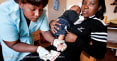
We also want to try to find ways to make sure that a mother is not bringing several children to a health visit when it is not necessary. We are working with mobile clinics and getting mothers educated on how to look for signs of malnourishment so that we are not focused on a center.
And then one of the other things we are doing is collecting a lot of data. We really need to better understand the impact of COVID in different environments. And that way, we can better design our programs for now and in the future.
What is the strategy behind discouraging mothers from coming to health clinics?
We really want to promote social distancing, and it is hard when you have a lot of kids to really make sure that they are coming to the centers and they have a safe visit. We are seeing if there are ways to try to reach out more to communities and seek out malnourished children, so a mother does not have to make a long trip in to the health center.
It sounds like a small thing, but it is one of the things that we could do to most help the situation. What we are saying is: How do we make that process different? How can we make sure that we can decrease the possible spread of disease? And one of them is: Let’s see if we can catch things so a mother doesn’t have to go to the clinic and bring her kids.
This seems to contradict a lot of public health messaging of seeking out care in health centers. How much of a shift in strategy does this require for WFP?
We have been working so hard to get mothers to come to clinics and to bring their children. And now we are saying, “Maybe you can take MUAC [mid-upper arm circumference] tape,” maybe a mother could be trained through better messaging to put the tape around the kid’s arm and measure it, and only in extreme situations does she bring a kid in. We are also looking at possible innovations — maybe even digital — that could be low touch.
“We really need to better understand the impact of COVID in different environments. And that way, we can better design our programs for now and in the future.”
— Lauren Landis, director of nutrition, WFPNormally, if you have been to one of these clinics, there are a lot of screaming babies as they get weighed and measured and are really handled to death. At this point, we don’t want to do that much touching, so what are the available innovations that we use to make the correct determination on a child’s health without having to do all of that weighing and measuring? We are working with the entire nutrition community, UNICEF and other organizations, to really think through this.
Do you consider this a long-term change in programming direction for WFP?
We are talking about a marathon, not a sprint, and what we are realizing very clearly is that this may be with us for a really long time. We may really need to rethink how we do nutrition programming in the field to better figure out access to beneficiaries. This is going to take time. There is no solution overnight.
What are the biggest challenges with continuing this work during the pandemic?
The biggest challenge is that nutrition is not well funded. We already have a shortfall. We know when we add COVID, it is going to get worse, so we are most concerned about countries where the malnutrition numbers are already high.
It is really important to stress these are preliminary projections and we are really cognizant this is only one piece of the puzzle. We are working with other agencies and a variety of organizations to look at the other pieces of the puzzle and fit them together to get a better model of the full picture. I believe when we get the fuller picture together, it is going to be even bigger than what we are talking about.
Visit our dedicated COVID-19 page for news, job opportunities, and funding insights.

About the author

Amy Liebermanamylieberman
Amy Lieberman is the U.N. Correspondent for Devex. She covers the United Nations and reports on global development and politics. Amy previously worked as a freelance reporter, covering the environment, human rights, immigration, and health across the U.S. and in more than 10 countries, including Colombia, Mexico, Nepal, and Cambodia. Her coverage has appeared in the Guardian, the Atlantic, Slate, and the Los Angeles Times. A native New Yorker, Amy received her master’s degree in politics and government from Columbia’s School of Journalism.
Search for articles


Most Read
- 1
- 2
- 3
- 4
- 5