
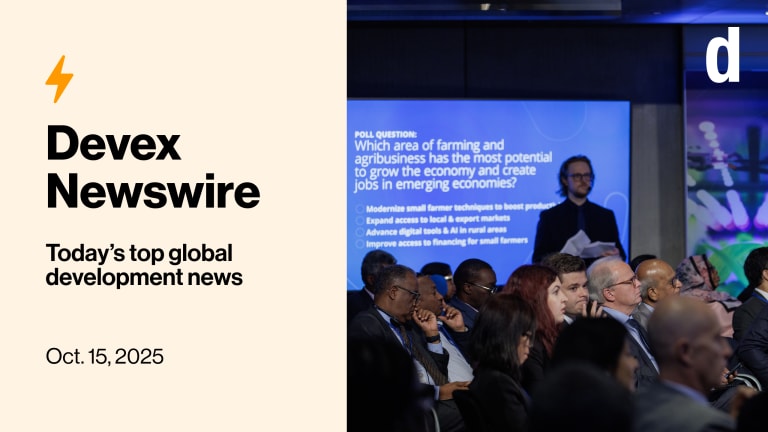
Wednesday, Oct. 15, 2025 <div id="wfpunicef" style="border-top: 3px dotted #ff9900; padding-top: 10px;"><h2>WFP, UNICEF eye integrated supply chain for malnutrition treatment</h2></div> By Elissa Miolene The World Food Programme and UNICEF are exploring new ways to streamline their supply chains, according to the WFP’s Valerie Newsom Guarnieri — including by integrating their procurement and delivery of ready-to-use therapeutic foods. “How do we ensure collective, coordinated action in support of those most in need?” asked Guarnieri, speaking from the stage of the InterAction Forum on Wednesday. “Does that involve a different way of designing and implementing our programs?” Today, the two organizations operate different assembly lines for those products, with WFP largely procuring treatments for moderate acute malnutrition and prevention, and UNICEF focusing on products that treat severe wasting, which the agency defines as the “most visible and lethal” type of malnutrition. Increasingly, the two agencies have looked toward linking their efforts, including through Joint Action to Stop Wasting, a partnership that was launched earlier this year. Guarnieri spoke of taking that collaboration one step further: with a single, united delivery platform — along with unbranded products up to the point of distribution — Guarnieri said such materials would not just move more efficiently, but reduce costs. “This is going to require that we work together in a different way at the clinic level, but it's also going to require that we streamline our supply,” she added. “That’s why the integrated supply chain is one of the aspects that we’re looking at.” UNICEF did not respond to a request for comment in time for publication. <div id="winner" style="border-top: 3px dotted #ff9900; padding-top: 10px;"><h2>And the winners are …</h2></div> By Elissa Miolene Seema Jilani and Mithqal Abutaha — two medical doctors at work in Gaza — have been awarded InterAction’s annual humanitarian award, an annual prize that recognizes outstanding professionals in the humanitarian sector. Jilani, a pediatrician with Texas Children’s Hospital, has spent the last two decades responding to crises in Gaza and the West Bank. Since the start of the two-year war, Jilani has been providing medical care to children through the International Network for Aid Relief and Assistance, often supporting child amputees, as Gaza is now home to the highest number of such children per capita than anywhere else in the world. Abutaha is a Gaza-based program manager at Project HOPE, a Washington, D.C.-based aid organization that has reached 276,000 people in Gaza during the same time period. Project HOPE has delivered more than 10 tons of medicines, medical supplies, hygiene kits, and other aid into Gaza since the war began, operating health clinics in both Deir al-Balah and Khan Younis. At InterAction’s annual forum in Washington, Save the Children’s head, Janti Soeripto, also named the award’s runner-ups: Marie Biotteau, a nutrition expert at the International Rescue Committee; Farah Naz Lucky, who took over the entire USAID portfolio focused on Rohingya refugees when the agency collapsed; and Mohammed Idriss, the executive director of Alight Sudan. <div id="ngoleaders" style="border-top: 3px dotted #ff9900; padding-top: 10px;"><h2>NGO leaders confront an unclear future — and a needed shift</h2></div> By Elissa Miolene Earlier this year, InterAction’s President and CEO Tom Hart didn’t know if his organization would be hosting its annual forum in the fall. But on a stage near the White House on Wednesday, Hart addressed some 200 NGO reps — stressing how, after USAID’s collapse, the sector’s long-yearned-for transformation was more important than ever. “Even though there are questions about how and with whom [foreign aid] will be done, we’ve made sure there’s been fuel in the engine so we can fight another day for the mission we all support,” Hart said. He added that his crystal ball wasn’t clear — but what was, he said, was the direction the sector needed to take. “It wouldn't be the right thing to simply try to recreate what we had,” Hart said. “We need to do less defending of what was, and more doing what we know needs to happen.” Hart outlined three areas where he felt the sector should accelerate its efforts: localization, transition, and rebuilding support. Hart nodded to the fact that for years, the aid sector had been inching toward shifting dollars and power to local groups — but that real progress on localization wasn’t happening fast enough. He then spoke about the need to prioritize transitioning organizational work to government responsibility and ensuring that handover is embedded into programmatic DNA. “Aid dependency is real,” said Hart. “It’s perfectly rational for a finance minister to say, ‘Oh, if you’re going to cover this, I’m going to take my scarce resource and cover that. ’” His last point — rebuilding support — was echoed over and over again throughout the morning. For the last 10 months, the criticism of foreign aid seems to have peaked, with some of the most powerful American politicians lamenting the sector for alleged waste, fraud, and abuse. Many in the United States, Hart mentioned, believe a quarter of the country’s budget goes toward foreign assistance. And when asked how much the U.S. should spend on aid, most say around 10% — 10 times the actual amount. We’re at a massive pivot moment, a massive transition. And things are not clear,” said Hart. “But what’s really clear is that it wouldn’t be the right thing simply to try to recreate what we had.” Tuesday, Oct. 14, 2025 <div id="debtdemands" style="border-top: 3px dotted #ff9900; padding-top: 10px;"><h2>Debt demands</h2></div> By Adva Saldinger A group of more than 160 civil society organizations called out the Group of 20 for a “lack of demonstrable progress” on debt during South Africa’s presidency of the forum for the world’s leading economies. “South Africa’s leadership in incorporating debt sustainability as one of its priorities has the potential to catalyse meaningful reform in global debt systems, addressing immediate crises while paving the way for systemic changes that benefit Africa and the developing world,” they wrote in a letter to the G20 leadership. “However, so far nothing tangible let alone ambitious has been achieved. We fear that South Africa runs the risk of failing to deliver meaningfully on this priority.” While there has been some progress under the G20 Common Framework for debt relief, the current mechanisms to restructure debt are too slow, offer too little relief, and fail to equally share responsibility between public and private creditors, they wrote. The international system is also not addressing the high cost of financing and increasing capital flows, which could help countries deal with the impacts of debt distress, they added. The letter pushed South Africa to take a stronger position on debt. South Africa is reportedly trying to release a debt declaration this week, if it can get other G20 members to agree. The civil society organizations did make a number of specific recommendations, including calling for a new United Nations framework convention on sovereign debt to build a new debt architecture, “radical reform” to existing debt structuring processes so they offer better, faster relief. They also called for G20 finance ministers to issue a declaration that supports creating an African Credit Rating Agency, an international public global debt registry, and support the establishment of a borrowers' club so debtor countries can share information and improve their negotiation positions. The Global Sovereign Debt Roundtable, which brings together public and private creditors with borrowing countries to tackle debt issues, meets on Wednesday. <div id="efficiencyupdate" style="border-top: 3px dotted #ff9900; padding-top: 10px;"><h2>Efficiency update</h2></div> By Adva Saldinger On Tuesday, World Bank President Ajay Banga made clear there is one thing he particularly despises: acronyms. He joked that there “must be a VP of acronyms somewhere in the building” and that he’d like to do away with them. Maybe that will be the next target of his efforts to streamline the bank and make it more efficient. So, where do those efforts to improve efficiency stand? Here is an update from Banga: • The time from a project being discussed to board approval is now down to an average of just over 12 months, from 19 months, after shifting to risk-based assessments rather than a one-size-fits-all approach. He said he hopes to get that a bit lower, but the bank has to find the right balance of projects it can approve in as little as 30 days and more complex projects, such as hydroelectric dams, that need significant due diligence and risk assessments and should take years to approve. • The bank will have a single country manager across all its operations in every country by the end of this fiscal year — providing a more unified presence that makes country-level engagement easier. • The bank’s merging of its operations, including finance and its knowledge business, is also aimed at creating more efficiency. On the knowledge side, he wants the bank to get better at rapidly replicating what works — what he called “stealing shamelessly.” • The bank is also getting better at working with MDBs and trying to co-finance projects more effectively and easily for borrowers who have often had to go through separate approval processes from different MDBs for a single project. The World Bank is working to sign agreements where they agree to use one another's due diligence or underwriting, or environmental and social standards, so borrowers only have to go through a single process. <div id="rebuildinggaza" style="border-top: 3px dotted #ff9900; padding-top: 10px;"><h2>Rebuilding Gaza — or redrawing it?</h2></div> By Elissa Miolene Last week, President Donald Trump unveiled a 20-part plan for Gaza — one that demanded an end to the two-year war, the release of Israeli hostages, and a suspension of military operations across the territory. The plan also included a proposal to “redevelop,” “rebuild,” and “energize” Gaza through a “Trump economic development plan.” Days later, that plan was agreed to by both Israel and Hamas. And at an event hosted at the World Bank on Tuesday, it prompted Nur Arafeh, a fellow at the Carnegie Endowment’s Middle East Center, to ask: Is Gaza poised to become the next experiment in “disaster capitalism”? “The concept basically captures how a disaster — whether it’s caused by a war, revolution, or ecological catastrophe — creates an environment for governments or other political authorities to dispossess and disempower communities,” said Arafeh, who noted the term was first coined by journalist Naomi Klein in 2007. “While doing so, the disaster provides opportunities for big businesses to profit from reconstruction funds, and to access unavailable resources, such as land and state-owned sectors of the economy — all this happens while citizens are distracted.” Arafeh said that many of the post-war plans for Gaza contained “the seeds of disaster capitalism,” including those developed by the governments of the United States, Israel, and two American think tanks. All four plans, Arafeh said, establish governance structures that incentivize land possession, noting that the proposal that inspired President Trump’s vision for a "Riviera of the Middle East” allows investors to purchase an “equity stake” in Gaza for 50 years. “Accumulation by dispossession is the process whereby reconstruction efforts become vehicles for appropriating public resources, seizing land, and transferring wealth from the dispossessed community to private capital,” she added. “We’re seeing this in the plans to recreate Gaza as the riviera of the Middle East, as a tech hub, or as a crucial space in the India, Middle East, Europe economic corridor.” <div id="promiseai" style="border-top: 3px dotted #ff9900; padding-top: 10px;"><h2>The promise and peril of AI</h2></div> By Elissa Miolene On Tuesday morning, the World Bank and Google announced they were teaming up to power the latest artificial intelligence venture — one that would accelerate the uptake of digital public infrastructure, such as digital payment and identification, across the world. It was yet another example of how AI is infiltrating every sector, including global development. But just up the street from the World Bank, several were voicing the need for caution, even as artificial intelligence’s footprint continues to expand. “[Governments are being] bombarded with pitches from private companies, who say that AI can solve all of their problems,” said Gabriel Demombynes, manager of the World Bank’s Human Capital Project, which focuses on helping countries invest in their citizens. “You don’t need to worry about training health workers, because AI can do everything that a doctor or health worker can do. You don’t need to worry about training your teachers, because you can just give them an AI tutor,” said Demombynes, speaking at a panel at the Center for Global Development. “It’s extremely difficult for those officials to judge what’s hype and what’s reality — and there’s a real danger that they’re going to be sucked up into the hype, and go with applications that don’t actually deliver.” One anecdote to that problem is evaluation, explained Temina Madon, the chief executive officer of the Agency Fund, a San Francisco-based philanthropic group. Madon highlighted how organizations seeking to use AI in their work need to also evaluate AI-infused projects across four levers: the model, the product, the user, and the impact. When looking at the model, Madon said, that’s asking whether an AI tool can reliably perform its task; when looking at the user, she added, that’s assessing whether the tool actually changes how its people think, feel, and act. That’s complicated, panelists added, and a different take on traditional randomized control trials, or other types of evaluation methods often used by development practitioners. “I think that a lot of the impact that these tools will have is not actually just based solely off of the technical reliability of the tool,” said Rebecca Sharp, the chief executive officer of global advisory firm IDinsight. “It is a lot about the user experience, and about the choice architecture, and design frameworks around how people interact with this.” Sharp said that at the United Nations General Assembly last month, she spoke with an India-based education expert who was excited about the possibilities of AI, but concerned about the side effects — if parents found out girls could receive their lessons from AI tutors at home, she said, they would have no reason to send them into a classroom. “The real-world effects are extremely nuanced,” Sharp said.


WFP, UNICEF eye integrated supply chain for malnutrition treatment
By Elissa Miolene
The World Food Programme and UNICEF are exploring new ways to streamline their supply chains, according to the WFP’s Valerie Newsom Guarnieri — including by integrating their procurement and delivery of ready-to-use therapeutic foods.
Printing articles to share with others is a breach of our terms and conditions and copyright policy. Please use the sharing options on the left side of the article. Devex Pro members may share up to 10 articles per month using the Pro share tool ( ).
About the author

Devex Editor
Thanks a lot for your interest in Devex News. To share news and views, story ideas and press releases, please email editor@devex.com. We look forward to hearing from you.
Search for articles


Most Read
- 1
- 2
- 3
- 4
- 5