
3 ways AI can support drug innovation and global research equity


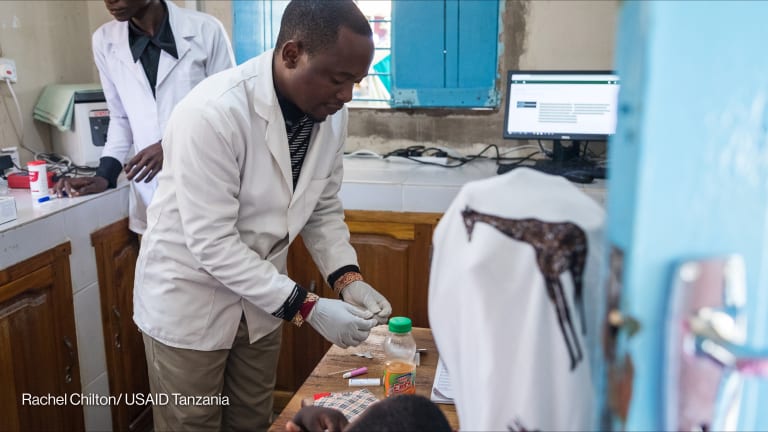
If artificial intelligence brings the promise of accelerating innovation in science, how can we harness its potential to advance the malaria elimination agenda? Momentum has stalled in the fight against one of the world’s deadliest diseases. And with global funding getting tighter, drug resistance on the rise, and the unpredictability of climate change, this perfect storm of threats could undo decades of progress.
To ensure we, as a global health community, can weather this storm and emerge better positioned to deliver the knockout punch to malaria, we must accelerate efforts to advance the next generation of interventions: longer-acting prevention medicines, single-dose treatments with higher barriers to resistance, and novel transmission-blocking technologies. Moreover, these innovations must be cocreated with researchers in endemic countries, whose expertise can ensure we deliver affordable, context-appropriate solutions.
With the perfect storm brewing, AI can be the difference maker — helping us identify future big bets in drug discovery, strengthening collaboration, and building a more inclusive global health system. And we don’t have to look far into the future to see this potential unfolding; Medicines for Malaria Venture, or MMV, is already forging partnerships and cocreating AI solutions that are turning this promise into reality. Here are three ways AI can bring us closer to a malaria-free future.
1. Accelerating the discovery of next-generation medicines
Drug discovery traditionally takes time, is complex, and costly. From identifying a promising compound to putting it in the hands of patients as a medicine, the process can take up to 20 years.
AI has the potential to transform the drug discovery process by rapidly scanning vast libraries of virtual compounds against target profiles, predicting how they will interact with parasites, and even anticipating where resistance might develop. This could have the potential to shorten timelines and ultimately lower overall costs, allowing researchers to focus on the most promising candidates.
MMV’s Malaria Inhibitor Prediction, or MAIP, platform is doing just that. The interface uses machine learning to predict whether a virtual molecule could have antimalarial activity and is already helping us prioritize molecules to acquire and screen. Critically, it’s open access on the ChEMBL website and is free to use, providing a new avenue for our organization to connect with partners interested in testing their molecules and ideas.

2. Cocreating innovation with endemic-country researchers
Too often, innovation in malaria research and development, or R&D, has been driven from outside endemic regions, with local expertise brought into drug development late in the process.
AI offers an opportunity to change that dynamic. By developing and applying AI tools together with scientists in malaria-endemic countries, we can draw on their firsthand insights into the reality of drug discovery in these settings, as well as transmission patterns, patient needs, health system realities, and much more, with AI solutions further advanced in the value chain.
Through its partnership with deepmirror, MMV is already cocreating the Drug Design for Global Health, or dd4gh, platform with researchers from around the world, aiming to accelerate the identification and selection of promising compounds for potential development into medicines. The platform is due to launch in March 2026 and is being molded with feedback from all users, including a workshop in Geneva involving 45 scientists, and another in Accra, Ghana, gathering 30 scientists from seven African countries.
3. Turning complex data into actionable strategies
The antimalarial toolbox already includes powerful tools such as vector control, vaccines, and chemoprevention, but their true impact depends on deploying them in the right place at the right time. AI can help by analyzing complex datasets — from climate trends to drug resistance patterns and transmission rates — to generate more precise insights.
For national malaria programs, this means stronger evidence to guide where to target resources, which interventions to prioritize, and how to adapt strategies as conditions shift. In fragile and resource-limited settings, that precision can be the difference between progress and deadly resurgence.
AI can also help us understand — from complex clinical data — how individual characteristics such as body weight, age, and sex can affect the absorption, distribution, metabolism, and excretion of drugs, also called pharmacokinetics. Support from the Gates Foundation is enabling MMV and the Swiss Data Science Center, or SDSC, to explore novel machine learning methods on a vast set of clinical data, across a spectrum of subjects and patients.
A multiplier in the antimalarial toolbox
Just as no single intervention will end the fight against malaria, AI is not a silver bullet. But it can be a powerful tool — a multiplier that accelerates innovation, strengthens collaboration, and makes research more inclusive.
With the perfect storm threatening to stall or even reverse progress, the global health community must explore the potential AI offers. By embracing this technology and ensuring endemic-country researchers help shape its application, we can build a more resilient global health system, enhance health security, and progress toward a future where nobody dies from a disease that is entirely preventable and treatable.
Follow MMV for the latest on its partnerships and progress in malaria drug discovery and development.
About the authors

Cristina Donini
Cristina Donini is the executive vice president for research, early development, and modelling at Medicines for Malaria Venture.
Jeremy Burrows
Jeremy Burrows is the vice president and head of drug discovery at Medicines for Malaria Venture.
Benoît Laleu
Benoit Laleu is the director for drug discovery and research drug discovery at Medicines for Malaria Venture.
Search for articles

Most Read
- 1
- 2
- 3
- 4
- 5