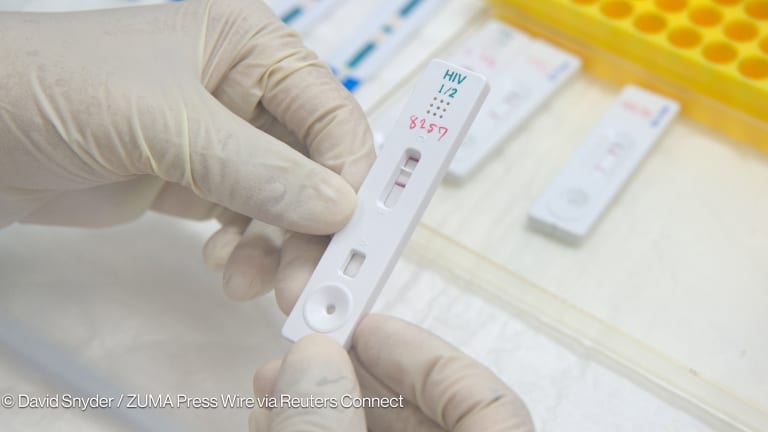


Nearly four years into the war in Ukraine, the geopolitical costs are well-documented — but the epidemiological costs are just beginning to surface. Chief among them is the toll on efforts to end HIV. While much of the world has made progress toward ending HIV, Eastern Europe and Central Asia, or EECA, have been left behind: It remains one of the few regions globally where new HIV infections continue to rise, placing it at the center of the fastest-growing HIV epidemic in the world.
The war alone did not set this trajectory, but it has drastically escalated it, intensifying existing vulnerabilities. By dismantling health care infrastructure and displacing millions of people, it has drawn renewed attention to a region where the HIV epidemic was already accelerating before the conflict began.
This evolution is not the result of a lack of tools or knowledge — effective HIV prevention and treatment exist. Rather, what too often fails are the systems meant to deliver them, constrained by stigma, criminalization, underinvestment, and an absence of sustained community leadership.
Across much of EECA, punitive laws and policies remain pervasive: All 16 countries in the region criminalize sex work; 13 criminalize HIV nondisclosure, exposure, or transmission; and seven criminalize personal possession of small amounts of drugs. These legal barriers are widely acknowledged to drive people most in need “underground” — and further from HIV prevention and treatment services.
To help break this cycle, the Elton John AIDS Foundation and Gilead Sciences created RADIAN in 2019, a long-term partnership that moves away from funding isolated projects and toward changing how HIV responses are built, sustained, and scaled across EECA. By centering the leadership of communities most affected by the regional HIV epidemic, RADIAN has already reached more than 367,000 people with direct services.
A blueprint for systems change
We based RADIAN on a simple premise: Durable progress requires systems change. That means investing in community-led innovation, embedding it within public health systems, and proving that these approaches can work at scale — even in complex and underresourced environments.
Over its first five years, RADIAN has supported partners across EECA to redesign how people access HIV services, shorten the path from diagnosis to treatment, reduce stigma inside institutions, and reach people who are too often excluded from care. RADIAN operates through a deliberate model: deep, place-based investments that demonstrate what effective HIV responses look like in practice, paired with funding that allows partners to respond quickly to emerging needs.
In Almaty, Kazakhstan, this approach led to faster treatment initiation, improved viral suppression, and the integration of community-led solutions into routine public services. One pilot saw 86% of patients with previously unsuppressed viral loads achieve stability after just six months of consistent nurse-led community outreach. Importantly, these results did not remain isolated. Once impact was demonstrated, public and multilateral funders stepped in to sustain and scale what worked.
This approach shows what is possible when local innovation is paired with long-term commitment by investing in communities, proving impact, and embedding successful approaches into systems that endure beyond any single funding cycle.
Responding to displacement across the EU
As the war in Ukraine forced millions of people to flee their homes, European Union countries became critical hosts for displaced populations living with and affected by HIV. While many EU health systems offer universal coverage, displaced people — particularly those without language skills, documentation, or familiarity with local procedures — often face significant barriers to accessing care. RADIAN-supported partners have worked across the EU to adapt HIV services to these realities, focusing on navigation, continuity of care, and integration into existing public systems rather than creating parallel structures.
In Germany, RADIAN is supporting an innovative model led by Deutsche Aidshilfe and 100% Life Germany that demonstrates how modern IT solutions can help displaced Ukrainians navigate unfamiliar health systems. Through digital tools, peer-led navigation, and structured referral pathways, the model enables refugees — including those without German language skills or knowledge of local procedures — to access HIV and other health services more quickly and effectively. This approach illustrates how community-led, technology-enabled solutions can be adapted and scaled in host-country settings responding to displacement.
Elsewhere in the EU, RADIAN partners are working to ensure that HIV prevention and treatment services remain accessible to both displaced populations and local communities, reinforcing health system resilience in the face of rapid demographic change.
Local leaders driving change
Sustainable HIV responses depend on the leadership of people working inside communities and institutions — those who understand where systems break down and how to fix them from the inside.
In Ukraine, community leader Vasyl runs Spectrum Kharkiv, an LGBTQ+ organization providing peer-led HIV testing and support. He has adapted services under wartime conditions to reach people who have been displaced multiple times. By building trust and reducing stigma, his work helps people access HIV services and identify infections that might otherwise go undiagnosed.
A similar effort is underway in Latvia, where changemaker Alex works at Mozaika, a Latvian NGO, to expand access to HIV prevention and preexposure prophylaxis, or PrEP. Through the PrEP Riga project, his outreach and education initiatives help reduce stigma and connect LGBTQ+ communities to essential services in a country with one of the European Union’s highest HIV rates.
This kind of leadership is essential to ensuring that HIV responses remain relevant, inclusive, and capable of adapting to change.
Scaling the model
The experience of RADIAN’s first five years shows that even in the shadow of war, progress in EECA is possible — not through short-term fixes, but through partnerships that prioritize evidence, equity, and sustainability. The challenge now is moving from “possible” to reality.
Ending HIV globally is not a technical challenge — it is a political and financial one. It means investing where the epidemic continues to grow. It means supporting innovation led by communities and enabling systems to change from the inside out.
We have the tools and the knowledge. What we need is the collective will to apply what works consistently, ambitiously, and at scale. Only then can we ensure that a person’s geography no longer determines their right to a healthy life — and end the HIV epidemic for everyone, everywhere.
To learn more about RADIAN and its work, visit radianhiv.org.
About the author

Anne Aslett
Anne Aslett is the global chief executive officer of the Elton John AIDS Foundation and has served the charity in various capacities for over 20 years. She leads the foundation’s mission and activities across the United Kingdom, the United States, Africa, Asia, and Eastern Europe, including grants to programs in over 102 countries. During Anne’s tenure, the foundation has raised more than $650 million, becoming one of the world’s leading AIDS funders and supporting over 3,100 projects to expand access to health care, challenge LGBTQ+ stigma, and help end AIDS.