
Over the past two decades, multilateral investment in health has delivered measurable and historic gains. Deaths from HIV/AIDS have decreased by 70%, malaria by 56%, and child mortality has reduced by 50%, thanks in part to immunization. Yet the very architecture that enabled this progress now faces political headwinds. Funding volatility, institutional skepticism, and rising mistrust have placed global health at the center of a broader crisis in multilateral governance. In a world defined by instability and polarization, institutions once seen as reliable are perceived as distant, opaque, or politically exposed. The question is no longer whether global health works. It is whether it retains the political legitimacy required to endure.
In response, much of the debate has narrowed to financing gaps — who will replace declining aid, which philanthropies will step in, and how to manage abrupt transitions. Financing is undeniably urgent. But funding is not the root problem. Legitimacy is. Global health agreements may be negotiated internationally, but they are implemented, ratified, and financed domestically. National parliaments determine whether global commitments are translated into law, into budget lines, and ultimately into services that reach people. If multilateralism is under strain, the response cannot be confined to donor conferences. It must include political ownership at home.
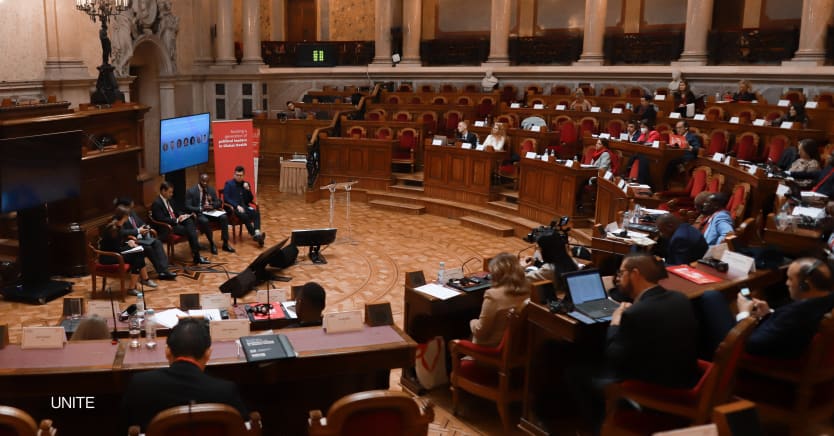
In many countries, parliaments are the cornerstone of representative democracy, and parliamentarians are its driving force. They are consensus builders by necessity, working across party lines to negotiate legislation and budgets. To reach a consensus. To promote trust. Parliamentarians can increasingly outlast governments and hold them to account, at the same time providing a degree of stability when there is turbulence at the top. Most significantly, as representatives of the people, it is parliamentarians who provide the legitimacy link from citizen to state. This makes parliamentarians not peripheral actors in global health governance, but central ones.
At a moment of retreat from multilateral forums, parliamentarians are uniquely positioned to stand up for global health progress. Doing so, however, requires political courage — the willingness to prioritize resilience over short-term political gain and to articulate why global health investment serves national interests.
Global health is no soft issue
As representatives bound by election cycles, parliamentarians understandably face the allure of short-termism and the need to prioritize domestic issues. In this environment, global health has been wrongly framed as a “nice to have.” In reality, pandemics, antimicrobial resistance, and health system fragility are not external issues. They are national security concerns with direct economic consequences. The disconnect between global health negotiations and domestic legislative processes has reinforced the false perception that these decisions occur elsewhere. In reality, their consequences are deeply local.
Just six years ago, the COVID-19 pandemic brought the world to a halt and claimed the lives of over 7 million people, yet the institutions that coordinated the response are being dismissed and dismantled, posing a serious threat in the case of future pandemics. The adoption of the World Health Organization Pandemic Agreement marked an important step toward stronger global coordination, but implementation now depends on domestic legislative action and budgetary decisions.
And, despite appeals to involve parliamentarians in the agreement, they were largely excluded from negotiations and insufficiently engaged throughout the process. Reform is undoubtedly needed in multilateral institutions and participatory processes, but reform should not be confused with retreat. For a start, the engagement gap needs immediate attention if global health is to be rightly recognized as a security issue.
Parliamentarians uniting for global health
There is a narrative that representatives have given up on global health, but action shows this is not so.
In the United Kingdom, parliamentary committees are standing up to aid budget threats, and in recipient countries, parliamentarians are forming alliances to advocate for funding. In 2025, the Global Health Advocacy Incubator, or GHAI, with support from Gavi, the Vaccine Alliance, brought parliamentarians together to sign the historic Istanbul parliamentary call to action to call for immunization funding. The forum is expected to spark national action plans, funding drives, and the creation of parliamentary caucuses dedicated to maintaining vaccination programs.
And just at the start of the month, the U.S. Congress voted to pass a $50 billion foreign affairs budget. While this included deep cuts to global health spending — almost a quarter less compared to 2024 and 2025 — bipartisan negotiations and parliamentary leadership preserved billions of dollars projected to be axed in the president’s “America First health strategy.
These examples provide a powerful reminder —there are parliamentarians speaking up for global health, not only on a national level, but on a regional and global scale in collaboration with health organizations and with each other. As the trend of cuts to global health funding escalates, we can be quick to forget that this is a political choice, not a fiscal inevitability. However, without access to like-minded partners, resources, and the support of expert organizations, the choice to stand up for global health can be an isolating one.
The necessity of collective parliamentary action
Legislators are most effective when they coordinate across borders. Regional and global parliamentary dialogue enables comparative learning, reduces political isolation, and strengthens collective resolve. On March 6th–7th in Manila, lawmakers from multiple regions will convene to address the future of global health financing and legislative accountability. When parliamentarians see peers defending health investments in diverse political contexts, the perceived political risk diminishes. Courage becomes shared rather than solitary. Political ownership becomes easier. Networks, civil society organizations, academia, and institutions that equip parliamentarians with science-based policy tools, comparative evidence, and peer support effectively strengthen their ability to champion the global health agenda while protecting hard-won gains.
Parliamentary engagement in global health cannot remain symbolic. Legislators shape budgets, enact laws, and influence public discourse. Their decisions and unique position to keep governments accountable determine whether international commitments translate into sustained national action. At a moment of uncertainty, defending global health is not an act of charity but an affirmation of shared security and economic stability. The durability of multilateral progress now depends not only on donors, but on representatives willing to drive structural reform at an international level, at the same time as anchoring global health firmly within domestic political systems. This is a time for political courage. It's time to UNITE.
Visit https://globalsummit.unitenetwork.org/2026/ for more information on the upcoming UNITE Global Summit in Manila, the Philippines.
About the authors

Ricardo Baptista Leite
Ricardo is the founder and president of UNITE Parliamentarians Network for Global Health. He is a Portuguese medical doctor, as well as the CEO of HealthAI – The Global Agency for Responsible AI in Health. In 2017, Ricardo founded UNITE, a network of over 500 current and former policymakers from 119 countries. He served as a member of the Portuguese Parliament for four terms and as deputy mayor and city councilor in two different municipalities in Portugal. His academic career spans the fields of policy, global health, and technology.
Dr. John Nkengasong
Dr. John N. Nkengasong is executive director for higher education, collaboratives, and special initiatives at the Mastercard Foundation. An internationally recognized virologist and global health leader, he previously served as U.S. global AIDS coordinator and senior bureau official for global health security and diplomacy, leading efforts to combat HIV/AIDS and strengthen global health systems. As founding director of the Africa Centres for Disease Control and Prevention, he guided the continent’s COVID-19 response. He has authored over 300 scientific papers and received numerous honors, including TIME 100 recognition and the Virchow Prize for Global Health.