Sudan: Warnings of an invisible crisis on the brink of 'mass atrocity'
The U.S. special envoy to Sudan stood before Congress on Wednesday to shed light on Sudan, after one year into the country's civil war.
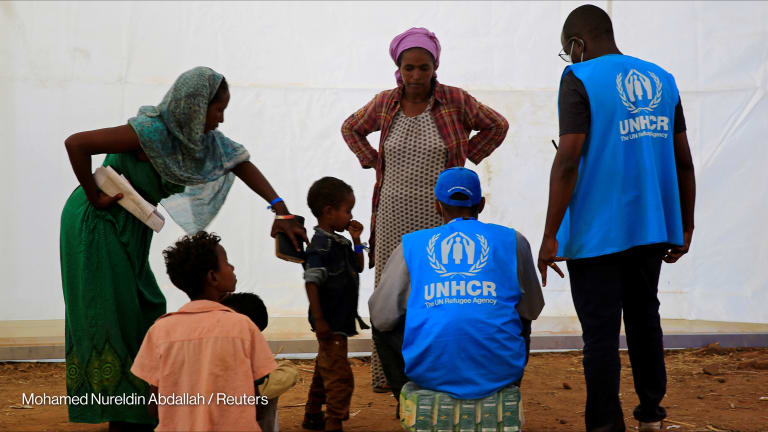
It’s been just over a year since Sudan erupted into conflict, forcing 8 million people from their homes and 5 million people toward famine. It started as an internal power struggle between two rival generals — Mohamed Hamdan Dagalo of the Rapid Support Forces paramilitary group, and Abdel Fattah al-Burhan of the Sudanese Armed Forces. But it has devolved into a complex humanitarian crisis — the fallout of which, according to testimony given on Wednesday to U.S. lawmakers, has remained invisible to the rest of the world. “We don’t have a credible death count. We literally don’t know how many people have died, possibly to a factor of 10 or 15,” Tom Perriello, the U.S. special envoy for Sudan, told a senate hearing on Wednesday. “Because of telecom blackouts, and because of the rampant harassment, abuse and detention of civil society actors, we have not always gotten a complete record.” For an hour-and-a-half, U.S. lawmakers hammered Perriello — who was appointed to his current role at the end of February — with questions on the crisis, from how the U.S. was preparing for an impending “full-scale assault” on the city of El Fasher by the Rapid Support Forces to how weapons were continuing to enter Sudan’s borders despite an ongoing arms embargo. The former, Perriello said, was a work in progress: Humanitarian groups are trying to prepare for that worst-case scenario, yet lack the protection mechanisms and peacekeeping forces from the United Nations or the African Union to properly respond to escalated violence. The latter question is something many have been trying to pin down for months. The United Arab Emirates was accused of supplying weapons, drones, and other arms to the Rapid Support Forces, according to investigations by The New York Times and The Wall Street Journal, but it has denied those allegations. In the months since, both Perriello and Linda Thomas-Greenfield, the U.S. ambassador to the U.N., have said both sides are continuing to receive support from outside players to fuel the fighting. “I found these reports credible,” Perriello told lawmakers on Wednesday, without singling out a particular country. “We are continuing to look into this in terms of our own production of potential sanction packages, as well as communication with regional actors in our efforts to try to compel people to get to peace talks.” Perriello told lawmakers his team had a plan; one that included "raising the costs" on both the warring parties and external players fueling the violence, expanding U.S. sanctions, applying additional pressure to enforce the U.N. arms embargo, and mustering regional political pressure to compel an end to the war. Still, the room pulsed with frustration, exhaustion, and emotion, with nearly every lawmaker lamenting the disconnect between the severity of the crisis and its lack of global visibility. Despite that, senators seemed distracted. A conflicting conference call, U.S. Senator Cory Booker told the special envoy, was pulling lawmakers in and out of the hearing. And though Booker apologized for the distraction, at one point, the senator had one ear to a cell phone and the other on Perriello’s testimony. At others, there was just one lawmaker in the room while they spoke about how little attention the crisis was receiving. In the face of those conflicting demands, Perriello sought to keep the focus on the potentially enormous human cost. “I want to be absolutely clear that the default trajectory is towards famine, and an increasingly factionalized state that brings in regional actors and presents an enormous and unconscionable humanitarian cost,” he said. He added that the lack of media attention toward the crisis — even six months before the war in Gaza took over most headlines — “has made it easier for bad actors inside and outside [Sudan] to get away with atrocities … when the world seems not to be watching.” That includes the blocking of humanitarian aid, which both sides of the conflict are alleged to have done. Toward the end of February, the U.S. State Department reported the Sudanese Armed Forces was prohibiting cross-border humanitarian assistance from Chad. At the same time, the Rapid Support Forces was “looting homes, markets, and humanitarian assistance warehouses in areas under their control.” And with the Rapid Support Forces threatening a looming siege of El Fasher, U.S. Senator Ben Cardin, a Democrat from Maryland, warned lawmakers Sudan was “on the brink of a mass atrocity against non-Arab ethnic groups.” He asked Pierello what the response would be. “How do you plan to galvanize additional humanitarian support for the aid workers trying to mitigate the impending famine?” he said. “How will you support the malign actions of external actors? How will you promote accountability for human rights abuses?” For months, the Senate Foreign Relations Committee has urged the Biden administration to do more to respond to the crisis in Sudan, most recently pushing for the U.S. president to sanction the Rapid Support Forces and its leader for human rights violations. The committee had also been applying pressure on the other chamber of Congress — the Republican-controlled House of Representatives — to pass a national security supplemental bill with $9 billion earmarked for humanitarian crises. That legislation was signed into law last week, the ripple effects of which Pierello said are having “an immediate effect on the ability of USAID [the U.S. Agency for International Development] and PRM [the State Department’s Bureau of Population, Refugees, and Migration] to save lives.” Despite that, Pierello caveated. “While aid is vital, human suffering in Sudan will not stop until this war is over,” he said.
It’s been just over a year since Sudan erupted into conflict, forcing 8 million people from their homes and 5 million people toward famine.
It started as an internal power struggle between two rival generals — Mohamed Hamdan Dagalo of the Rapid Support Forces paramilitary group, and Abdel Fattah al-Burhan of the Sudanese Armed Forces. But it has devolved into a complex humanitarian crisis — the fallout of which, according to testimony given on Wednesday to U.S. lawmakers, has remained invisible to the rest of the world.
“We don’t have a credible death count. We literally don’t know how many people have died, possibly to a factor of 10 or 15,” Tom Perriello, the U.S. special envoy for Sudan, told a senate hearing on Wednesday. “Because of telecom blackouts, and because of the rampant harassment, abuse and detention of civil society actors, we have not always gotten a complete record.”
This article is free to read - just register or sign in
Access news, newsletters, events and more.
Join usSign inPrinting articles to share with others is a breach of our terms and conditions and copyright policy. Please use the sharing options on the left side of the article. Devex Pro members may share up to 10 articles per month using the Pro share tool ( ).
Elissa Miolene covers U.S. foreign assistance from Washington, D.C. She previously covered education at The San Jose Mercury News, and has written for The Wall Street Journal, the San Francisco Chronicle, and other news outlets across the world. Before shifting to journalism, Elissa led communications for aid agencies in the United States, East Africa, and South Asia.