




Ten years ago, I left Southern California to return to the Philippines with the intention of “living the life of Riley” – a U.S. dollar-earning retiree lying in a hammock by the sea, with nary a care in the world.
But here I am today, working with a nongovernmental organization that is immersed in a world defined by such buzzwords as poverty alleviation, renewable energy and global warming, capability building and sustainability, gender equity and women empowerment. Instead of whiling away the time contemplating nothing more serious than the next fresh-fish recipe, I now have to worry about submitting deliverables on time, attending seminars and workshops and conferences, and raising funds – while writing yet another proposal.
My official title is president, but I am also known – only half in jest – as the CBO, or chief begging officer. The perks, however, are unbeatable: no high heels and stockings and suits, and no mobile phones disrupting village meetings.
Rural development work is unlike any other in that it requires a special kind of passion, of commitment. It is a job that is at once challenging and humbling, maddeningly frustrating and rewarding. And it definitely is not for the upward-mobile. As I constantly remind my mostly college-educated staff, in this kind of work one need never worry about flunking a lifestyle check because the end result is invariably “unexplained poverty.” (Or, as a sign surreptitiously scrawled on our office bulletin board declares, “Poverty alleviation is for them; poverty-creation is for us!”)
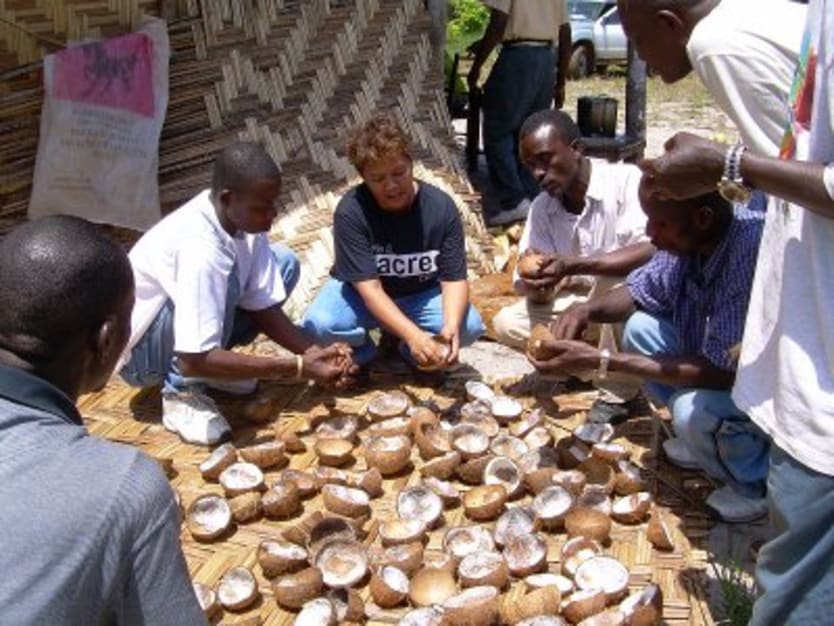
But what a way to rediscover one’s country of birth! Since my job takes me to remote communities without electricity – where our NGO works with villagers on how to make a living by adding value to coconut waste byproducts, through the use of renewable energy – I have the opportunity to see a country very different from how it is depicted in the tourist brochures, or in the hard-hitting editorial pages of major Philippine newspapers. It is also by working with the poor that I have come to appreciate all over again the innate goodness of the Filipinos, their resourcefulness and resiliency, and, above all, their cheerfulness.
There are “lessons learned” galore.
The first is that we in the so-called civil society do not have all the answers when it comes to rural development. You want to build a better mousetrap or, in our particular case, a better twining (rope-making) instrument? Don’t bother searching the Web for the desired configuration; let the local workers themselves figure it out and watch productivity triple from their improved design. And if you want three successive rainy days to help grass grow on the coconut fiber nets installed along a heavily eroded hillside, you don’t think cloud-seeding; you dip into the petty cash fund to pay for the fresh blood of a piglet that is sprinkled by the village “wise man” on the site.
The second lesson is that communications need not be by the book or by the ubiquitous manual, because rural folk often feel intimidated, and reluctant to express themselves, in the confines of a formal meeting room. As one village elder put it, when asked where she had been, “To yet another wir-as wir-as” – her take on meetings where resolutions made and passed are presaged by “Whereas…”
Then there is the yawning gap between the capabilities of a community-based start-up enterprise and the voluminous demands (at rock-bottom prices) of the export market – a leading factor in the demise of many rural livelihood projects. While there is a smaller domestic market that pays better prices, it is often dominated by government-funded projects that take months, if not years, to pay for goods and services. In addition, the cost of borrowing money, even from so-called government financing institutions, is simply beyond the capability of small community-based enterprises.
The most important lesson learned is never to take for granted the aspirations of the poor, especially the women. For example, when we first went into one village to introduce the coconut fiber-processing program, the plan was to have women carry out the twining and weaving from their homes. After all, isn’t it the dream of any housewife to earn money without having to commute to work? Well, not exactly. A month after coming up with this brilliant, home-based idea, we noted a sharp decline in productivity and quality. Soon, a group of women requested that a common work shed be built next to the main coir processing plant just outside the village proper. The leader explained how the women were too distracted working from home, what with children and chores, adding, “And we want to be able to leave our homes in the morning, all dressed and powdered up – and when asked by neighbors where we’re going, we tell them (sticking her chin out), ‘To the office!’” Another housewife piped in, while suppressing a giggle, “And we relish the thought that it’s our husbands who are left at home taking care of the kids and doing the cooking!”
Yes, we now have a new work shed – affectionately called “the office” – where more than a dozen women weave nets and doormats. Production has more than doubled, with the reject rate virtually at zero. Oh, and we also have men bringing in lunch for their working wives.
Indeed, this new-found “women power” has catapulted one of our workers to the top job as the first-ever female president of a small coconut farmers’ cooperative. Many more of our women workers have also earned “credit-worthiness” ratings from local banks and lending institutions, and can now make purchases on credit at village stores.
The rewards of this job are the intangibles. What other job is there that makes one cry with joy when the first cocofiber net rolls off the loom? Or when lush, green grass is seen sprouting on nets covering what was once a barren hillside? How does one describe the feeling to see a 92-year-old grandmother and a paraplegic father of four proudly showing off their skills (and earning some money) in turning the wheel of the twiner? What other job is there where a first-ever purchase order is passed around and kissed – and blessed in a Thanksgiving mass?
A community development worker is always left to ponder if one’s “message” ever gets across. To know what I mean, try explaining the wisdom of environmental conservation to a group of fishermen who grumble, “The sea turtle’s got it made; it has its own foundation!”
But then again, salvation does come, albeit in the most unexpected way: I was showing a videotape of a previous visit to a fishing village that featured scenes of merrymaking during a fiesta celebration, along with scenes of the stunning sunset and sunrise at the beach and mountain ranges. Figuring that no one in the audience would be interested in touristy footage, I fast-forwarded the tape. But someone asked to see it all, and I obliged. As scene upon exquisite scene unfolded on the screen, I could hear gasps; I turned to see the awestruck faces. A voice, almost a whisper, broke the silence. “How beautiful is our village!” Another remarked, “It looks better than a postcard!” adding, “We work all the time, we hardly ever notice.” Finally, with conviction, someone declared, “That is why we must take good care of our seas and forests!”
After more than 10 years (and counting), I still ask myself, at the end of each day, whether or not what I’m doing is truly making a difference in the lives of others. I know I am not alone with these thoughts, and I share these excerpts from a journal written by a priest who has spent most of his life working with “the poor and the obscure” in the Philippines:
Located in its hidden landscape, you are nobody. You won’t be projected in media; no one out there is bombarded with images of your noble commitments. You have disappeared into this setting that allows you to blend into a nondescript space that exists only in the people’s and your own consciousness. … What am I doing here? Crossing a flooded river or getting lost in the forest also has led me to tell myself: I don’t have to be here…”
I do not profess to have found the answers to poverty alleviation, and I don’t think I ever will. Of one thing I am certain, however: Mother Teresa was right in saying, “Helping the poor does not eliminate poverty, but the act of giving, of helping, forever changes the life of the giver.”
Read more development aid news online, and subscribe to The Development Newswire to receive top international development headlines from the world’s leading donors, news sources and opinion leaders — emailed to you FREE every business day.
About the author

Perla Manapol
Perla L. Manapol is the president of Sustainable Rural Enterprise, an NGO based on the main campus of Aklan State University in the Philippines. She is a former U.S. foreign service officer and a resident of Southern California. Her current activities are focused on “clean and green” cooking mechanisms, and she blogs at http://coconutsgalore.blogspot.com.
Search for articles


Most Read
- 1
- 2
- 3
- 4
- 5