The untold origins of COP30’s flagship multibillion-dollar forest facility
Built on a World Bank concept from 2009, the new fund channels sovereign and private investments into protecting tropical forests while promising financial returns. Who were the minds behind the idea?
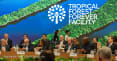
The Tropical Forest Forever Facility launched on Nov. 6, just before the official start of the 30th United Nations Climate Change Conference, COP30, in Belém, Brazil, with an unexpected splash: $5.5 billion in first-day commitments from governments. The scale of pledges for the fund — which will harness investments rather than aid to pay countries to protect their tropical forests — is far short of the ultimate goal of $25 billion, but higher than expected, according to insiders. Brazil, as COP30 host, helped usher in this plan. The fund itself will be hosted at the World Bank. “We are feeling very good,” Garo Batmanian, general director of the Brazilian Forest Service who helped shepherd the fund from idea to reality, told Devex. “This was above our expectation … We think this is a very good start.” The facility, known as TFFF, has been years in the making. While deforestation has slowed, it still remains alarmingly high. The world lost 6.7 million hectares of forest cover in 2024 alone — about the size of Panama. While TFFF attempts to reduce that without relying solely on aid, there are still criticisms about the volatility of the financial model, as well as the implications of monetizing forests. The TFFF concept was first floated during the COP15 in Copenhagen in 2009 by former World Bank treasurer Kenneth Lay. It then evolved under the stewardship of Batmanian, a former global lead for forest, biodiversity, and landscapes at the World Bank, and took off in the last year as Brazil prepared to lead COP and make it the first one held in the Amazon rainforest. Brazil stands to gain the most from TFFF. “We were all very conscious of the deforestation issues,” Lay told Devex. “It seems obvious that you have these tropical countries that are custodians of this global resource. But if you look at the short-term finances, it was a lot more profitable to cut the trees down than to keep them standing.” Lay was looking for a way to generate profits as an incentive for countries to protect their forests. He found inspiration in sovereign wealth funds, which manage countries’ reserves to generate economic returns for citizens. He envisioned a multilateral version, dedicated to forest conservation. The investment strategy was to be modeled on university endowments, which invest across diversified portfolios that provide relatively consistent returns. This structure would allow for nations investing in TFFF to get their money plus a small interest payment. Any profits beyond that would be spent on rainforest conservation. It has evolved somewhat since then. Here’s how the current model works: TFFF uses a layered investment model. Sovereign governments contribute the first layer of capital — ideally around $25 billion — which serves as a cushion to absorb potential losses. This initial investment is meant to attract around $100 billion from private investors, who would face lower risk. The total $125 billion is then invested into emerging country bonds to generate profits. While the investors get a portion of the gains from the investment, tropical forest countries would receive cash payouts equivalent to $4 per hectare. Countries then have the “discretion to use the [forest payments] as they see fit” according to the latest concept note, but a minimum of 20% must be allocated to Indigenous peoples and local communities. “Even back then, there was no way you were going to get these major sovereigns to stand up and just pay cash,” said Lay. “We had to make sure it didn’t compete with other overseas development assistance. So we made it an investment rather than a grant.” Last week, Norway, Brazil, and Indonesia announced significant pledges, along with smaller ones from France, Portugal, and the Netherlands. The United Kingdom and United States will not invest. Germany is expected to announce an investment on Thursday. The history of the facility The facility took a winding path to where it is today. “There wasn’t a whole lot of momentum,” back in 2009, Lay said. Then in 2015, he brought it up over coffee in Davos and sparked the interest of a senior Rockefeller Foundation manager. The foundation provided the money to continue refining the idea at the Center for Global Development, where Lay, along with several others, further expanded the model. In 2018, the World Bank, where Batmanian was working at the time, showed interest in the model. It then pulled back, in part due to the pressures of the COVID-19 pandemic, Lay said. Eventually, Batmanian moved over to the Ministry of Environment and Climate Change in Brazil and took the idea with him. “If Brazil had not picked this up, it was not likely to get going,” Lay said. Lay’s idea is still the foundation of the modern version, with a few differences. Lay had proposed that the fund’s entire capital would be provided by nations. But the Brazilian team proposed today’s model of $25 billion from nations that will enable another $100 billion in private investment. “I think they just came to the conclusion that $100 billion in sovereign loans would be too difficult to get,” said Lay. “And that’s fair.” The second difference is that the investment was originally going to be a fully diversified long-term endowment fund, similar to how university endowments work. But there was a concern that this long-term view might not lead to regular annual payouts, due to potential market volatility. Christopher Egerton-Warburton, founding partner and co-CEO of Lion's Head Global Partners, a London-based merchant bank, was helping Brazil design the structure and proposed putting 70% of the portfolio into high-yield debt, which typically comes from emerging markets and low-grade private debt. This has an added potential long-term benefit of driving down the interest rates of developing country sovereign bonds, and potentially slowly chip away at their debt burdens. Investment, not aid The plan holds particular appeal in a world of declining traditional official development assistance, or ODA, and increasing calls for private investment. “We are trying to get away from requesting donations from countries. We are asking them to make investments that come from a different part of the budget,” Batmanian explained. “It doesn’t impact the fiscal status of the country the same way, because it’s not a donation, so it doesn’t get out of your books. Countries will be paid back.” That distinction — investment, not aid — could make all the difference. As public sector budgets tighten, climate finance is shifting toward models that aim to crowd in private capital. “The public sector is being strained for many different reasons,” he said. “ODA from the global north is not increasing fast enough, and they have a lot of competing priorities. What we are asking here is: Instead of donating a billion dollars, if you invest a billion dollars, you generate another $4 billion worth of private capital.” Andrew Deutz, the managing director of global policy and partnerships at the World Wildlife Fund, told Devex that TFFF satisfies what’s needed in the climate financial architecture right now. “It represents everything that developed countries have been asking for in the climate finance debates: it is based on investments rather than foreign aid grants; the investor pool includes developing countries; it effectively leverages private investment; it has the full backing of the majority of the world's tropical forest countries; and the codesign process has been led by a developing country,” he said. “It seems to me like a win-win situation,” said Batmanian. Funding commitments Norway’s pledge to invest $3 billion over 10 years is subject to further refinements of the financial model and other countries’ investments of at least $9.8 billion in 2026. Norwegian Prime Minister Jonas Gahr Støre said that Norway’s share cannot be more than 20% of the total junior debt tranche — the riskier part that nations are taking on. Brazil reconfirmed the $1 billion commitment it announced during the U.N. General Assembly. Indonesia also committed $1 billion. In a small surprise, Portuguese Prime Minister Luís Montenegro announced a $1 million investment despite not having appeared on the speakers list. France promised $570 million and the Netherlands donated $5 million for the TFFF secretariat — not as an investment. Germany, one of the countries expected to show the highest investment, has not announced a pledge, though Chancellor Friedrich Merz said that “Germany supports the Tropical Forest Forever Facility and will contribute a significant amount to the success of this initiative.” Sources told Devex that this amount could be in the hundreds of millions — far short of expectations. In the first announcement from a nongovernment investor so far, Australian billionaire Andrew Forrest, founder of the Minderoo Foundation and the Fortescue Metals Group mining company, announced $10 million. Thirty-four countries covering over 90% of the tropical forests in developing countries endorsed the TFFF, including Indonesia, the Democratic Republic of Congo, and China. Criticisms The primary concern with TFFF is that it relies on high market returns from investments in order to generate payments to forest countries — meaning if investment performance falters, the payouts shrink or stop. Some environmental groups are concerned that TFFF turns forests into financial assets rather than ecosystems with intrinsic value. The Global Forest Coalition called it “a continuation of a free-market model dressed up as climate finance,” warning that tying forest protection to market performance could make funding unstable if investments falter. One expert called the fund “inherently risky and designed to benefit investors first, rather than the forests and the countries that host them.” There are also some structural concerns as well, for example, whether these investments might not be new investments, but count toward public international climate finance flows. “The danger is TFFF investments could count towards the [new collective quantified goal, or NCQG] and artificially inflate” it, said Julia Grimm, a senior adviser on climate finance and adaptation at the independent NGO Germanwatch, referring to the new finance goal from developed to developing countries last year. “The TFFF launch might lead to decreasing attention for other important climate finance outcomes at COP30,” she added. Instead, she argued that only payouts from TFFF to rainforest countries should count toward the NCQG. Rewarding what’s already working TFFF’s model is deliberately selective, said Batmanian. It isn’t designed to finance reforestation in countries still struggling with high deforestation rates. Instead, it rewards governments that prove they can keep forests standing. “We are rewarding countries that are already doing their homework,” Batmanian said. “If you have a deforestation below 0.5% — that means you have a deforestation below the global average.” The fund also builds in incentives to keep pushing that number lower. “Even if you have below 0.5%, that means you’re still having some deforestation, and in that case, you have a discount,“ he said. “You lose 100 hectares worth of rewards for each hectare that was deforested. So it’s not that you just get paid for the hectare that was deforested.” For Batmanian, the key isn’t just the financial architecture, but the simplicity of how it’s monitored. “We don’t need 10 Ph.D.s per hectare to go there and verify the forest is there,” he said. All data is collected from satellite observations, which can be used by each country to report their deforestation rates. The Norway factor — and Brazil’s early bet Much of the early momentum came from familiar forest champions. Norway — long a global leader in forest finance — was the first high-income country to announce an investment. “Norway has been our partner for many years,” Batmanian said. “They saw the value of this time not making a donation but making an investment instead.” But Batmanian is quick to point out that the first actual investor wasn’t Norway — it was Brazil. “Because we were talking about investment, not donations, Brazil was able to step up the first one,” he said. “When President [Luiz Inácio] Lula [da Silva] went to Indonesia last week, the president of Indonesia also saw the value of TFFF and said that they were going to match the contribution that Brazil made.” What comes next The fund ultimately aims to raise $25 billion, and the next year will be critical. “The US $5 billion worth of investments represents the starting line towards full capitalization,” said Deutz. “Now we need a lot more developed and developing countries to follow Brazil’s, Indonesia’s and Norway's lead and invest billions more in the coming months.” The $5.5 billion remains precarious, however. Over the next year, countries other than Norway will have to put in $9.8 billion in order for Norway’s investment to come through. Lay hasn’t lost hope that the U.S. could make an investment down the line. The U.S. still gives to the Global Environment Facility, or GEF, one of the world’s main multilateral funds for environmental protection and sustainable development. Earlier this year, a representative of the United States Treasury Department participated in a meeting to structure the ninth replenishment of GEF, despite the U.S. government shutdown, and said that the chance of continued contributions from the U.S. sounded “positive but not certain.” “The [TFFF] is a very Republican-friendly proposal,” said Lay. “It’s not asking for grants, it’s investments that will pay them interest and their principal. It’s relying very heavily on the private markets.” As TFFF moves forward, the model could be used for other aspects of climate change. Lay said that has been a hope from the start. “People have said to me, ‘oh we could do loads of things with this,’ to which my reply has been, let’s start with the trees.”
The Tropical Forest Forever Facility launched on Nov. 6, just before the official start of the 30th United Nations Climate Change Conference, COP30, in Belém, Brazil, with an unexpected splash: $5.5 billion in first-day commitments from governments.
The scale of pledges for the fund — which will harness investments rather than aid to pay countries to protect their tropical forests — is far short of the ultimate goal of $25 billion, but higher than expected, according to insiders. Brazil, as COP30 host, helped usher in this plan. The fund itself will be hosted at the World Bank.
“We are feeling very good,” Garo Batmanian, general director of the Brazilian Forest Service who helped shepherd the fund from idea to reality, told Devex. “This was above our expectation … We think this is a very good start.”
This article is free to read - just register or sign in
Access news, newsletters, events and more.
Join usSign inPrinting articles to share with others is a breach of our terms and conditions and copyright policy. Please use the sharing options on the left side of the article. Devex Pro members may share up to 10 articles per month using the Pro share tool ( ).
Jesse Chase-Lubitz covers climate change and multilateral development banks for Devex. She previously worked at Nature Magazine, where she received a Pulitzer grant for an investigation into land reclamation. She has written for outlets such as Al Jazeera, Bloomberg, the Organized Crime and Corruption Reporting Project, and The Japan Times, among others. Jesse holds a master’s degree in Environmental Policy and Regulation from the London School of Economics.