• News
    • Latest news
    • News search
    • Health
    • Finance
    • Food
    • Career news
    • Content series
    • Focus areas
    • Try Devex Pro
  • Jobs
    • Job search
    • Post a job
    • Employer search
    • CV Writing
    • Upcoming career events
    • Try Career Account
  • Funding
    • Funding search
    • Funding news
  • Talent
    • Candidate search
    • Devex Talent Solutions
  • Events
    • Upcoming and past events
    • Partner on an event
  • Post a job
  • About
      • About us
      • Membership
      • Newsletters
      • Advertising partnerships
      • Devex Talent Solutions
      • Contact us
Join DevexSign in
Join DevexSign in

News

  • Latest news
  • News search
  • Health
  • Finance
  • Food
  • Career news
  • Content series
  • Focus areas
  • Try Devex Pro

Jobs

  • Job search
  • Post a job
  • Employer search
  • CV Writing
  • Upcoming career events
  • Try Career Account

Funding

  • Funding search
  • Funding news

Talent

  • Candidate search
  • Devex Talent Solutions

Events

  • Upcoming and past events
  • Partner on an event
Post a job

About

  • About us
  • Membership
  • Newsletters
  • Advertising partnerships
  • Devex Talent Solutions
  • Contact us
  • My Devex
  • Update my profile % complete
  • Account & privacy settings
  • My saved jobs
  • Manage newsletters
  • Support
  • Sign out
Latest newsNews searchHealthFinanceFoodCareer newsContent seriesFocus areasTry Devex Pro
    • News
    • Global Development

    UNDP's Achim Steiner on the 'chronic erosion' of development

    For this special episode of our podcast series, Devex Senior Reporter Adva Saldinger sits down with UNDP chief Achim Steiner to discuss the impact of the Trump administration's cuts to UNDP.

    By Adva Saldinger // 14 May 2025
    <a class="spreaker-player" href="https://www.spreaker.com/episode/exclusive-interview-undp-s-achim-steiner-on-the-chronic-erosion-of-development--66082342" data-resource="episode_id=66082342" data-width="100%" data-height="200px" data-theme="dark" data-playlist="false" data-playlist-continuous="false" data-chapters-image="true" data-episode-image-position="right" data-hide-logo="true" data-hide-likes="false" data-hide-comments="false" data-hide-sharing="false" data-hide-download="false" data-title="Exclusive Interview: UNDP&#39;s Achim Steiner on the &#39;chronic erosion&#39; of development">Listen to "Exclusive Interview: UNDP&#39;s Achim Steiner on the &#39;chronic erosion&#39; of development" on Spreaker.<script async src="https://widget.spreaker.com/widgets.js"></script></a> Listen on Spotify, Apple Podcasts, Soundcloud, YouTube, or search “Devex” in your favorite podcast app. When Achim Steiner took on the role of United Nations Development Programme administrator in June 2017, the agency was in transition, and as he prepares to depart after two terms, it is once again facing a period of change and disruption. Some 100 UNDP programs have been affected by the Trump administration’s stop-work orders or terminations, according to Steiner. These disruptions haven’t fundamentally altered the agency’s portfolio because they don’t rise to that “magnitude,” and because the U.S. government’s financing of UNDP is limited, he told Devex in a recent interview for the This Week in Global Development podcast. But the individual cancellations have had a significant impact, abandoning yearslong partnerships, disrupting HIV/AIDS medication supply chains, and forcing UNDP to stop work in countries suffering crises that focus on both immediate response and stabilization. The U.S. cuts come on the heels of a decade-long trend he described as a “chronic erosion of the volume of finance” to development cooperation. Even while official development assistance numbers appeared to be rising, the truth behind the figures is that “for much of the developing world, such as the African continent, it's either been a stagnant or even a declining amount of funding.” For UNDP and many other multilateral institutions, core financing has also been on the decline. “We have faced already a financial phenomenon that is equivalent to defunding international cooperation.” And while poverty has eased, multilateral institutions are being questioned about why development assistance has not solved the world’s most pressing challenges, fueling skepticism about the effectiveness of multilateral institutions. But he acknowledged that many institutions have also not been self-critical enough when engaging in these discussions. “The confidence that development works has been severely questioned and eroded in my mind, sadly, very often for ideological reasons rather than for factual reasons,” he said. Too often, the focus of “aid bureaucracies” has been how to further cut overhead costs on staff or travel, he added. UNDP scrutiny is warranted, Steiner said, but questioning whether it could squeeze more than 92 cents of every dollar into programs misses the point. “That's not going to solve the great challenges of our time,” he said. At the same time, he stressed that the U.N. system must avoid waste and is “in urgent need of a decluttering, of a reconcentration on core functions.” Under his leadership, UNDP has tried to adapt — diversifying partnerships, experimenting with financing models, and helping countries create customized plans aimed at attracting private capital, Steiner said. At the upcoming Financing for Development conference in Seville, Spain, Steiner said the global community faces a choice. “We can either haggle over a chessboard where there is hardly anything left to haggle over” or seize the moment to chart new pathways for financing global challenges. In some countries, private finance will be a key part of the equation, but that means that scarce aid resources should focus on poorer countries, small island developing nations, and crisis-affected countries where private finance is not a viable option. That means deploying instruments to de-risk investment and building hybrid finance models, he said. So while he prepares to leave an agency that is in some ways under threat, Steiner said this moment could present an opportunity to overcome past risk aversion to “actually change things that have rendered our institutions less effective and less agile than they should be.”

    Related Stories

    A look at UN80, and how emerging donors are reshaping the aid landscape
    A look at UN80, and how emerging donors are reshaping the aid landscape
    A look at the Trump administration's plan for DFC
    A look at the Trump administration's plan for DFC
    The next steps after FfD4, and how UN programs are affected by aid cuts
    The next steps after FfD4, and how UN programs are affected by aid cuts
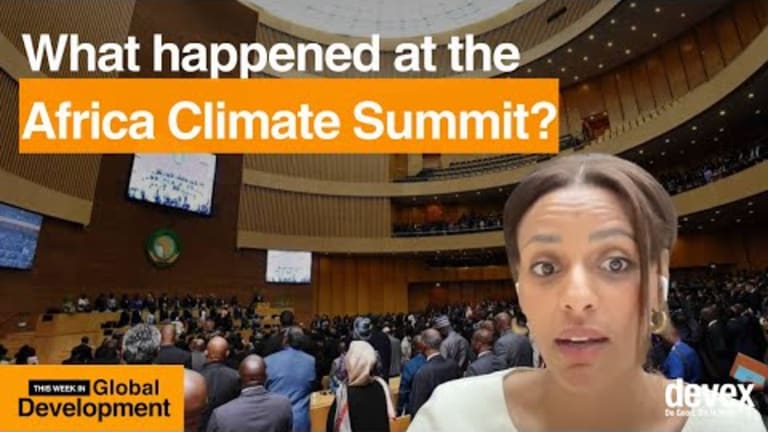
    The Africa Climate Summit, and a new legal test for the Trump administration
    The Africa Climate Summit, and a new legal test for the Trump administration

    Listen to "Exclusive Interview: UNDP's Achim Steiner on the 'chronic erosion' of development" on Spreaker.

    Listen on Spotify, Apple Podcasts, Soundcloud, YouTube, or search “Devex” in your favorite podcast app.

    When Achim Steiner took on the role of United Nations Development Programme administrator in June 2017, the agency was in transition, and as he prepares to depart after two terms, it is once again facing a period of change and disruption.

    This article is free to read - just register or sign in

    Access news, newsletters, events and more.

    Join usSign in
    • Funding
    • Democracy, Human Rights & Governance
    • Institutional Development
    • Trade & Policy
    • United Nations Development Programme (UNDP)
    • This Week in Global Development
    Printing articles to share with others is a breach of our terms and conditions and copyright policy. Please use the sharing options on the left side of the article. Devex Pro members may share up to 10 articles per month using the Pro share tool ( ).

    About the author

    • Adva Saldinger

      Adva Saldinger@AdvaSal

      Adva Saldinger is a Senior Reporter at Devex where she covers development finance, as well as U.S. foreign aid policy. Adva explores the role the private sector and private capital play in development and authors the weekly Devex Invested newsletter bringing the latest news on the role of business and finance in addressing global challenges. A journalist with more than 10 years of experience, she has worked at several newspapers in the U.S. and lived in both Ghana and South Africa.

    Search for articles

    Related Stories

    Global developmentRelated Stories - A look at UN80, and how emerging donors are reshaping the aid landscape

    A look at UN80, and how emerging donors are reshaping the aid landscape

    Global developmentRelated Stories - A look at the Trump administration's plan for DFC

    A look at the Trump administration's plan for DFC

    Global developmentRelated Stories - The next steps after FfD4, and how UN programs are affected by aid cuts

    The next steps after FfD4, and how UN programs are affected by aid cuts

    Global DevelopmentRelated Stories - The Africa Climate Summit, and a new legal test for the Trump administration

    The Africa Climate Summit, and a new legal test for the Trump administration

    Most Read

    • 1
      Why NTDs are a prime investment for philanthropy
    • 2
      US lawmakers strike $50B foreign assistance deal, surpassing Trump's plan
    • 3
      Why are 3.4 billion people still offline?
    • 4
      The old aid model is dead. Now comes the fight over what replaces it
    • 5
      Exclusive: Inside US-UN plan to remake funding for humanitarian crises
    • News
    • Jobs
    • Funding
    • Talent
    • Events

    Devex is the media platform for the global development community.

    A social enterprise, we connect and inform over 1.3 million development, health, humanitarian, and sustainability professionals through news, business intelligence, and funding & career opportunities so you can do more good for more people. We invite you to join us.

    • About us
    • Membership
    • Newsletters
    • Advertising partnerships
    • Devex Talent Solutions
    • Post a job
    • Careers at Devex
    • Contact us
    © Copyright 2000 - 2026 Devex|User Agreement|Privacy Statement