Venezuela's watershed moment puts spotlight on institutions
Aid leaders say Venezuela’s political shift opens a narrow window for humanitarian action and MDB reengagement, but debt, frozen assets, and U.S. policy could determine what happens next.
Just over a month after Venezuela’s dramatic political upheaval, the world is watching to see what will happen next. Humanitarian organizations, civil society, and citizens in Venezuela are waiting to see if international institutions will move in quickly despite the country’s debt, frozen assets, and the risks associated with addressing a deep humanitarian crisis while supporting longer-term recovery. “We are at a watershed moment in which there’s a big opportunity for things to change in Venezuela,” said Roberto Patiño, founder of the Venezuelan NGOs Mi Convive and Alimenta La Solidaridad, during a recent Devex Pro briefing. “And that includes the role of these [international] organizations.” Patiño was joined by former World Food Programme Executive Director David Beasley, who helped negotiate WFP’s entry into Venezuela in 2021, during political isolation and economic collapse. Their partnership began nearly a decade ago, when Patiño, then running a small grassroots feeding program, approached Beasley on a crowded bridge between Colombia and Venezuela. “It was a divine connection orchestrated from above,” Beasley recalled of their first meeting, which came amid mass migration and chaos at the border. That encounter laid the groundwork for WFP’s eventual operations inside Venezuela. Now, while Beasley and Patiño see promise and potential for Venezuela moving forward, they say change needs to come from the United States, which recently arrested Venezuelan President Nicolás Maduro at his home in the capital of Caracas and imprisoned him in New York. “[The White House] own the responsibility to make certain that things go forward,” Beasley said. “They need to move quickly and make assess the humanitarian situation.” Behind the humanitarian urgency lies a deeper institutional test. After years of isolation, Venezuela has no active portfolio with the World Bank or the Inter-American Development Bank, remains in arrears, and lacks up-to-date economic data. Reengagement would mean navigating debt restructuring, governance concerns, and U.S. political backing — all while millions face food insecurity and collapsing public services. A decade of isolation For much of the past 20 years, Venezuela has been largely cut off from international financial institutions. Under Chavismo — the left-wing populist political ideology initiated by former President Hugo Chávez that champions social welfare and anti-imperialism — multilateral development banks such as the World Bank and IDB were viewed as ideological adversaries, Patiño said. As a result, MDB portfolios in the country dwindled to nearly nothing. Meanwhile, hyperinflation, institutional collapse, and political repression hollowed out public services. “We’re talking about a country where the education system basically collapsed,” Patiño said. “Many children in Venezuela were only going to school three times a week, and sometimes for just a couple of hours.” Food insecurity also remains severe. Beasley described school kitchens “all but dilapidated” and warned that child malnutrition cannot wait for political negotiations to settle. Yet operating in Venezuela has required delicate negotiation. Beasley defended engagement with politically controversial authorities, such as Maduro and the Taliban in Afghanistan, as a humanitarian necessity. “Do you want to look good, or do you want to do good?” he said, adding that pointing figures might make people look like they’re doing something, but the real action happens when you sit down and negotiate, no matter the adversary. “Some of my friends will sit in their ivory tower. ‘Oh, you shouldn’t sit down and negotiate with the Taliban or Maduro.’ And I'm like, that’s who controls the access. I have no choice, and I’m not going to let innocent children die.” Patiño agreed that engagement, even amid repression, was essential. His organization fed as many as 18,000 children per day at its peak, despite arrest warrants issued against him. Will MDBs reenter? With political dynamics shifting, attention is turning to MDBs and international financial institutions. But major hurdles remain, including debt arrears and questions over governance and creditworthiness. Venezuela has a massive total external debt, estimated at over $150 billion, to China, Russia, and other countries. That makes it challenging, if not impossible, to bring new investors in. Experts have argued that the International Monetary Fund could help restructure the debt and provide technical assistance for reform. Venezuela can use its Special Drawing Rights, which are reserve assets held by the IMF, but is currently suspended from exchanging them for cash because a majority of the IMF’s members did not recognize the Maduro government. That could change in the coming months. While no moves have been made yet, Bloomberg reported last month that the IMF and World Bank boards discussed Venezuela and discussed a lack of official data and the rising humanitarian need in Venezuela. According to the Atlantic Council, the IMF has not conducted an economic assessment of Venezuela since late 2004. Patiño argued that Venezuela’s economic fundamentals — vast oil, gas, and gold reserves — create a credible pathway back. He said that by selling the oil at market price, removing certain allowances for countries that could get it for free, such as Cuba, and reducing corruption, “the oil income of Venezuela will almost double.” Venezuela also has 31 metric tons of gold bars held in the Bank of England, which in 2020 was equal to about $1.95 billion. Since then, the price of gold has more than doubled. However, the bank has refused to release requests from the Maduro administration because the U.K. government did not formally recognize his leadership. Now, however, these reserves could become part of a recovery package, Beasley said. Cash transfers and civil society One area of potential expansion is cash-based programming. Under the previous government, authorities resisted cash transfers, fearing a loss of political control. But both speakers argued that transparent systems could deliver economic stimulus and empower communities. “When it’s done right strategically … it has a multiplier effect on the economy,” Beasley said, noting that WFP scaled cash transfers globally from hundreds of millions to between $2 billion and $3 billion annually during his tenure. Patiño added that Venezuela’s widespread adoption of financial technology, including crypto, driven by hyperinflation, could open room for innovation. At the same time, domestic civil society remains fragile. Several restrictive NGO laws passed in recent years have curtailed activities. Patiño stressed that recovery will require lifting those constraints and empowering local actors. “When you think about the capacities of the Venezuelan state, they’re very diminished,” he said. “This needs to be an effort of the whole society.”
Just over a month after Venezuela’s dramatic political upheaval, the world is watching to see what will happen next. Humanitarian organizations, civil society, and citizens in Venezuela are waiting to see if international institutions will move in quickly despite the country’s debt, frozen assets, and the risks associated with addressing a deep humanitarian crisis while supporting longer-term recovery.
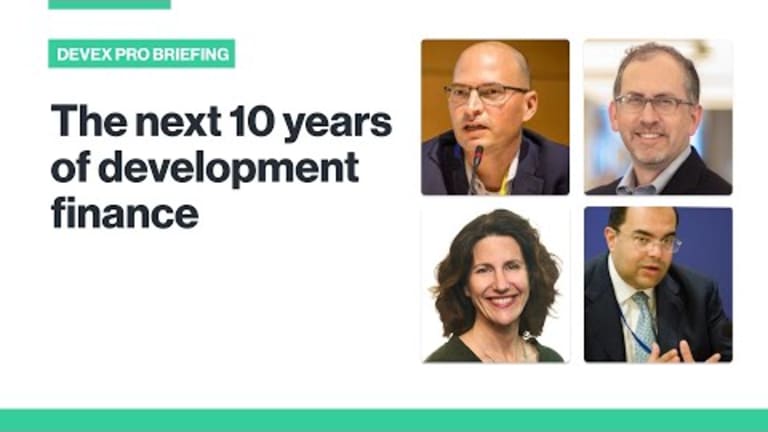
“We are at a watershed moment in which there’s a big opportunity for things to change in Venezuela,” said Roberto Patiño, founder of the Venezuelan NGOs Mi Convive and Alimenta La Solidaridad, during a recent Devex Pro briefing. “And that includes the role of these [international] organizations.”
Patiño was joined by former World Food Programme Executive Director David Beasley, who helped negotiate WFP’s entry into Venezuela in 2021, during political isolation and economic collapse. Their partnership began nearly a decade ago, when Patiño, then running a small grassroots feeding program, approached Beasley on a crowded bridge between Colombia and Venezuela.
This story is forDevex Promembers
Unlock this story now with a 15-day free trial of Devex Pro.
With a Devex Pro subscription you'll get access to deeper analysis and exclusive insights from our reporters and analysts.
Start my free trialRequest a group subscription Printing articles to share with others is a breach of our terms and conditions and copyright policy. Please use the sharing options on the left side of the article. Devex Pro members may share up to 10 articles per month using the Pro share tool ( ).
Jesse Chase-Lubitz covers climate change and multilateral development banks for Devex. She previously worked at Nature Magazine, where she received a Pulitzer grant for an investigation into land reclamation. She has written for outlets such as Al Jazeera, Bloomberg, the Organized Crime and Corruption Reporting Project, and The Japan Times, among others. Jesse holds a master’s degree in Environmental Policy and Regulation from the London School of Economics.