WHO's Africa chief on why health system reform is a marathon
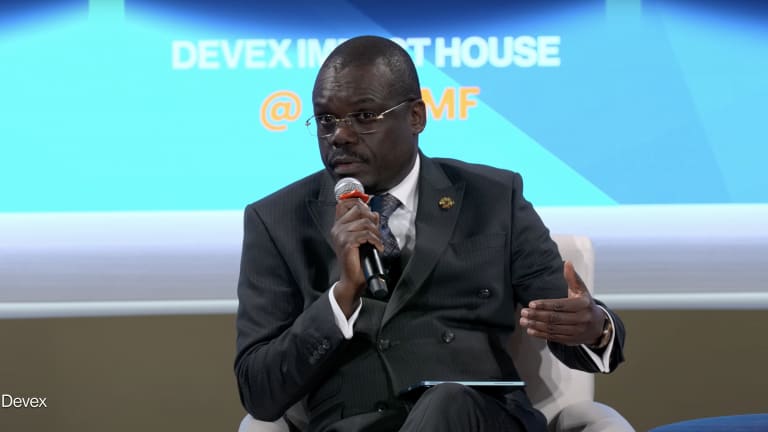
Dr. Mohamed Janabi, the new regional director of the World Health Organization's office for Africa, outlined his vision for advancing health sovereignty for countries across the continent.
Last year, Dr. Mohamed Yakub Janabi was appointed as the new regional director of the World Health Organization's office for Africa — taking office at the beginning of July during a complex, unprecedented moment. In the wake of drastic foreign aid cuts that abruptly hit health systems across the continent, his first seven months in office were marked by a period that was “very intense for stabilization, refocusing, rebuilding confidence in our systems,” he said during a Devex Pro event last week. On top of that, health authorities across Africa responded to 114 health outbreaks on the continent last year. “Did the [aid] cuts affect us? Definitely,” he said. He said that in some countries, there will be up to 60% disruptions in areas such as essential health services, maternal care, vaccinations, surveillance, and workforce training. But he said the key moving forward will be governments prioritizing the most cost-effective interventions — with a focus on prevention of disease rather than a more expensive response. “The savior of my continent is investing in primary health care — is investing in universal health coverage. This will rescue us,” he said. “It’s always cheaper to prevent it. It's always cheaper to intervene within 72 hours.” This includes prioritizing routine immunization and maternal and child health services, while strengthening surveillance systems and adopting a One Health approach. It also means increasing pharmaceutical manufacturing on the continent, building more resilient supply chains, investing in community health workers, expanding telemedicine, and tackling rising obesity rates that are driving increases in diabetes. It includes moving away from vertical programming towards integrated systems. Last year, the "Accra Reset" was launched, which is a shift toward country-led, partner-aligned, accountability-driven health development on the continent. Janabi said what the “Accra Reset” is doing differently from other efforts in the past is supporting accountability platforms so countries can track partner support. He added that the continent must also work to increase domestic investments, private sector and philanthropic involvement, as well as strengthen national budget execution. He said it's also important for the continent to invest more heavily in data systems to improve planning, increase joint procurement, and increase taxes and innovative financing mechanisms, such as debt swaps, to make health financing more sustainable. “Last year was a wake-up call for all our member states that donor-dependent health budgets are not something which is very sustainable,” he said. But the most important thing is the health sovereignty of each country— and to move away from instances where people from the global north parachute in with solutions, he said. “At the end of the day, our member states: We are responsible for our health, so we have to take charge,” he said. WHO plays the role of providing technical leadership, as well as strong monitoring and rigorous evaluation. “I believe we should give member states a fishing road, not a fish,” he said. He said WHO is also prioritizing bringing countries together to share success stories — such as Rwanda’s high national health insurance coverage. Reform is a marathon, Janabi said. “I think what matters is that we are moving decisively to the right direction.” Janabi also took on the role while WHO, as an agency, at the global level, was making cuts in response to its smaller budget. It was the “most challenging and painful time,” Janabi said, as his office had to part ways with skilled staff. In the first tranche, WHO’s Africa region lost 421 staff, and then there was another batch of staff who received reassignments because they worked at the agency for more than 10 years. Globally, WHO currently has over 7,000 staff, but it expects to reach about 6,000 by June, he said. But Janabi also added they didn’t have to close any of their 47 African country offices. He also emphasized they can create performance efficiencies with a leaner team. He said last year’s Ebola outbreak in the Democratic Republic of the Congo demonstrated an example of heightened collaboration between multiple agencies and doing more with less. The outbreak was contained within 90 days, and those who responded to the outbreak left the area stronger than it was before — with running water and solar panels, for example. “We responded within days, not weeks,” he said. “I believe strongly that if we avoid duplication, if we avoid fragmentation, coherence will be there.” On the Trump administration’s withdrawal from WHO, Janabi hopes the U.S. will "review its decision." “I hope the dust will settle so that all of us can work — because the viruses will keep coming, the outbreaks will keep coming. I think we need each other very much," he said. He added that beyond funding, U.S. colleagues have provided crucial expertise and collaboration. "They are personal friends," he said, adding that part of his medical training was in South Carolina. The U.S. State Department is currently signing bilateral health deals with countries. Janabi said there’s nothing new about this bilateral approach, but it's important these deals reflect country sovereignty. "Are they the priorities of the country? Can it be discussed? Can everyone read between the lines?” he said. “I've never been against bilateral, but I'm a strong believer of multilateralism.”
Last year, Dr. Mohamed Yakub Janabi was appointed as the new regional director of the World Health Organization's office for Africa — taking office at the beginning of July during a complex, unprecedented moment.
In the wake of drastic foreign aid cuts that abruptly hit health systems across the continent, his first seven months in office were marked by a period that was “very intense for stabilization, refocusing, rebuilding confidence in our systems,” he said during a Devex Pro event last week. On top of that, health authorities across Africa responded to 114 health outbreaks on the continent last year.
“Did the [aid] cuts affect us? Definitely,” he said. He said that in some countries, there will be up to 60% disruptions in areas such as essential health services, maternal care, vaccinations, surveillance, and workforce training.
This story is forDevex Promembers
Unlock this story now with a 15-day free trial of Devex Pro.
With a Devex Pro subscription you'll get access to deeper analysis and exclusive insights from our reporters and analysts.
Start my free trialRequest a group subscription Printing articles to share with others is a breach of our terms and conditions and copyright policy. Please use the sharing options on the left side of the article. Devex Pro members may share up to 10 articles per month using the Pro share tool ( ).
Sara Jerving is a Senior Reporter at Devex, where she covers global health. Her work has appeared in The New York Times, the Los Angeles Times, The Wall Street Journal, VICE News, and Bloomberg News among others. Sara holds a master's degree from Columbia University Graduate School of Journalism where she was a Lorana Sullivan fellow. She was a finalist for One World Media's Digital Media Award in 2021; a finalist for the Livingston Award for Young Journalists in 2018; and she was part of a VICE News Tonight on HBO team that received an Emmy nomination in 2018. She received the Philip Greer Memorial Award from Columbia University Graduate School of Journalism in 2014.