• News
    • Latest news
    • News search
    • Health
    • Finance
    • Food
    • Career news
    • Content series
    • Focus areas
    • Try Devex Pro
  • Jobs
    • Job search
    • Post a job
    • Employer search
    • CV Writing
    • Upcoming career events
    • Try Career Account
  • Funding
    • Funding search
    • Funding news
  • Talent
    • Candidate search
    • Devex Talent Solutions
  • Events
    • Upcoming and past events
    • Partner on an event
  • Post a job
  • About
      • About us
      • Membership
      • Newsletters
      • Advertising partnerships
      • Devex Talent Solutions
      • Contact us
Join DevexSign in
Join DevexSign in

News

  • Latest news
  • News search
  • Health
  • Finance
  • Food
  • Career news
  • Content series
  • Focus areas
  • Try Devex Pro

Jobs

  • Job search
  • Post a job
  • Employer search
  • CV Writing
  • Upcoming career events
  • Try Career Account

Funding

  • Funding search
  • Funding news

Talent

  • Candidate search
  • Devex Talent Solutions

Events

  • Upcoming and past events
  • Partner on an event
Post a job

About

  • About us
  • Membership
  • Newsletters
  • Advertising partnerships
  • Devex Talent Solutions
  • Contact us
  • My Devex
  • Update my profile % complete
  • Account & privacy settings
  • My saved jobs
  • Manage newsletters
  • Support
  • Sign out
Latest newsNews searchHealthFinanceFoodCareer newsContent seriesFocus areasTry Devex Pro
    • News
    • Humanitarian

    Why famine is 'inevitable' in Gaza — and what's next

    All signs point to famine in Gaza, according to Michael Fakhri, the U.N. special rapporteur on the right to food. But, he says, a famine declaration is not what should prompt the international community to act.

    By Tania Karas // 31 January 2024
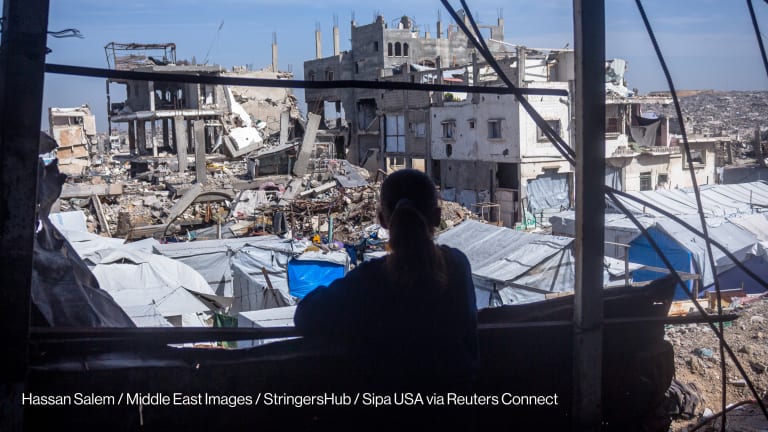
    The reports coming out of Gaza lately are dire: The territory is spiraling toward a full-scale famine as Israel’s total siege of the territory stretches into its fourth month. Israel’s bombing campaign has destroyed not only homes, schools, and hospitals but also Gaza’s farming fields and other agricultural infrastructure. Parents in Gaza are often going hungry so that their children can eat what little is available — and sometimes the only option is animal feed or grass, according to recent reports. The high risk of severe malnutrition carries long-lasting consequences for children in particular, such as physical and cognitive impairment, said Michael Fakhri, the U.N. special rapporteur on the right to food. Based on an assessment carried out in November and early December by the Integrated Food Security Phase Classification, or IPC, they project that for the period of Dec. 8 through Feb. 7, Gaza’s entire population of some 2.2 million people would face crisis levels of hunger, with 1 in 4 households facing famine. “This is the highest share of people facing high levels of acute food insecurity that the IPC initiative has ever classified for any given area or country,” it noted. While there hasn’t been an official declaration of famine, there are “pockets of famine” throughout the territory, U.N. agencies said earlier this month. They are calling for aid trucks stranded at the Rafah border crossing to be allowed inside Gaza immediately, as well as guarantees of safety for humanitarian workers. Meanwhile, many countries decided to pause funding to the UNRWA, the U.N. agency for Palestinian affairs and the main aid distributor in Gaza, after Israel accused 12 UNRWA employees of participating in the Hamas attack on Oct. 7. Cutting off that funding would mean famine is now “inevitable,” Fakhri said. Israel’s position is that there is enough food and water for civilians in Gaza and that the United Nations should hire more staffers and bring in more trucks to distribute aid. It also says its military is coordinating with humanitarian groups to allow for the safe passage of aid convoys. Devex spoke with Fakhri to learn more about the situation in Gaza. This conversation has been edited for length and clarity. First, what constitutes a famine? And where are we now with regard to Gaza? There is no legal definition of famine. If you think about the term genocide or starvation, the place often people will start with is some sort of legal interpretation. The most common way people understand is there or is there not a famine is they turned to the Integrated Food Security Phase Classification. The IPC is a conglomerate of different international organizations and experts. And they have a metric of measuring different degrees of hunger up until the highest degree, which is IPC phase five. And that phase five is when people say, “OK, this is a famine.” “Palestinians are being starved by Israel. … That part is clear. So I don't know why that's not also enough to sort of force the international community to action.” --— Michael Fakhri, the U.N. special rapporteur on the right to food To declare a famine … there's three things that they look for. First, they'll see if at least 20% of households are already starving or facing an extreme lack of food. Second, they’ll look at children, and if they see at least 30% of children are suffering from acute malnutrition. And the third criteria is that two people for every 10,000 are dying each day due to outright starvation, or because of malnutrition and disease. That being said, it's interesting to me why one has to wait for some sort of official declaration of famine for action. What is clear and indisputable is famine is imminent. It's around the corner. And so I don't know why that [declaration] should mobilize people, because we should be preventing that. Because once you reach that stage of famine, that's a failure of the international system. That's a profound, profound institutional, political failure across the board. And the other challenge is — actually there might already be a famine in Gaza because it's really hard to measure these things in the midst of an armed conflict. Up until recently, many of us in the U.N. system have been saying famine is imminent. Now, with the defunding of UNRWA, the U.N. Relief and Works Agency, famine is looking inevitable, unless something changes within days or weeks. If there were to be a declaration of famine in Gaza, what difference would it make? It sounds like you’re advising that we prioritize the reality on the ground over the definition of famine. Why does it matter if it's IPC four or IPC five, this technical definition? What we do know is, this is a case of starvation. Now, that's a legal term. And what starvation means is, that's an action. Palestinians are being starved by Israel. Which means they're being denied access to the essentials of life. That part is clear. So I don't know why that's not also enough to sort of force the international community to action. And I'll add another thing, the International Court of Justice said there’s a plausible case of genocide. And one of the points of evidence that they saw as to why was this [is because of the] denial of access to food and denial of humanitarian aid. “2.2 million people were made to go hungry within weeks, over half of which are children.” --— Michael Fakhri Can you compare what is happening in Gaza with other food access situations you've observed in other conflicts? I'm always reluctant to compare different situations of extreme hunger because I think it's actually more important to measure against people’s history. So if we were to look at [the last major declaration of famine in] Somalia in 2011, it's important to look at the history and context of Somalia and the people in that region itself as the context, as opposed to comparing different conflicts. What makes the war in Gaza and the potential famine and the actual situation of starvation unique, in broad terms, is the speed. The humanitarian community has never seen an entire population made to go hungry so completely and so quickly. It was within weeks. If you look at the denial of humanitarian aid, we raised the alarm of a risk of genocide because we immediately saw how quickly hunger was skyrocketing. This was first and foremost because on Oct. 9, the [Israeli] minister of defense declared a total siege and imposed the total siege. The second reason [why Gaza is unique] is yes, now there's some humanitarian aid trickling in, but it's really slow. The U.N. agencies, humanitarian agencies across the board are all ready to provide aid, and not enough is getting in on time to meet people's needs. The third reason it was such a quick and complete situation of a hunger crisis was because Israel was not only destroying civic infrastructure, but it was destroying the food system itself. In the north, over 22% of agricultural land and orchards and greenhouses were destroyed, 70% of fishery boats were destroyed. So Israel is destroying the Palestinian people's ability to feed themselves within Gaza. And the final reason is because even before the war, 50% of people in Gaza were food-insecure, and 80% relied on humanitarian aid. Because of a 16-year blockade. So it's this unique set of conditions which triggered this — really, it’s incredible, the speed and the completeness; 2.2 million people were made to go hungry within weeks, over half of which are children. This is what makes this one unique. What other tools might be available to the international community to end this hunger crisis and avoid the worst outcomes? First, starvation is a violation of international law. This was reaffirmed by the Security Council itself in a resolution from 2018. And in terms of international legal tools, I think so many tools have been used and attempted at this stage. Now, what we know is this: The U.N. secretary-general used one of his most powerful tools when he evoked Article 99 and forced the Security Council to address the situation. We've seen one Security Council resolution passed for a temporary humanitarian relief, and it focused on children. We saw the most recent attempts in the Security Council to pass a resolution to ensure some humanitarian relief. What's interesting to me is not the fact that the U.S. vetoed it; it was the fact that Israel on the record said it would not comply with this resolution before the vote was even taken. And we've seen the International Court of Justice raise the issue and say there is a plausible case for genocide — that there is a risk of genocide. There's a legal duty to prevent genocide. And from a human rights perspective, so many human rights experts, like myself and other mandates, have raised the alarm in so many different forms, including the General Assembly, and the Human Rights Council, and the U.N. Committee on World Food Security. Now, the next question is how do we then organize political energy through these legal tools? And I think now, there's a strong argument to be made that with the support and authority and legitimacy of all these legal tools and arguments and institutional dynamics, one can say, the international community needs to pressure and force Israel to comply with all of these international laws, first to prevent genocide and ensure that humanitarian aid reaches the Palestinian people. The safest and the easiest way to guarantee all of these international laws are complied with is an immediate cease-fire. This is the clear consensus, from a human rights perspective, across the board of all the human rights experts and U.N. system.

    Related Stories

    Famine officially declared in the Gaza Strip
    Famine officially declared in the Gaza Strip
    Devex Dish: Lessons from twin famines in Gaza and Sudan
    Devex Dish: Lessons from twin famines in Gaza and Sudan
    The split screen of the Gaza Humanitarian Foundation
    The split screen of the Gaza Humanitarian Foundation
    Devex Dish: AGRA enters a new era with Alice Ruhweza at the helm
    Devex Dish: AGRA enters a new era with Alice Ruhweza at the helm

    The reports coming out of Gaza lately are dire: The territory is spiraling toward a full-scale famine as Israel’s total siege of the territory stretches into its fourth month. Israel’s bombing campaign has destroyed not only homes, schools, and hospitals but also Gaza’s farming fields and other agricultural infrastructure.

    Parents in Gaza are often going hungry so that their children can eat what little is available — and sometimes the only option is animal feed or grass, according to recent reports. The high risk of severe malnutrition carries long-lasting consequences for children in particular, such as physical and cognitive impairment, said Michael Fakhri, the U.N. special rapporteur on the right to food.  

    Based on an assessment carried out in November and early December by the Integrated Food Security Phase Classification, or IPC, they project that for the period of Dec. 8 through Feb. 7, Gaza’s entire population of some 2.2 million people would face crisis levels of hunger, with 1 in 4 households facing famine. “This is the highest share of people facing high levels of acute food insecurity that the IPC initiative has ever classified for any given area or country,” it noted.

    This article is free to read - just register or sign in

    Access news, newsletters, events and more.

    Join usSign in

    More reading:

    ► WFP's McCain faces staff revolt over Gaza

    ► Besieged UN relief outfit plots future in Gaza’s hellscape

    ► The insider perspective on the humanitarian crisis in Gaza

    • Democracy, Human Rights & Governance
    • Humanitarian Aid
    Printing articles to share with others is a breach of our terms and conditions and copyright policy. Please use the sharing options on the left side of the article. Devex Pro members may share up to 10 articles per month using the Pro share tool ( ).

    About the author

    • Tania Karas

      Tania Karas@TaniaKaras

      Tania Karas is a Senior Editor at Devex, where she edits coverage on global development and humanitarian aid in the Americas. Previously, she managed the digital team for The World, where she oversaw content production for the website, podcast, newsletter, and social media platforms. Tania also spent three years as a foreign correspondent in Greece, Turkey, and Lebanon, covering the Syrian refugee crisis and European politics. She started her career as a staff reporter for the New York Law Journal, covering immigration and access to justice.

    Search for articles

    Related Stories

    GazaRelated Stories - Famine officially declared in the Gaza Strip

    Famine officially declared in the Gaza Strip

    Devex DishRelated Stories - Devex Dish: Lessons from twin famines in Gaza and Sudan

    Devex Dish: Lessons from twin famines in Gaza and Sudan

    HumanitarianRelated Stories - The split screen of the Gaza Humanitarian Foundation

    The split screen of the Gaza Humanitarian Foundation

    Devex DishRelated Stories - Devex Dish: AGRA enters a new era with Alice Ruhweza at the helm

    Devex Dish: AGRA enters a new era with Alice Ruhweza at the helm

    Most Read

    • 1
      Why NTDs are a prime investment for philanthropy
    • 2
      The silent, growing CKD epidemic signals action is needed today
    • 3
      Trump withdraws, defunds dozens of international orgs and treaties
    • 4
      Why capital without knowledge-sharing won't solve the NCD crisis
    • 5
      Why are 3.4 billion people still offline?
    • News
    • Jobs
    • Funding
    • Talent
    • Events

    Devex is the media platform for the global development community.

    A social enterprise, we connect and inform over 1.3 million development, health, humanitarian, and sustainability professionals through news, business intelligence, and funding & career opportunities so you can do more good for more people. We invite you to join us.

    • About us
    • Membership
    • Newsletters
    • Advertising partnerships
    • Devex Talent Solutions
    • Post a job
    • Careers at Devex
    • Contact us
    © Copyright 2000 - 2026 Devex|User Agreement|Privacy Statement