
• News
    • Latest news
    • News search
    • Health
    • Finance
    • Food
    • Career news
    • Content series
    • Focus areas
    • Try Devex Pro
  • Jobs
    • Job search
    • Post a job
    • Employer search
    • CV Writing
    • Upcoming career events
    • Try Career Account
  • Funding
    • Funding search
    • Funding news
  • Talent
    • Candidate search
    • Devex Talent Solutions
  • Events
    • Upcoming and past events
    • Partner on an event
  • Post a job
  • About
      • About us
      • Membership
      • Newsletters
      • Advertising partnerships
      • Devex Talent Solutions
      • Contact us
Join DevexSign in
Join DevexSign in

News

  • Latest news
  • News search
  • Health
  • Finance
  • Food
  • Career news
  • Content series
  • Focus areas
  • Try Devex Pro

Jobs

  • Job search
  • Post a job
  • Employer search
  • CV Writing
  • Upcoming career events
  • Try Career Account

Funding

  • Funding search
  • Funding news

Talent

  • Candidate search
  • Devex Talent Solutions

Events

  • Upcoming and past events
  • Partner on an event
Post a job

About

  • About us
  • Membership
  • Newsletters
  • Advertising partnerships
  • Devex Talent Solutions
  • Contact us
  • My Devex
  • Update my profile % complete
  • Account & privacy settings
  • My saved jobs
  • Manage newsletters
  • Support
  • Sign out
Latest newsNews searchHealthFinanceFoodCareer newsContent seriesFocus areasTry Devex Pro
    • News
    • Food systems

    How Trump’s US aid stop-work order affects global food aid

    Everything we could glean about the chaos the 90-day aid pause has caused for U.S-funded food, nutrition, and agriculture programs.

    By Tania Karas // 29 January 2025
    The United States is the world’s biggest donor of international food aid: It funnels billions of dollars annually into emergency vouchers for food in crises, school meals programs, more productive crops, and improving smallholder farmers’ livelihoods in the world’s lowest-income countries. On Friday, that entire system came crashing down when the State Department issued an unprecedented stop-work order for foreign aid grants and contacts as part of the Trump administration’s 90-day freeze of nearly all foreign assistance. While “emergency food aid” is exempt from the order, it remains unclear what counts under that umbrella. Meanwhile, the directive has paralyzed a vast swath of U.S.-funded food aid and agricultural research work. It has hit many programs funded by the U.S. Agency for International Development, with its nearly $5 billion annual budget for food aid. USAID’s flagship food security initiative, Feed the Future, has ground to a halt. With an annual budget of nearly $1 billion, the initiative works to address root causes of hunger by boosting nutrition and agriculture-led economic growth in 20 countries across Africa, Asia, and Latin America. The effects of the order were swift: Within hours, international NGOs, small local organizations, and big for-profit development contracting companies that carry out food security and nutrition programs on behalf of the U.S. government were hit with a barrage of individual stop-work orders. The emails kept arriving through the weekend and are still landing in inboxes worldwide. “It’s manufactured chaos,” said an Africa-based senior humanitarian official at a U.S.-funded organization that delivers food aid. “The humanitarian and development sector is shaken. As INGOs, we are familiar with crisis and sudden shocks, but something like this, which completely threatens our ability to help people who are most vulnerable — it just leaves us very helpless and frustrated.” The official asked to remain anonymous, citing fear of losing their organization’s U.S. funding for good — as did all of the humanitarian officials Devex spoke to for this article. Current and former USAID staffers also asked to remain unnamed. The Trump administration has said it is pausing aid as it conducts a review to ensure all U.S. foreign assistance aligns with its “America First” agenda. Decisions on whether programs will be continued, modified, or terminated altogether will follow the review. Adding to the chaos, the State Department on Tuesday approved a waiver for “life-saving humanitarian assistance programs,” which includes food — but it does not mention nutrition, agriculture, or related aid. Meanwhile, many millions of dollars’ worth of food aid hang in the balance. The ONE Campaign noted that in Mozambique, some 2,000 metric tons of U.S. food commodities valued at $3.5 million risk spoilage if they don’t reach the 99,000 people for whom they were procured. Another INGO told Devex it will be unable to continue supporting 15,000 people in Haiti with agricultural inputs so they can grow their own food, and that nearly 70,000 people in Ethiopia will lose access to safe drinking water. Two INGOs that Devex spoke to get at least one-third of their funding from the United States government. They said they do not have the cash reserves to make it through the 90 days without drastically scaling down their programming, as the freeze has blocked them from accessing funds that USAID has previously committed to them. “It’s terrifying to see how much damage that’s going to be done,” said a former USAID official who worked on food security. “This is reversing decades of American leadership in supporting global food security, and we have helped feed hundreds of millions of people over the years and help them feed themselves.” Parsing State Department and USAID memos The one-page stop-order memo sent Friday notes that “emergency food assistance and administrative expenses, including salaries, needed to administer such assistance” are covered by an exemption. Organizations may still need to seek a waiver to continue their programming. Longer-term development aid — such as agricultural extension services and scientific research on climate-resilient crop varieties — must be stopped. But just what counts as “emergency food assistance” is unclear. Does it cover school meal programs that feed millions of children in lower-income countries daily? Or cash and vouchers, which also help prop up local food markets? Or malnutrition treatment in the form of ready-to-use therapeutic foods, or RUTFs, a high-calorie peanut paste that helps children recover from the most severe form of malnutrition known as wasting? All of that is still unknown. “Around 60% of emergency food assistance is delivered through cash and vouchers,” said the Africa-based humanitarian official. “Does this exemption apply to cash and vouchers as well? We do not know. There is not enough clarity. Also, the people who have been pushed to the brink of famine or who are facing severe acute levels of malnutrition — will just some dry rations or food packets save those lives? Perhaps not.” And in a place such as Sudan, the world’s biggest hunger crisis where nearly 25 million people face acute hunger, food aid alone will do little to stop the spread of famine. “There are other life-saving core humanitarian assistance that are both complementary to food aid and just as important, like basic shelter,” said a U.S.-based senior humanitarian official. “[Water, sanitation, and hygiene] is really one of the biggest pieces that is very tied to food aid. If those aren’t given a waiver, then even the ability for that emergency food aid to be effective is going to be limited.” Four NGOs told Devex their attempts to get answers from their respective USAID contracting officers have been met with either “radio silence” or the agency staff’s own lack of insight. “There’s a real vacuum of information,” said the U.S.-based humanitarian official. “We have received no definition of ‘emergency food aid’ from USAID.” Meanwhile, hundreds of contractors working within USAID’s Bureau for Humanitarian Assistance, or BHA, have been furloughed as the stop-work order hits the projects that fund their positions, Devex reported Tuesday. One current and one former USAID official tell Devex that the furloughs are also hitting contractors at the Bureau for Resilience, Environment, and Food Security, or REFS. As for how the order might affect United Nations food agencies that get U.S. funding: The World Food Programme appears to be shielded by the emergency food aid exemption. Meanwhile, UNICEF, which delivers nutrition aid, said it remains “determined to deliver our support to children even as we work through the implications of the decision.” The U.S. contributes 45% of WFP’s $9.7 billion budget, and 15% of UNICEF’s $8.9 billion budget. Defining ‘emergency food aid’ What falls under the “emergency food assistance” exemption may depend on where a specific program’s funding comes from, explains Stephanie Mercier, senior policy adviser with the Washington-based Farm Journal Foundation. For example, USAID’s $3 billion annual Emergency Food Security Program — which is administered by BHA and comprises a huge part of the bureau’s work — is likely exempt from the stop-work order. Another category of food aid, whose standing under the stop-work order is more ambiguous, is USAID’s Food for Peace program, which provides both emergency and nonemergency food aid. It delivers food commodities grown by U.S. farmers to vulnerable populations abroad. Because Food for Peace is administered by USAID, it could be covered by the order and forced to halt its work. The nonemergency component is particularly likely to face stoppage. But the entire Food for Peace program may not be affected by the order at all, because it’s funded through the U.S. agricultural appropriations bill, authorized by the farm bill — and the stop-work order applies only to accounts funded by Titles III and IV of the state and foreign operations funding bill. “So you arrive at two different outcomes depending on which one of those is the binding one,” Mercier said. “And I think that’s probably one of the reasons why the eight organizations who deliver these programs are so confused.” A third category of USAID-administered food aid does not seem to fall under the stop-work order: Those funded by the U.S. Department of Agriculture. That includes the Food for Progress program, which aims to improve agricultural productivity in lower-income countries; and the McGovern-Dole Food for Education program, which focuses on education, child development, and food security abroad and funds school meals. Meanwhile, Feed the Future has been dramatically impacted. The program is administered through USAID’s Bureau for Resilience, Environment, and Food Security. Because it’s not emergency food aid — but rather, longer-term agricultural development funds to help vulnerable communities reduce reliance on foreign aid — nearly the entire scope of its work seems to all fall under the stop-work order. Its Feed the Future Innovation Labs, which develop technologies to feed a growing population amid climate change and are hosted at universities around the U.S., have been ordered to stop working, according to two people who have worked on them. All four INGOs that Devex spoke to are all interpreting the “emergency food assistance” slightly differently in terms of which of their programs it affects. USAID, for its part, did not reply to Devex’s request for clarification by press time. Tallying the costs As with any humanitarian and development aid, time is of the essence, and 90 days is a long time to wait for money to start flowing again. The stakes are perhaps highest for those who depend on U.S. aid for food security and lifesaving malnutrition treatment. In the case of young children, failure to treat them for malnutrition right away could lead to lifelong developmental delays, as well as dangerous conditions such as stunting and wasting. There are also likely to be added costs to U.S. taxpayers. For example, because the freeze coincides with the planting season for many crops in areas where the U.S. funds agricultural support, farmers may miss the entire season — meaning a year’s worth of seed investment and scientific research could be lost. And organizations that are forced to cut staff or stop operations will not be able to quickly rehire and start back up. “Without U.S. government funding the scale at which we are operating, we will not be able to sustain ourselves even for a few months, because for these 90 days, we are basically talking about halting $100 million in programs,” said the Africa-based humanitarian official. “We don’t have reserves of $100 million. We will have to drastically scale down.” Several experts Devex spoke to questioned why so much work needs to be stopped as the State Department conducts its review. “No one is disputing the value of a review of looking at the value proposition of foreign assistance, in part because I think we’re confident that we can demonstrate its benefits and the need for it in the places we’re working in,” said the U.S.-based humanitarian official. “But the pause — even with some of the exceptions that are currently outlined, and even more so when the absence of really any kind of real guidance — is causing real world impacts now that will not be able to be undone, even if and when the pause is lifted.” “Reviewing the programs is fine. It’s good to make sure that programs are being effective and working. But to halt them completely while you’re doing that, it just doesn’t make sense,” said a third humanitarian official. “In addition to the vast harm that is going to be caused to the people that we serve, it’s expensive. It’s wasteful,” the third official continued. “You can’t just turn these things on and off — you know, flip a switch, turn it off for a month and then come back. There’s startup costs involved in that. It’s chaotic and expensive.” Finally, there are the costs to the United States’ reputation — both as a development partner and global leader in foreign aid. Said the former USAID official: “The private sector is not going to see us as a very trusted partner if all of a sudden we promise to deliver something and then tomorrow we cannot follow through because we’re not supposed to do any work.” Update, Jan. 31, 2025: This story has been updated to reflect how the 90-day aid freeze may affect the World Food Programme.

    Related Stories

    The US is breaking a lifesaving global food aid system
    The US is breaking a lifesaving global food aid system
    A successful US food aid program needs agriculture investment, experts say
    A successful US food aid program needs agriculture investment, experts say
    World Food Prize laureates call for doubling of food and agriculture aid
    World Food Prize laureates call for doubling of food and agriculture aid
    The next global food crisis will come. The US is not ready
    The next global food crisis will come. The US is not ready

    The United States is the world’s biggest donor of international food aid: It funnels billions of dollars annually into emergency vouchers for food in crises, school meals programs, more productive crops, and improving smallholder farmers’ livelihoods in the world’s lowest-income countries.

    On Friday, that entire system came crashing down when the State Department issued an unprecedented stop-work order for foreign aid grants and contacts as part of the Trump administration’s 90-day freeze of nearly all foreign assistance. While “emergency food aid” is exempt from the order, it remains unclear what counts under that umbrella.

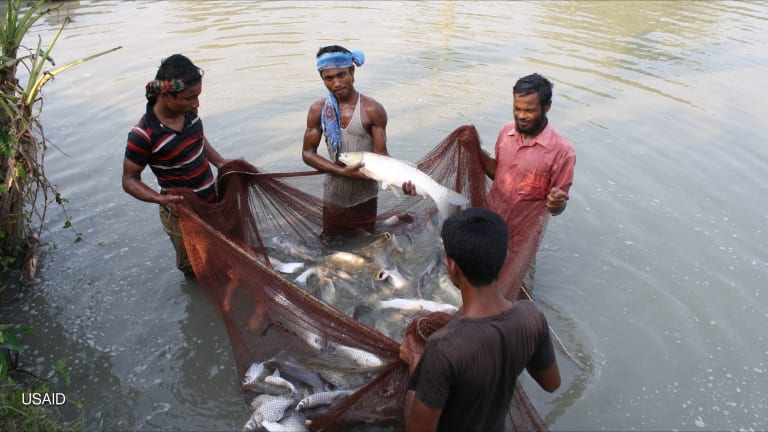
    Meanwhile, the directive has paralyzed a vast swath of U.S.-funded food aid and agricultural research work. It has hit many programs funded by the U.S. Agency for International Development, with its nearly $5 billion annual budget for food aid. USAID’s flagship food security initiative, Feed the Future, has ground to a halt. With an annual budget of nearly $1 billion, the initiative works to address root causes of hunger by boosting nutrition and agriculture-led economic growth in 20 countries across Africa, Asia, and Latin America.

    This article is free to read - just register or sign in

    Access news, newsletters, events and more.

    Join usSign in

    More reading:

    ► Scoop: USAID furloughs hundreds of contractors from humanitarian bureau

    ► State Department approves waiver for lifesaving humanitarian aid

    ► Exclusive: State Department issues stop-work order on US aid

    • Humanitarian Aid
    • Democracy, Human Rights & Governance
    • Agriculture & Rural Development
    • Funding
    • Trade & Policy
    • United States Agency for International Development (USAID)
    Printing articles to share with others is a breach of our terms and conditions and copyright policy. Please use the sharing options on the left side of the article. Devex Pro members may share up to 10 articles per month using the Pro share tool ( ).

    About the author

    • Tania Karas

      Tania Karas@TaniaKaras

      Tania Karas is a Senior Editor at Devex, where she edits coverage on global development and humanitarian aid in the Americas. Previously, she managed the digital team for The World, where she oversaw content production for the website, podcast, newsletter, and social media platforms. Tania also spent three years as a foreign correspondent in Greece, Turkey, and Lebanon, covering the Syrian refugee crisis and European politics. She started her career as a staff reporter for the New York Law Journal, covering immigration and access to justice.

    Search for articles
    Related Stories

    Opinion: Food systemsRelated Stories - The US is breaking a lifesaving global food aid system

    The US is breaking a lifesaving global food aid system

    Devex Pro LiveRelated Stories - A successful US food aid program needs agriculture investment, experts say

    A successful US food aid program needs agriculture investment, experts say

    Food SystemsRelated Stories - World Food Prize laureates call for doubling of food and agriculture aid

    World Food Prize laureates call for doubling of food and agriculture aid

    Opinion: Food SecurityRelated Stories - The next global food crisis will come. The US is not ready

    The next global food crisis will come. The US is not ready

    Most Read

    • 1
      Building hope to bridge the surgical access gap
    • 2
      Turning commitments into action: Financing a healthier future after HLM4
    • 3
      Why women’s health innovation needs long-term investment
    • 4
      Innovation meets impact: Fighting malaria in a warming world
    • 5
      How country-led ecosystems drive sustainable health impact
    • News
    • Jobs
    • Funding
    • Talent
    • Events

    Devex is the media platform for the global development community.

    A social enterprise, we connect and inform over 1.3 million development, health, humanitarian, and sustainability professionals through news, business intelligence, and funding & career opportunities so you can do more good for more people. We invite you to join us.

    • About us
    • Membership
    • Newsletters
    • Advertising partnerships
    • Devex Talent Solutions
    • Post a job
    • Careers at Devex
    • Contact us
    © Copyright 2000 - 2025 Devex|User Agreement|Privacy Statement