




BARCELONA — Spectacles, contact lenses, and minor surgeries are all innovations that have been developed over the decades and mean that many who would have lived with poor vision can today live unencumbered by sight issues.
While such corrective measures exist, that ingenuity around vision care cannot stop there, said Anurag Hans, head of Base of Pyramid innovation and market acceleration at Essilor — a global company working to improve lives by improving sight.
More focus on vision:
► Nigeria's biggest cause of permanent blindness is failing to attract attention
There are 2.5 billion people living with some form of vision impairment today — the leading causes of which are usually uncorrected refractive errors and cataracts. Eighty percent of those impairments are considered avoidable, but the likelihood of those being avoided in low- and middle-income countries decreases due to four factors, according to Hans.
“The lack of affordable products, the awareness of need, or the availability of a pair of corrective glasses, lack of access to a primary vision care provider, and attitudes or acceptance are the main barriers,” said Hans, explaining that many communities still see spectacles as undesirable.
The way to overcome these four challenges — and achieve Essilor’s goal of eradicating poor vision by 2050 — is to innovate, he said.
“Innovation is critical and central to all our operations irrespective of the market or the consumer type, but especially in low- and middle-income countries — what we call the ‘Base of the Pyramid.’”
Speaking to Devex, Hans explained why innovation is crucial in LMIC settings and shared his advice on how others can put creativity front and center of vision care projects.
“Companies need to look at consumer preferences, lifestyles, needs, and willingness to pay — and then use that as a hard constraint to come up with a product … rather than using an existing model from high-income contexts and trying to create a stripped down version to make it more affordable.”
— Anurag Hans, head of Base of Pyramid innovation and market acceleration, EssilorThis conversation has been edited for length and clarity.
How critical is innovation when it comes to delivering vision care in LMICs?
It becomes all the more critical if you contrast it with how innovation is typically viewed in the developed context where a lot of the structure around innovation is already there — the rules of the market and of the industry are already defined. In the low- and middle-income market context, that structure itself is missing, which basically means that there is a need for innovation across a lot of different areas.
The challenge is that there are no best practices to emulate, therefore innovation — especially in these markets — is more holistic. It's not like you can pick one part of the puzzle and innovate around it.
What examples do you have of successful innovation within the vision space in LMICs?
There's a lot of innovation around service delivery, so basically business model innovation. A successful example of that is our flagship Eye Mitra program where the lack of primary vision care providers in communities is the main bottleneck. What we do is identify youth from low-income communities and train them with the skills needed to start their own microbusinesses to provide these primary vision care facilities.
Similarly, there is a need to redesign products keeping in mind the needs of the consumers. In the process of getting a pair of spectacles, usually a consumer has to go to a technician for screening and then there is a wait before the consumer can collect the customized spectacles.
In the BoP context, that's a difficult thing to do because consumers can’t afford to make multiple trips to the technician as most of them rely on daily wages and each day they miss work, they lose money. To address this need, we have developed “Ready-to-Clip” eyewear, where customized spectacles can be delivered on the spot by fitting precut lenses into a range of frames. That helps overcome a big hurdle on the product and service delivery side.
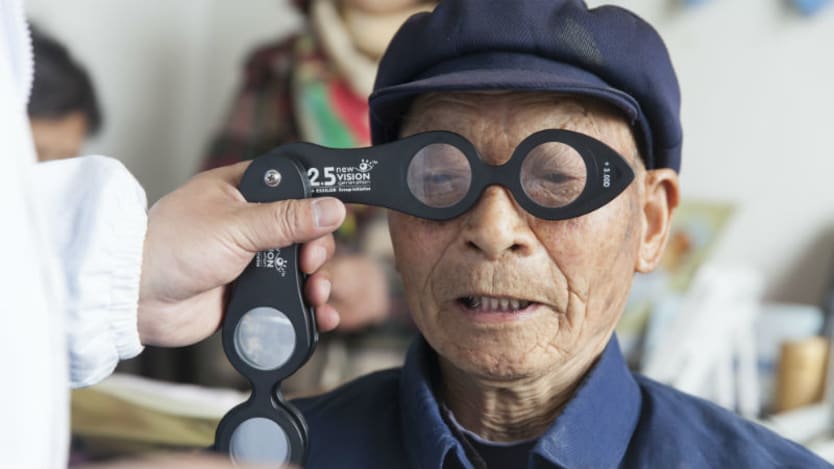
One other bottleneck is coming up with a screening tool that is easy to use, affordable, robust, and withstands the environment of the BoP context. Two years ago, we ran an open innovation challenge and invited innovators from around the world to come up with an easy-to-use, portable, and inexpensive refraction tool. The winning prototype has just been developed and we think it could really change the way technicians deliver eye screenings in BoP contexts.
You really need to place yourself in the shoes of the BoP consumer to successfully innovate in this context. A lot of companies make the mistake of thinking that developing no frills or scaled down versions of their class A products can help them come up with a product suited for the BoP.
Companies need to look at consumer preferences, lifestyles, needs, and willingness to pay — and then use that as a hard constraint to come up with a product and service delivery model, rather than using an existing model from high-income contexts and trying to create a stripped down version to make it more affordable.
What advice would you give to other organizations working to tackle poor vision in terms of how they’re harnessing innovation?
We believe that the only way that anybody can come up with successful BoP innovations — whether in the context of vision care or any other context — is to innovate from scratch, taking the needs and the perspectives of these consumers as a starting point.
We also focus a lot on partnerships, especially since last-mile costs and access usually define whether an action is going to be sustainable or not. In most communities, we have very strong local partners and that ensures whatever we're doing across product or service delivery actually reaches the local communities.
Across all our actions, we realized that it’s not possible for any one entity to achieve something of this magnitude alone. Our experience over the past eight to 10 years has further reinforced our belief that the only way we can achieve our ambition of eradicating uncorrected poor vision by 2050 is if we are able to bring together a large number of equally motivated, like-minded partners.
A great example is our recent partnership with Alibaba in China. Alibaba’s Rural Taobao outlets, where rural residents can digitally access the same selection of goods and services available to their urban counterparts on Alibaba, are being converted into vision care points for these communities. Community members can get their eyes tested by optometrists who travel to them in mobile vans. Once residents have the prescription they need, they can buy their spectacles online via the rural Taobao shops.
There are a lot of organizations and companies targeting the same BoP consumer, but in silos. We believe that the time is right for all these companies to come together and marry their efforts so that a comprehensive set of services and products can be brought to the BoP consumer.
Devex, with financial support from our partner Essilor, is exploring challenges, solutions, and innovations in eye care and vision. Visit the Focus on: Vision page for more.
About the author

Devex Editor
Thanks for reading and for your interest in Devex. Sponsored content is produced in collaboration between Devex’s partnerships editorial team and our partners to promote a partner’s work or perspective on a particular issue. It gives actors across the global development sector — including nongovernmental organizations, private sector stakeholders, aid agencies and government institutions — the opportunity to go beyond traditional advertising and tell their stories in an impactful way. If you'd like to learn more about how you can shine a spotlight on a particular issue with Devex, please email advertising@devex.com. We look forward to hearing from you.
Search for articles



Most Read
- 1
- 2
- 3
- 4
- 5