Aftermath of Afghan quake shows fallout of USAID withdrawal
With USAID support largely gone, Afghanistan struggles to respond to a quake that has blocked roads, overrun hospitals, and stretched relief operations thin.
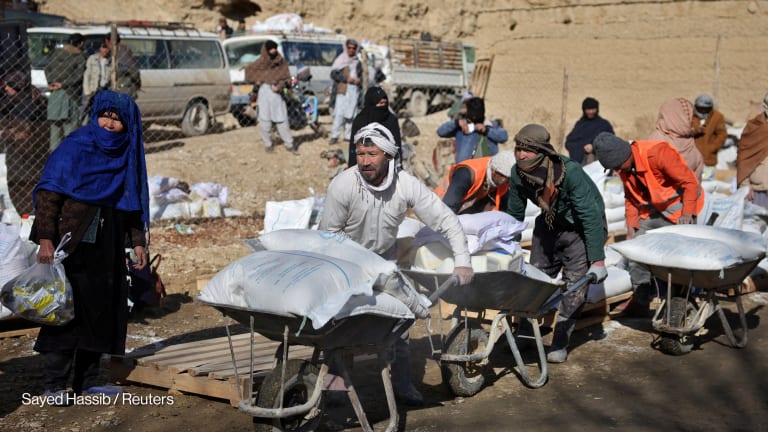
Afghanistan’s eastern provinces are still reeling from last week’s powerful earthquake and continuing aftershocks. The magnitude 6.0 earthquake left hospitals overflowing, mountain roads blocked, and relief operations stretched thin. The disaster has underscored how the withdrawal of U.S. Agency for International Development funding has left the country far more vulnerable to catastrophe. For decades, USAID spearheaded programs that did more than respond to emergencies — they built infrastructure ahead of time. From funding rural health clinics and training midwives to backing food security programs and supporting logistics operations that could reach remote mountain villages, USAID’s footprint often focused on prevention. In Afghanistan, that helped to bolster their ability to withstand shocks before they struck. Now, much of that safety net is gone. Since U.S. funding cuts earlier this year, more than 420 health facilities across Afghanistan have closed, including 80 in the eastern region where the earthquake hit. The result was immediate: In the first days of the response, hospitals were running low on lifesaving supplies such as saline, IV fluids, and bandages. Back in 2023, when Afghanistan was hit by a 6.3 magnitude earthquake, USAID provided immediate humanitarian assistance, sending in $12 million in immediate assistance for medical care and supplies such as blankets, solar lamps, clothing, emergency shelter kits, cooking and water collection materials. “Just the basics are in critically low supply,” Kate Carey, the humanitarian affairs officer at the United Nations Office for the Coordination of Humanitarian Affairs, or OCHA, told Devex. The impact extends beyond health. The U.N.’s humanitarian air service, once bolstered by international donors, was forced to cut back its helicopter fleet earlier this year. That has made reaching remote communities in places such as Kunar province — where villagers are perched on mountainsides with little road access — nearly impossible, Carey said. Mine clearance, another sector USAID had long invested in, has slowed, leaving earthquake-displaced families at risk of stepping on newly exposed ordnance. Food security is another looming crisis. The World Food Programme has warned of drastic cuts to their operations and food rations. That erosion of support threatens to reverse fragile gains made over the past four years. The pattern is clear: where preventative investments once cushioned communities, gaps are widening. “When funding runs dry, or there are significant cuts like the ones that we’ve seen, the first thing to go is prevention,” Carey explained. “The preventative measures that we would like to implement in order to prevent a situation like this got cut. We are forced to triage — to save lives today, while knowing the lack of preparedness will cost lives tomorrow.” Neighboring countries, including Pakistan, Tajikistan, and Uzbekistan, have stepped in with in-kind support — tents, food, and medical items — while India, Saudi Arabia, and Russia have pledged assistance, Carey said. Much of this aid bypasses the multilateral system and is routed directly through Afghan authorities, who themselves face limited capacity despite moving quickly to deploy helicopters and restore mobile connectivity after the quake. Winter is fast approaching in Afghanistan’s high-altitude east. With temperatures already dropping, the need for shelter, warm clothing, and heating fuel is urgent. The U.N. is preparing a flash appeal to cover needs through December, but with humanitarian budgets slashed across With Europe and the U.S. support no longer helping to prepare the country for shocks, officials warn that the response will fall short. “We're having to not only prioritize, but deprioritize,” said Carey. “We're having to make very difficult choices and trade-offs about what we're supporting and what we're not supporting.”
Afghanistan’s eastern provinces are still reeling from last week’s powerful earthquake and continuing aftershocks. The magnitude 6.0 earthquake left hospitals overflowing, mountain roads blocked, and relief operations stretched thin. The disaster has underscored how the withdrawal of U.S. Agency for International Development funding has left the country far more vulnerable to catastrophe.
For decades, USAID spearheaded programs that did more than respond to emergencies — they built infrastructure ahead of time. From funding rural health clinics and training midwives to backing food security programs and supporting logistics operations that could reach remote mountain villages, USAID’s footprint often focused on prevention. In Afghanistan, that helped to bolster their ability to withstand shocks before they struck.
Now, much of that safety net is gone.
This article is free to read - just register or sign in
Access news, newsletters, events and more.
Join usSign inPrinting articles to share with others is a breach of our terms and conditions and copyright policy. Please use the sharing options on the left side of the article. Devex Pro members may share up to 10 articles per month using the Pro share tool ( ).
Jesse Chase-Lubitz covers climate change and multilateral development banks for Devex. She previously worked at Nature Magazine, where she received a Pulitzer grant for an investigation into land reclamation. She has written for outlets such as Al Jazeera, Bloomberg, the Organized Crime and Corruption Reporting Project, and The Japan Times, among others. Jesse holds a master’s degree in Environmental Policy and Regulation from the London School of Economics.