• News
    • Latest news
    • News search
    • Health
    • Finance
    • Food
    • Career news
    • Content series
    • Focus areas
    • Try Devex Pro
  • Jobs
    • Job search
    • Post a job
    • Employer search
    • CV Writing
    • Upcoming career events
    • Try Career Account
  • Funding
    • Funding search
    • Funding news
  • Talent
    • Candidate search
    • Devex Talent Solutions
  • Events
    • Upcoming and past events
    • Partner on an event
  • Post a job
  • About
      • About us
      • Membership
      • Newsletters
      • Advertising partnerships
      • Devex Talent Solutions
      • Contact us
Join DevexSign in
Join DevexSign in

News

  • Latest news
  • News search
  • Health
  • Finance
  • Food
  • Career news
  • Content series
  • Focus areas
  • Try Devex Pro

Jobs

  • Job search
  • Post a job
  • Employer search
  • CV Writing
  • Upcoming career events
  • Try Career Account

Funding

  • Funding search
  • Funding news

Talent

  • Candidate search
  • Devex Talent Solutions

Events

  • Upcoming and past events
  • Partner on an event
Post a job

About

  • About us
  • Membership
  • Newsletters
  • Advertising partnerships
  • Devex Talent Solutions
  • Contact us
  • My Devex
  • Update my profile % complete
  • Account & privacy settings
  • My saved jobs
  • Manage newsletters
  • Support
  • Sign out
Latest newsNews searchHealthFinanceFoodCareer newsContent seriesFocus areasTry Devex Pro
    • News
    • Artificial intelligence

    Amid AI, Wikipedia stakes out its value, including in the global south

    A quarter-century after its revolutionary launch, the world's online encyclopedia adjusts to artificial intelligence, while trying to teach it a few things using the human touch.

    By Anna Gawel // 15 January 2026
    Wikipedia, which turns 25 years old today — eons in tech time — still boasts an army of hundreds of thousands of volunteers to keep it honest and human. Artificial intelligence boasts seemingly infinite data and algorithms that have helped it become almost human in its thinking. Can the two coexist? Or more specifically, can Wikipedia collaborate, let alone compete with the inexorable march of AI? Maryana Iskander thinks so. She’s CEO of the Wikimedia Foundation, the nonprofit that powers the ubiquitous website. She pointed to advantages such as the language diversity that Wikipedia maintains over AI — for now at least. Iskander noted that Wikipedia converts, translates, and creates content in roughly 350 languages, many of them overlooked dialects in the global south and beyond. It’s part of why the foundation was chosen to be among the top five finalists in the MacArthur Foundation 100&Change competition. She said it was a way to “remind people that as societies are getting more polarized everywhere, not just the United States, but everywhere, that multilingualism and the opportunity to help present neutral, accurate, verifiable content is going to be critical for societies in every corner of the world.” Neutral, accurate, and verifiable — Iskander said those characteristics are what Wikipedia prides itself on as it relies on human volunteers, or Wikipedians, who write, edit, and correct articles. And in an age of misinformation, mistrust, and content overload, Wikipedia could even serve as a model for AI, she said. “I think generative AI has been a headline story. … What is challenging is that this asset is becoming more vital but less visible,” she said, noting that transparency in AI remains a concern. “People are less likely to come to [our] site because they're getting their answers in a different way. And our job is to adapt to that and to make sure that people still have a sense of where their information is coming from,” Iskander explained. “I've spent a lot of time in the last four years talking about why Wikipedia can be a model for doing AI differently, having models that are more open, giving attribution … so we all know where the answers that we're getting are coming from, encouraging AI companies to think about preserving that provenance of information. So that, for me, feels like that technology evolution is still underway.” Iskander started her stint as CEO of the foundation four years ago by going on a listening tour, talking to about 300 people across 55 countries — a reflection of the human buy-in on which Wikipedia is based. Now, Iskander is stepping down from her role as CEO, although she still sees a future for Wikipedia in the next 25 years by keeping humans at the forefront of its work, including with its own use of artificial intelligence. “Probably the most important thing is that there are humans in the loop on all of our uses of AI,” she said. “So machines are there to help humans. Maybe that sounds silly in a world in which we're all talking about how much more the machines are doing, but actually, the collective wisdom of human beings still being in the driver's seat continues to be critical for how Wikipedia uses machine learning.” “I am, at heart, an optimist, and I think that Wikipedia is a project of optimism, right? It started when people all said it wasn't going to work. … And over the years, every time there has been a big technology innovation, the early headlines often say this is going to eat up Wikipedia,” she added. “And I guess all I have to rely on is that 25 years later, that not only has that not been true, but that this … thing that started as a joke most people now think of as one of the most reliable sources of information on the internet.”

    Related Stories

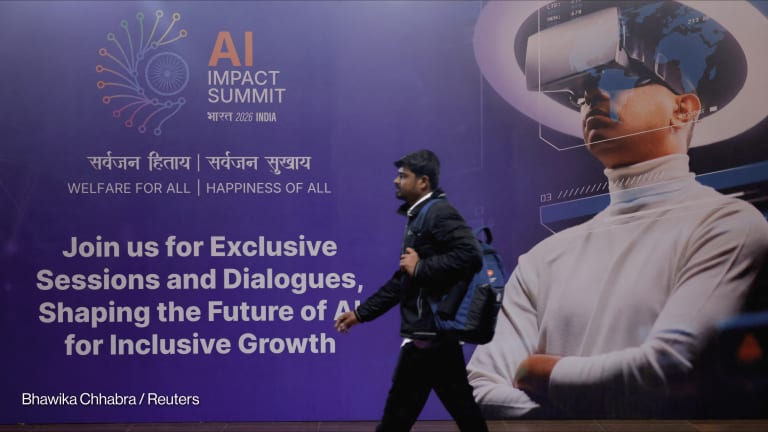
    Special edition: The global south demands a voice on AI at India summit
    Special edition: The global south demands a voice on AI at India summit
    How the development sector is finding its own way with AI
    How the development sector is finding its own way with AI
    UN agencies embrace AI as budgets fall and staff demand rises
    UN agencies embrace AI as budgets fall and staff demand rises
    Devex Newswire: US tests UN aid overhaul with $2B humanitarian pledge
    Devex Newswire: US tests UN aid overhaul with $2B humanitarian pledge

    Wikipedia, which turns 25 years old today — eons in tech time — still boasts an army of hundreds of thousands of volunteers to keep it honest and human. Artificial intelligence boasts seemingly infinite data and algorithms that have helped it become almost human in its thinking.

    Can the two coexist? Or more specifically, can Wikipedia collaborate, let alone compete with the inexorable march of AI?

    Maryana Iskander thinks so. She’s CEO of the Wikimedia Foundation, the nonprofit that powers the ubiquitous website. She pointed to advantages such as the language diversity that Wikipedia maintains over AI — for now at least.

    This article is free to read - just register or sign in

    Access news, newsletters, events and more.

    Join usSign in

    More reading:

    ► Is artificial intelligence a superpower or a weapon? (Pro)

    ► One big misconception about AI in development? It taking over the workforce

    ► How the development sector is finding its own way with AI

    • Innovation & ICT
    • Private Sector
    • Social/Inclusive Development
    • Media And Communications
    • Wikimedia Foundation
    Printing articles to share with others is a breach of our terms and conditions and copyright policy. Please use the sharing options on the left side of the article. Devex Pro members may share up to 10 articles per month using the Pro share tool ( ).

    About the author

    • Anna Gawel

      Anna Gawel

      Anna Gawel is the Managing Editor of Devex. She previously worked as the managing editor of The Washington Diplomat, the flagship publication of D.C.’s diplomatic community. She’s had hundreds of articles published on world affairs, U.S. foreign policy, politics, security, trade, travel and the arts on topics ranging from the impact of State Department budget cuts to Caribbean efforts to fight climate change. She was also a broadcast producer and digital editor at WTOP News and host of the Global 360 podcast. She holds a journalism degree from the University of Maryland in College Park.

    Search for articles
    Related Stories

    Devex NewswireRelated Stories - Special edition: The global south demands a voice on AI at India summit

    Special edition: The global south demands a voice on AI at India summit

    Artificial intelligenceRelated Stories - How the development sector is finding its own way with AI

    How the development sector is finding its own way with AI

    Artificial IntelligenceRelated Stories - UN agencies embrace AI as budgets fall and staff demand rises

    UN agencies embrace AI as budgets fall and staff demand rises

    Devex NewswireRelated Stories - Devex Newswire: US tests UN aid overhaul with $2B humanitarian pledge

    Devex Newswire: US tests UN aid overhaul with $2B humanitarian pledge

    Most Read

    • 1
      How green bonds can close the infrastructure finance gap
    • 2
      From India to the world: Advancing quality maternal care at scale
    • 3
      Inside Mars, Inc.'s $1 billion pivot toward sustainability
    • 4
      Climate change mandates more innovation in yellow fever vaccines
    • 5
      Africa can pay for its own health if we choose efficiency over dependency
    • News
    • Jobs
    • Funding
    • Talent
    • Events

    Devex is the media platform for the global development community.

    A social enterprise, we connect and inform over 1.3 million development, health, humanitarian, and sustainability professionals through news, business intelligence, and funding & career opportunities so you can do more good for more people.

    • About us
    • Membership
    • Newsletters
    • Advertising partnerships
    • Devex Talent Solutions
    • Post a job
    • Careers at Devex
    • Contact us
    © Copyright 2000 - 2026 Devex|User Agreement|Privacy Statement