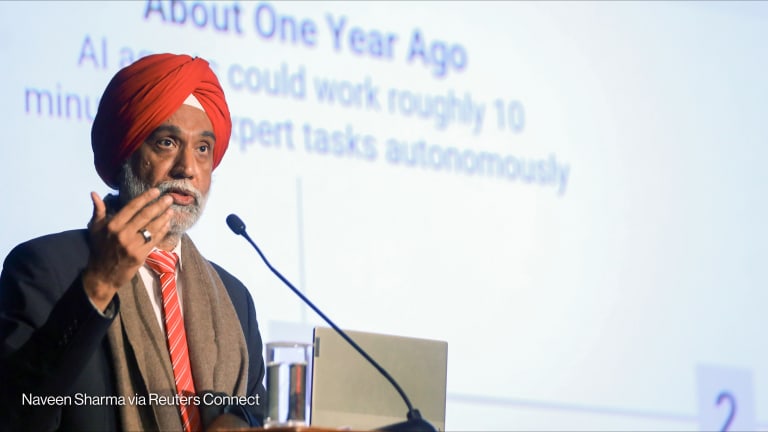



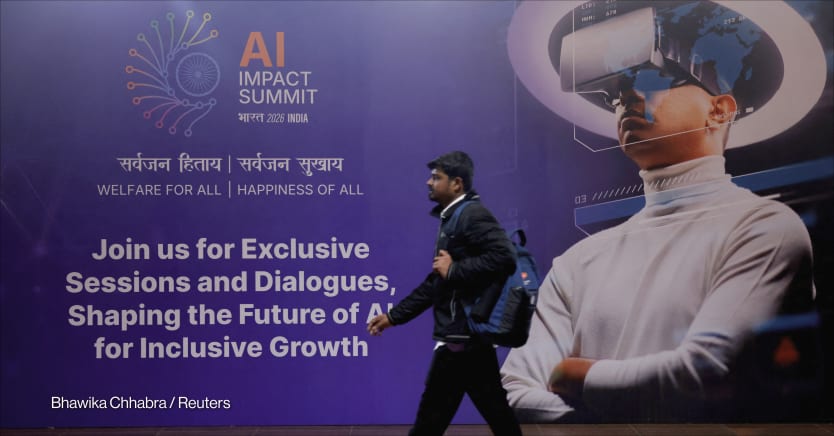
The posters and floral displays plastered across the streets of New Delhi during last week’s India AI Impact Summit left little room for ambiguity about the host country’s optimism on how AI will change the world. “Welfare for all. Happiness of all,” the posters read – many beneath an enlarged photograph of Indian Prime Minister Narendra Modi’s face.
Inside the summit itself, however, the mood was more measured.
As it becomes increasingly evident that artificial intelligence will drastically reshape global development, one question loomed large throughout the week: Who gets to shape AI?
“I don’t see why the technology can’t slow down,” Rachel Adams, founder and CEO of the Global Centre on AI Governance, told me. “Whose idea of where the world is at and how quickly it is moving are we listening to?”
India, the host of this major AI summit, wants more people to listen to the global south, especially given how AI is transforming sectors such as agriculture, health, and education.
The conference also focused on AI governance and safety, and how to ensure that the technology moves beyond hype to deliver measurable impact.
Summits like this can help to catalyze those conversations, said Claire Melamed, vice-president for AI and digital cooperation strategy at the U.N. Foundation. “How do we work out what’s the good AI and create the incentives, create the funding, create the policy frameworks that are going to push AI down that path?” she asked at one panel talk.
Public chaos, private talks
There was no shortage of high-profile participants to weigh in on that question. I attended talks by Google CEO Sundar Pichai, French President Emmanuel Macron, and Wikipedia cofounder Jimmy Wales, to name a few.
But one prominent philanthropist was conspicuously absent: Bill Gates. He was scheduled to present a keynote on Thursday, but canceled just hours beforehand. Employees of the Gates Foundation spent the week being ushered out of panel talks in an attempt to avoid the press.
At a conference beset with drama, however, gossip about the no-show was quickly eclipsed by other controversies. Business rivals OpenAI CEO Sam Altman and Anthropic CEO Dario Amodei made headlines after refusing to join hands during a photo op on the summit stage, and an Indian university sparked national embarrassment after it was discovered attempting to pass off a Chinese-made robot as its own.
The event was also widely criticized for its poor organization and for feeling at times more like a jobs fair than a forum for multilateral diplomacy. With an estimated 50,000 people flocking to the main venue, many in the hope of finding employment or funding for nonprofit ventures, long security queues and standstill traffic meant that some speakers missed their own panel talks.
As a result, many delegates told me that some of the best conversations were happening at private dinners in the nearby hotels — but that meant less space for attendees from the tech, development, and civil society sectors to overlap, they said.
“When I say it’s been a bit crazy, it’s that there’s so much excitement about being here – but it’s kind of reinforced some of those silos,” said Priya Vora, CEO of the Digital Impact Alliance.
AI for all
But there were also benefits to the summit being open to everyone. Despite her bafflement at the many requests for selfies, Melamed of the U.N. Foundation said it was nice to see so many young people engaging.
“It’s just amazing. You can’t walk down any hallway in the conference center without having amazing conversations with young people in India who are using AI to develop new businesses, to develop lots of really inspiring social projects,” she said.
This is the fourth summit aimed at coordinating government action on the safe use of AI, but the first to take place in the global south.
That is significant, said Adams, because it could help to ensure global regulations aren’t just set by a handful of countries. “With standards-setting processes in the past, they have been dominated by the people with the time and the resources,” she said. “And that has tended to exclude global south experts and representatives.”
But it’s also important for the general public to be involved in conversations about AI, she said, calling the lack of civil society engagement a “democratic deficiency.”
Namya Mahajan, cofounder of the Indian ed tech nonprofit Rocket Learning, said that hosting the summit in India represented a step forward.
“It’s moving closer to the communities that are using it the most [for development],” she told me. Rocket Learning aims to improve early childhood education by using AI-enabled WhatsApp messages to deliver tips and training to parents and community day care workers.
Ensuring that technology reaches communities where they are at — such as on WhatsApp — was a big theme throughout the summit. Many emphasized the importance of AI tools being available in local languages.
One nonprofit presenting its work at the summit was Digital Green, which uses an AI-powered assistant, FarmerChat, to deliver information and advice to smallholder farmers in 15 unique languages using voice-enabled technology.
“That is where I think it’s a big game-changer, to be able to converse to a product in a very natural way,” said Vineet Singh, chief technical officer at Digital Green.
AI can enable governments to tap into local talent within communities who speak minority languages, said Lacina Koné, CEO of Smart Africa, a Pan-African institution working to drive digital transformation. “We have never had a time where we have an emerging technology addressing the part of the society in Africa which [lacks education opportunities],” he said. “Being smart does not mean being smart in English, French, or Spanish. … You can be smart in your own language,” he said.
To ensure a focus on equity, many emphasized the importance of keeping humans in the loop — including Modi, who cautioned that “the ultimate responsibility for decision-making must always remain with human beings.”
“AI is coming into a world which is already highly unequal,” Melamed said. To ensure that the benefits of AI are evenly distributed, the United Nations is helping to facilitate “a global conversation among governments to make sure that we’re thinking about how to put people at the heart of this technology,” she said.
AI “is our opportunity to genuinely change the world, if we can get people to focus on what does everybody need, what would drive growth for everybody,” said Laura Gilbert, senior director of AI at the Tony Blair Institute for Global Change. For her, making sure that AI is inclusive is “war … and I don’t accept an outcome in which we lose,” she said.
Related reads:
• Can AI drive climate adaptation for India’s farmers?
• Why AI can’t transform classrooms until it learns local languages
• Opinion: Africa's AI future hinges on youth investment
Sovereign and open-source AI
The summit’s location in the global south also sharpened the debate around sovereign AI, with Macron warning countries against becoming mere data mines for foreign companies.
Data is often described by AI experts as the new oil — a resource of growing strategic and economic value. But its rising importance has also heightened concerns about the extraction of data from low- and middle-income countries, as well as its potential misuse for surveillance or discrimination.
“Now everyone is talking about sovereignty, but we’ve been talking about sovereignty for the past five years,” Kone said. Smart Africa is promoting “data embassies” to enhance digital sovereignty and data sharing across the continent, as well as AI scaling hubs to increase local skills and training, he said.
When it comes to core pillars of AI, such as large-scale computing infrastructure, local talent, and funding, “no one country among African countries can do this alone,” he said. The idea behind Smart Africa is to “cooperate or collaborate on the foundations, and compete on performance,” he said.
As well as cross-border collaboration, building open-source AI as a public good can also help more countries access AI tools, some said.
“Building in the public sector with open source is incredibly important,” Gilbert said. “You cannot go and say to people, ‘Trust us, we’re doing good things.’ You have to prove it.”
Building open-source AI tools also creates a feedback loop for improvement, said Singh of Digital Green. “If this is a digital public good and open, and it gets more usage, we see stronger signals that it improves faster, and we can serve our users collectively in a better way.”
Conversations on how to build sovereign AI in LMICs often focused on bolstering infrastructure, such as data centers and internet connectivity.
But the primary focus should be on creating societal impact, not sovereign models or supply-side constraints, Vora said. “Of course you need compute, and of course you need all of these inputs. But none of that will matter unless you’re pointing AI at real problems to solve,” she said.
Read: Is artificial intelligence a superpower or a weapon? (Pro)
+ Devex Pro members can get the most out of our coverage on how AI is getting integrated into globaldev work. A Pro membership gives you access to all our expert analysis, insider insights, funding database, exclusive events, and more. Not a Pro member yet? Start your 15-day free trial today.
A third way?
Those real problems took center stage in the summit’s outcome document. Signed by 88 countries and international organizations, the text emphasized the need to democratize AI resources and ensure equitable, trustworthy, and human-centric AI development.
But like last year’s summit in Paris, countries failed to come to a consensus on how to regulate AI.
“We totally reject global governance of AI,” White House technology adviser Michael Kratsios said on Friday, arguing that focusing AI policy on safety “inhibits a competitive ecosystem.”
But while India failed to chart the way forward on global consensus on governance, it did offer an alternative, reframing AI as a tool for maximizing societal good and helping countries to achieve development goals — and positioning LMICs as agenda-setters in the process.
This “third way” is distinct from the U.S. emphasis on unchecked innovation or Europe’s regulatory approach, said Adams, focusing instead on impact. Rather than being a race to develop the most powerful technologies, “in the global south I think you’re seeing a lot more countries starting from the premise of how do we build safe, inclusive, trustworthy and useful technologies, that help our people with the issues that we are most concerned about, which will be achieving development priorities,” she said.
The summit saw the launch of sector-specific AI impact casebooks, showcasing real-world AI deployments to provide a blueprint for implementing the technology in the global south. Many speakers also stressed the need to distinguish between hype and solutions with real impact, with new funding initiatives announced to bolster the evaluation of the impact and cost-effectiveness of AI tools.
“If we don’t measure those [impacts], we don’t know which technology is positive, which is neutral, and which is negative,” said Iqbal Dhaliwal, global executive director of The Abdul Latif Jameel Poverty Action Lab. With governments increasingly facing fiscal constraints, they “need clarity about where to invest their scarce dollars,” he said.
“We live in an age of AI hype right now,” said Alain Labrique, director of digital health and innovation department at the World Health Organization. “There’s a lot of inflated expectation.”
But scientific, evidence-based approaches to AI are important because “they’re credible, they build trust, and they also ensure safety,” he said. “From the training of models all the way to their deployment, we see science as an important part of the fabric of AI-based innovation.”
Related reads:
• UN tech envoy talks AI governance and the private sector
• UN launches two institutions to govern artificial intelligence
Sign up to Newswire for an inside look at the biggest stories in global development.
About the author

Catherine Davison
Catherine Davison is an independent journalist based in Delhi, India, writing on issues at the intersection of health, gender, and the environment.