As COP30 begins, new funding targets methane from oil, rice and waste
New investments aim to slash methane from fossil fuels, rice paddies and landfills — targeting the gas responsible for a third of current warming.
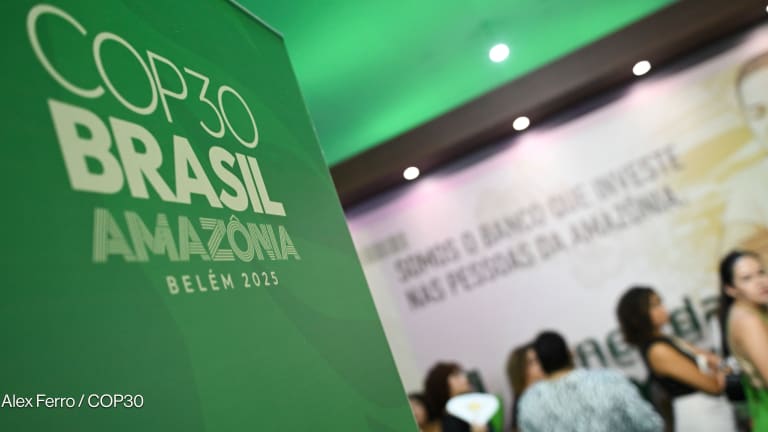
Thursday marked the first day of the COP30 leaders summit in Belém, Brazil — the high-level prelude to next week’s official talks — and methane is already coming in hot. Fitting, since it’s the gas heating the planet the fastest. Two major initiatives were rolled out on Thursday to tackle methane from two fronts: fossil fuels and rice. Bloomberg Philanthropies announced a $100 million investment to cut methane leaks from the oil and gas industry. The Global Methane Hub — a coalition of philanthropies and organizations working to slash methane emissions by 35% by 2030 — is a partner on Bloomberg’s investment, and also has committed $30 million to the new Rice Methane Innovation Accelerator to speed up research and deployment of low-emission rice farming. Methane accounts for about 30% of current global warming. It is far more potent than carbon dioxide but lingers in the atmosphere for a shorter time — making it one of the fastest ways to slow temperature rise if emissions are reduced. Cutting global methane by 30% by 2030 would have a similar impact to removing 10 gigatons of CO2 — the equivalent of shutting more than 2,000 coal plants. It remains to be seen whether this early momentum will translate into methane becoming a major topic at the 30th United Nations Climate Change Conference. “We need to tackle methane across oil and gas, agriculture, and waste if COP30 is to succeed. That requires concrete action,” Ana Toni, Brazil’s national secretary for climate change, said in a press call announcing the Bloomberg initiative. Oil and gas Oil and gas operations are responsible for roughly a quarter of human-caused methane emissions — much of it from leaks, venting, and flaring when gas is not captured or sold. Bloomberg Philanthropies said the $100 million will focus on four areas: • Better detection: Expand satellite coverage to spot methane leaks faster and at higher resolution. • Faster response: Grow global alert networks to flag super-emitters, track repairs and keep data public. • Policy and industry push: Work with major emitting countries and U.S. states to design and enforce methane rules and standards. • More people using the data: Train governments, civil society, and operators to use emissions data to drive action. The potential impact of strong methane policy is already visible in the Permian Basin. Research using satellite and aircraft data has shown that New Mexico — which adopted stricter methane rules — has lowered emissions, while neighboring Texas, with looser regulations and the same geology, has not, according to Marcelo Mena, chief executive of the Global Methane Hub. Gov. Michelle Lujan Grisham said New Mexico has cut oil and gas methane emissions by half while increasing production, adding that satellite data is essential to “measure our success and hold industry accountable.” The U.S. example is especially notable given the political backdrop: while the federal government is not expected to send a high-level delegation to COP30 under President Donald Trump, about 100 U.S. mayors and other local officials are still heading to Belém, arguing that methane and climate action can continue even without federal backing. Rice fields: A quieter but major source Rice cultivation generates about 10% of human-made methane emissions. Flooded fields create low-oxygen environments where bacteria break down organic matter — such as rice straw — and release methane. To address this, the Global Methane Hub announced $30 million for the Rice Methane Innovation Accelerator. The aim is to develop and scale practices that help farmers grow rice with lower emissions, without compromising yields or livelihoods. The accelerator plans to raise at least $100 million and already has backing from the Gates Foundation, Philanthropy Asia Alliance, Quadrature Climate Foundation, and Temasek Life Sciences Laboratory. By early 2026, it will publish a road map assessing the readiness of methane-reducing techniques such as alternate wetting and drying — a method tested for decades that periodically drains rice fields to reduce water use and methane. “Rice is one of the world’s most important crops, embedded in culture and economies,” said Yvonne Pinto, director-general of the International Rice Research Institute. “Farmers need new methods to adapt and grow more sustainably.” Food waste: Another piece of the puzzle Earlier this week at the C40 World Mayors Summit, the Global Methane Hub announced a $10 million plan to help cities in Latin America and the Caribbean cut methane from food waste — another major source of emissions when organic matter decomposes in landfills. The funding will support city-level methane reduction strategies, along with new finance, data, and policy tools. In Belém specifically, the hub will support the city’s first organic waste segregation and composting facility, to be launched during COP30 and positioned as a model for low-methane urban systems in the Amazon. So with that, methane will leave a tangible legacy in Belém through new facilities and funding. Whether COP30 leaves a legacy on methane globally remains to be seen. Update, Nov. 21, 2025: This article has been updated to clarify that Marcelo Mena, the chief executive of the Global Methane Hub, is the source of information comparing New Mexico’s emissions to Texas.
Thursday marked the first day of the COP30 leaders summit in Belém, Brazil — the high-level prelude to next week’s official talks — and methane is already coming in hot. Fitting, since it’s the gas heating the planet the fastest.
Two major initiatives were rolled out on Thursday to tackle methane from two fronts: fossil fuels and rice. Bloomberg Philanthropies announced a $100 million investment to cut methane leaks from the oil and gas industry. The Global Methane Hub — a coalition of philanthropies and organizations working to slash methane emissions by 35% by 2030 — is a partner on Bloomberg’s investment, and also has committed $30 million to the new Rice Methane Innovation Accelerator to speed up research and deployment of low-emission rice farming.
Methane accounts for about 30% of current global warming. It is far more potent than carbon dioxide but lingers in the atmosphere for a shorter time — making it one of the fastest ways to slow temperature rise if emissions are reduced. Cutting global methane by 30% by 2030 would have a similar impact to removing 10 gigatons of CO2 — the equivalent of shutting more than 2,000 coal plants.
This article is free to read - just register or sign in
Access news, newsletters, events and more.
Join usSign inPrinting articles to share with others is a breach of our terms and conditions and copyright policy. Please use the sharing options on the left side of the article. Devex Pro members may share up to 10 articles per month using the Pro share tool ( ).
Ayenat Mersie is a Global Development Reporter for Devex. Previously, she worked as a freelance journalist for publications such as National Geographic and Foreign Policy and as an East Africa correspondent for Reuters.