
“Efficiency,” “alignment,” “sustainability,” “leverage.” In Washington, D.C., where health and finance ministers, global health leaders, and international funders gathered for the World Bank’s Spring Meetings, these are ways of talking — or not talking — about a growing fear: A large group of countries are facing an alarming health funding landscape. “We have a problem globally,” health economist David Evans said Thursday at a forum on health financing. The problem, Evans said, is particularly acute in a group of 28 low- and middle-income countries whose governments are spending less on health than they did before the COVID-19 pandemic, with no prospect — according to International Monetary Fund projections — of returning to those pre-pandemic levels in the next five years. At the same time that national governments confront fiscal constraints that create tradeoffs between health spending and other budget line items, international health and development organizations are competing with each other this year for donor funding that threatens a post-pandemic retraction. The World Bank’s International Development Association, or IDA, the World Health Organization, and Gavi, the Vaccine Alliance are all calling on donors to replenish their funding this year. “We are an instrument of the ambition of our donors. I can’t fabricate money out of thin air,” World Bank President Ajay Banga said earlier this week when asked about his hopes for the replenishment of IDA, the bank’s lending arm for the world’s lowest-income countries. Even with record levels of overall aid funding, the share arriving in low-income countries has shrunk as donors redirect funds to the crisis in Ukraine, “global public goods” such as climate change, and even to pay for the domestic costs of hosting refugees. “If you’re taking that away from those 28 countries, you’re saying, ‘people can die here,’ essentially,” Evans said. In 2022, a quarter of official development assistance went to Ukraine and to support refugees within donor countries, leading to a decline in aid to African countries and the lowest-income countries, according to an analysis by One Campaign. Major donors including the European Union, France, Germany, and the United States have announced cuts to development assistance this year. “G20 governments seem to have forgotten the devastating effect that COVID19 had on the globe — and the devastating toll that other preventable diseases have on so many people in our world,” David McNair, One Campaign executive director for global policy, told Devex. He added that full financing for IDA and Gavi this year and the Global Fund to Fight AIDS, Tuberculosis and Malaria next year is “absolutely critical.” Asked by Devex to describe the current state of global health financing in one word, another NGO leader texted: “Precarious.” Reach and resources On Thursday, sharing the main stage with WHO Secretary-General Tedros Adhanom Ghebreyesus, Banga announced that the World Bank will extend its health programs to 1.5 billion people by 2030 — roughly doubling its current reach. But it’s not clear if that target comes with additional funding — and if so, where that funding will come from. On stage in the World Bank’s atrium, Banga mentioned a 50% increase in the bank’s funding for health, but that figure doesn’t appear in any of the accompanying materials about the target. “We are an instrument of the ambition of our donors. I can’t fabricate money out of thin air.” --— Ajay Banga, president, World Bank In a call with reporters earlier in the week, the bank’s health lead, Juan Pablo Uribe, said the new target is based on the roughly $4.4 billion the bank spent on health 2023 and a desire “to maintain and, of course, as possible increase that funding number in the future.” One reporter on the call politely asked the officials to restate what exactly it was they were announcing. A similar sentiment came through during the public announcement on Thursday. Nigerian Health Minister Muhammad Ali Pate said he was “very encouraged” to hear the 1.5 billion commitment, but added that for Nigeria to contribute a potential 100 million people to that goal requires “backing that up with resources.” Banga’s reform agenda for the bank is focused on fixing the institution’s internal “plumbing,” in hopes that streamlining operations and shortening timelines can help the bank achieve more with the resources it has. This week Banga has repeatedly emphasized that he has limited money to work with. The bank’s largest shareholder, the United States, believes a “very strong replenishment is absolutely necessary,” Jay Shambaugh, the undersecretary for international affairs at the U.S. Treasury, said on Tuesday. “We also thought in this replenishment round are really hoping to drive attention not just towards headline numbers but towards impact, and try to make sure that … IDA is using its balance sheet as well as possible,” he added. No ‘magic pot’ of money Within the global health landscape, sustainable financing for HIV presents a particular challenge. Due to the epidemic’s emergency origins, HIV-affected countries disproportionately rely on external funding to support their response efforts and are therefore highly exposed to any changes in donor commitment. In low- and middle-income countries, roughly one-third of overall health financing comes from international donors, according to Jaime Atienza Azcona, director of the equitable financing practice department at UNAIDS. But for HIV/AIDS, Atienza Azcona said, that reliance on international funding rises to three-quarters. At the same time, the reduction of new HIV infections has been slower than projected, while international donor funding is flat or decreasing. “There is no magic, hidden pot of money out there waiting to be invested,” said Mike Ruffner, deputy coordinator for financial and programmatic sustainability for PEPFAR, the U.S. government’s global HIV/AIDS initiative. “We have to be smarter about what we do today. We’re fundamentally spending our money the same way we were a decade ago,” Ruffner said. That is putting pressure on health ministers to squeeze everything they can out of tight budgets, through reforms and other displays of “country ownership” that make them better candidates for support from external donors who have to pick and choose. Nigeria is pushing a “trilateral compact” between its federal government, subnational governments, and external donors to use limited health funds more efficiently. Indonesia is trying to turn $4 billion in multilateral development bank loans into a catalyst for private sector investment in health. Kenya is rallying around “donor transition road maps.” Meanwhile, health ministries are putting pressure on their finance colleagues to give them a bigger share of national budgets. “We have to go there with threats,” said Emily Chirwa, deputy director of policy and planning for Malawi’s Ministry of Health. For example, with 80% of Malawi’s AIDS drugs paid for by international donors, what happens to people living with HIV if those donors start to pull back? Malawi increased the health sector’s share of the national budget from 8.5% to just over 12% this year, Chirwa said. But, she noted, the country’s per capita health spending is still only half of what WHO recommends. The “rapid progress” on many global health indicators seen in the early 2000s has “markedly stalled since 2015,” according to WHO, putting progress toward health-related Sustainable Development Goals at risk. On Tuesday, the World Bank hosted a closed-door meeting on “unveiling pathways towards sustainable and innovative financing for public health in Africa.” One person who attended the meeting told Devex a key message was: “We’re in a very dire situation.”



“Efficiency,” “alignment,” “sustainability,” “leverage.”
In Washington, D.C., where health and finance ministers, global health leaders, and international funders gathered for the World Bank’s Spring Meetings, these are ways of talking — or not talking — about a growing fear: A large group of countries are facing an alarming health funding landscape.
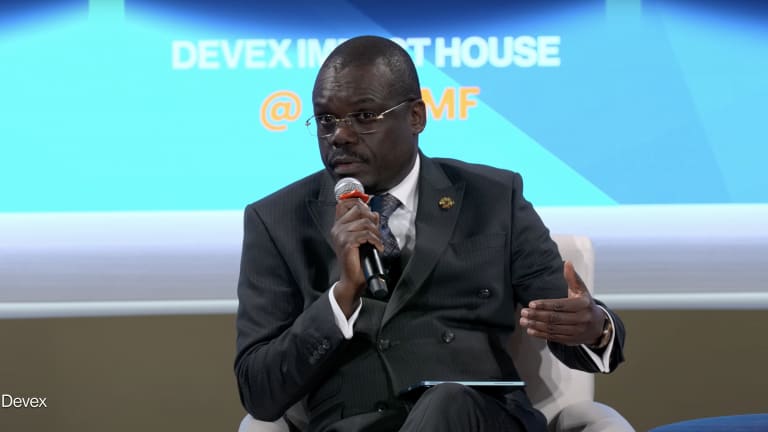
“We have a problem globally,” health economist David Evans said Thursday at a forum on health financing.
Printing articles to share with others is a breach of our terms and conditions and copyright policy. Please use the sharing options on the left side of the article. Devex Pro members may share up to 10 articles per month using the Pro share tool ( ).
About the author

Michael Igoe@AlterIgoe
Michael Igoe is a Senior Reporter with Devex, based in Washington, D.C. He covers U.S. foreign aid, global health, climate change, and development finance. Prior to joining Devex, Michael researched water management and climate change adaptation in post-Soviet Central Asia, where he also wrote for EurasiaNet. Michael earned his bachelor's degree from Bowdoin College, where he majored in Russian, and his master’s degree from the University of Montana, where he studied international conservation and development.
Search for articles


Most Read
- 1
- 2
- 3
- 4
- 5