



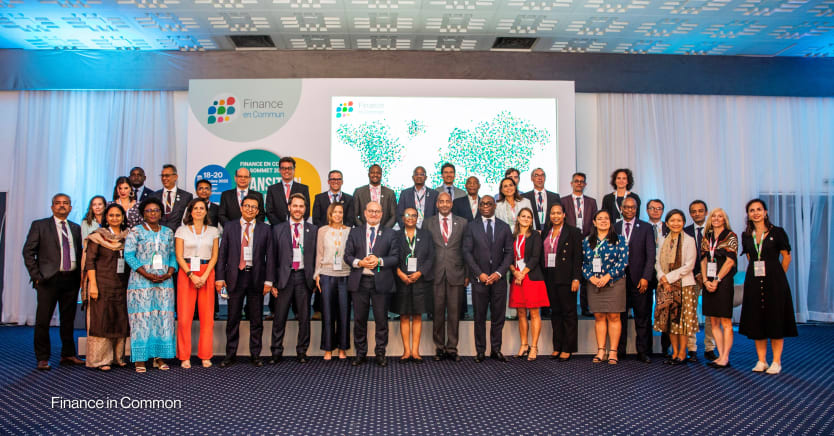
Five years after its launch, Finance in Common, or FiCS, is entering a more demanding phase.
The question is no longer whether public development banks, or PDBs, can convene — FiCS has shown this is possible by bringing together more than 540 PDBs and partners managing approximately $23 trillion in assets into a coordinated global platform working toward a sustainable future. According to the network’s five-year activity report, PDBs are now recognized by countries as decisive for providing the long-term, lower-cost financing necessary to meet the Sustainable Development Goals.
The real challenge now is moving toward a coherent financial system capable of delivering results at scale for people and planet.
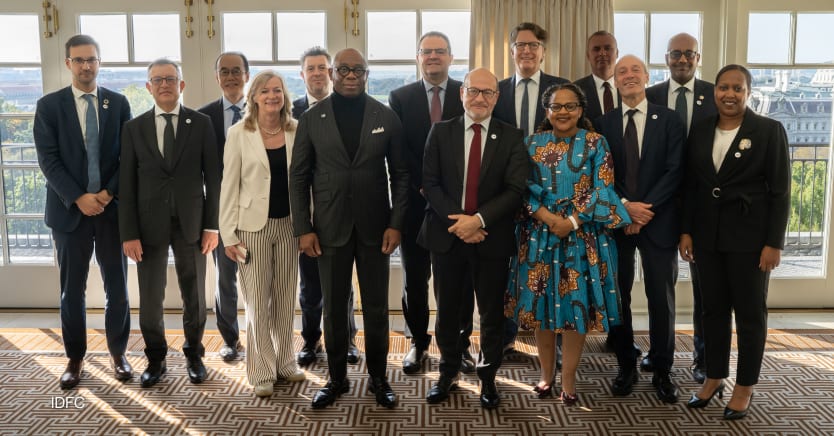
At the heart of this transition is the International Development Finance Club, or IDFC — a network of 27 national and regional development banks with a strong footprint in emerging and developing economies. While FiCS widens coordination, IDFC works to deepen operational alignment, bringing PDB mandates closer to national development strategies and the SDGs.
Spearheading these efforts is Serge Ekué, chair of IDFC. His leadership is shaped by the other hat he wears as president of the West African Development Bank, or BOAD, serving eight countries within the West African Economic and Monetary Union. For this region — which faces acute climate risks despite contributing minimally to global emissions — making projects bankable is not an abstract goal, but a daily operational challenge.
Devex spoke with Ekué about how closer alignment among public development banks can lower the cost of capital, mobilize private investment, and deliver climate resilience in West Africa.
This interview has been edited for length and clarity.
Five years into the Finance in Common movement, there is an increasing focus on demonstrating impact. From your vantage point, what signals of success matter most in assessing how FiCS is improving coordination among PDBs and shifting the needle on sustainable development?
Key signals of success that matter include things like tangible coordination outcomes. Are PDBs cofinancing projects at scale? Are we building joint pipelines across institutions, rather than relying on isolated bilateral initiatives?
In terms of mobilization, which remains the central question, numbers that show private coinvestment mobility through FiCS, supported de-risking tools, and blended finance facilities are critical to proving that public capital is unlocking real flows — things like standardizing the framework [or] tracking methodology for climate, biodiversity, and policy influence.
In the end, the success of FiCS will not be measured simply by the growth of the network, but by the depth of engagement, the alignment of practices, and the measurable impact on financing the SDGs.
How do you see the IDFC’s specific mandate complementing the broader FiCS platform, and how can these two networks work in tandem to reduce fragmentation in the development finance landscape?
They play distinct but deeply complementary roles. Where IDFC’s mandate emphasizes peer learning, capacity building, harmonized methodologies — like green finance tracking — and operational cooperation among its members, FiCS amplifies that work by embedding these practices into a global ecosystem.
If these two platforms are strategically aligned, they can move from a network dynamic to a more integrated development finance architecture — reducing duplication, strengthening collective impact, and improving global financial alignment with climate and SDG objectives.
To summarize: IDFC deepens where FiCS widens. IDFC provides the technical coherence and operational backbone, while FiCS provides political scale and global orchestration.
What types of instruments or risk-sharing mechanisms do you see as the most promising for PDBs, particularly to mobilize private capital for climate, resilience, and sustainable infrastructure in developing markets?
Some of the most promising instruments and mechanisms include:
1. Blended finance and guarantee structures, including partial credit and partial risk guarantees, as well as first- and second-loss mechanisms. Because of their strong credit ratings, PDBs can use guarantees to share risk with private partners, making investments in sustainable infrastructure, renewables, and resilience more bankable.
2. Local currency financing combined with de-risking instruments. Currency risk is often a major deterrent for private capital entering emerging markets.
3. Outcome-based or performance-linked structures. Instruments that tie returns to climate or development outcomes, such as resilience bonds or SDG-linked loans, can mobilize investors who are seeking both impact and financial returns.
PDBs are now recognized as decisive for long-term and lower-cost financing of investments in sustainable development. How are you translating this global recognition into tangible results for West Africa, and how does Finance in Common help amplify this model?
We define ourselves as interconnectors, linking those who have capital and risk-bearing capacity with those who have projects and urgent needs. The context in West Africa is that we face significant climate vulnerabilities, including coastal erosion and food system disruptions, yet we contribute relatively little to global emissions. So the challenge for us is to translate the growing global recognition of the strategic role of PDBs into affordable financing on the ground.
In terms of what [BOAD is] doing: One, we are strategically mobilizing climate finance. Over the years, we have built significant experience and increased our investments and commitments in both mitigation and adaptation projects. We work closely with global climate funds, [which] allows us to naturally bring concessional resources into our subregion. We have also launched climate project preparation facilities to fast-track climate finance mobilization.
Two, by cofinancing with multilateral institutions and leveraging guarantee mechanisms, we can reduce borrowing costs and the overall cost of capital for both sovereign and private sector projects.
We are also investing in the blue economy and climate resilience, and we amplify this work through the FiCS and IDFC networks. Being part of these platforms gives us access to shared analytical tools, global best practices, strategic partnerships, and cofinancing opportunities.
IDFC has been a leader in translating global goals into reality, particularly in green finance mapping and reporting. How can IDFC’s leadership in setting rigorous standards and reporting metrics serve as the operational “engine” for the broader FiCS movement?
IDFC has long championed rigorous measurement and reporting, especially in areas like climate finance, which is at the core of our mandate. Through initiatives such as the Green Finance Mapping exercise and the Common Principles for Climate Mitigation and Adaptation Finance Tracking, we have built a strong operational framework. This operational backbone is critical for several reasons.
The first one is that it creates trust and comparability. Shared definitions and reporting formats mean that financial institutions, governments, and investors can compare and aggregate data reliably. That enables better decision-making.
Two, it drives accountability. When members report against rigorous metrics, stakeholders — including civil society and international partners — can clearly see progress or gaps, building confidence.
And three, it supports the development of bankable project pipelines, which is central to our work. Strong standards help shape investment-ready projects by embedding environmental and social safeguards that are increasingly required by private capital.
You have advocated for a unified PDB system. Looking toward 2030, what one structural reform do you believe FiCS and IDFC must secure for the global financial architecture in the next five years?
That is a difficult question, but if I had to identify one structural reform for the next five years, it would be embedding PDBs into a unified financial ecosystem that can systematically mobilize private capital at scale.
The reality is that private capital pockets are deep enough to finance global development needs. The issue is not the lack of capital; it is the lack of structures that make projects bankable and aligned with environmental, climate, and credibility standards. That is where we have a role to play.
In practical terms, reform could include global or regional guarantee platforms, expanded local currency facilities, and better integration of PDB data and climate and SDG finance metrics. It also means stronger alignment between PDB mandates, national development strategies, and the SDGs.
Explore FiCS’ five years of impact and its recently released activity report at https://financeincommon.org/five-years-of-fics.
This content is sponsored by Finance in Common as part of Financing the Future — a series exploring how the global development finance system is evolving to unlock capital, reform institutions, and build investable markets for sustainable growth. Click here to learn more.
About the author

Devex Partnerships
Thanks for reading and for your interest in Devex. In collaboration with our partners, Devex’s partnerships editorial team produces content to promote a partner’s work or perspectives on a particular issue. It gives actors across the global development sector — including nongovernmental organizations, private sector stakeholders, aid agencies and government institutions — the opportunity to go beyond traditional advertising and tell their stories in an impactful way. If you’d like to learn more about how you can shine a spotlight on a particular issue with Devex, please email partnerships@devex.com. We look forward to hearing from you.
Search for articles


Most Read
- 1
- 2
- 3
- 4
- 5