Career paths for UN peacekeepers
As approximately 17,000 U.N. peacekeepers face job losses due to budget cuts, Devex asks the experts for advice on their next steps.
In October, United Nations peacekeepers became the latest in the aid sector to face job cuts. An announcement by the U.N. stated that the loss of funding, largely linked to the U.S. foreign aid cuts, will mean eliminating around 25% of the 68,000-strong workforce. With such a niche skill set, the question of what's next looms large for many of these professionals. “If you find yourself in the mix of that change where peacekeeping missions are reduced … you have to ask yourself, ‘How can I pivot?’ said Daniel Mutuku, a Kenya-based learning and development consultant. “I will tell you, there are so many ways that you can pivot.” Peacekeepers typically have a military or police background and are deployed to overseas missions in an effort to reduce conflict, protect civilians, and create the conditions for political dialogue and peace. Known informally as the blue helmets — as a nod to their uniform — these professionals are currently deployed across 11 missions, including in India, Lebanon, and South Sudan. “Our peacekeepers, your peacekeepers, protect people — they make the difference between life and death for hundreds of thousands of civilians,” said Jean-Pierre Lacroix, the U.N. peacekeeping chief, in a statement. The budget for peacekeeping missions comes from U.N. member states, and historically over a quarter of that has been provided by the U.S. But as President Donald Trump continues his crackdown on foreign aid, the funding loss means missions cannot be sustained at the same level. The budget for peacekeeping operations will be cut by 15% in the next fiscal year, following a request from the U.N. Secretary-General António Guterres. This translates to the sending home of approximately 17,000 peacekeepers. “Unfortunately, we have no other option,” said Lacroix. Devex asked the experts what those affected can do next and how they can best utilize their experience and expertise. 1. Rejoin the military or police Before becoming U.N. peacekeepers, these individuals start their careers in their own country’s armed forces or police service. From there, they can be nominated for peacekeeping duty if their country is a U.N. member state. Other civilian roles can be applied for via the U.N. careers website. One option for peacekeepers who find themselves out of a job is to rejoin their national services. Many may have been seconded to their mission anyway, making returning to their previous force easier. Peacekeepers may also be better placed than other U.N. functions to find work given the increase in defence and military focus among certain governments, said Holly White, a human resources consultant with experience in the U.N. system. The likes of the U.K., India, and Sweden have, for example, increased their national security budgets. Some individuals could, however, face issues if their home country is no longer safe or they simply don’t wish to return. “Maybe they had kept their career moving from mission to mission, and now they're going to have to return back to a place that they might not have been for many years,” said White. “It's going to take a while to acclimate … so give yourself a little grace and then do that exploration.” 2. Identify similar roles across the sector Another option is to find a similar role but with a different entity. Many affected peacekeepers have reached out to Guillaume Stollsteiner, founder of Swiss HR consultancy Transition and Performance, or TNP, which runs programs for NGO staff affected by the global restructuring. He shared that “their first concern is trying to find something in the same industry.” Although the title might be unique to the U.N., several NGOs, governments, and foundations utilize the same skillset and have similar roles to those of peacekeepers. “Maybe they could find roles in emergency response or coordination,” said Stephanie Playford, founder of United Career Coalition, a platform that provides access to U.N. career insights. “Familiarize yourself with which foundations or organizations align with peacekeeping principles and how these organizations benefit from the peacekeepers' experience and principles,” she advised. Despite a slowdown in hiring across the sector, Devex’s jobs board currently lists vacancies for a humanitarian disarmament and peacebuilding manager with the Danish Refugee Council, a governance and peacebuilding expert with Committed to Good, and a humanitarian access and safety adviser with the Norwegian Refugee Council. As the aid sector adapts to the rise of technology, there could also be roles in emerging spaces, Playford added. These include peace-tech entrepreneurship, where innovative technologies are tested for early warning systems or humanitarian coordination, or in think tanks looking at peace, innovation, and research. 3. Transition into the private sector According to Stollsteiner, a lot of the skills that peacekeepers possess may be sought after by corporations looking to enter emerging markets. Peacekeepers have skills in risk assessment, operations, management of people, community engagement, and logistics, said Katarina Holm-DiDio, an executive and leadership team coach who has supported civilian personnel in peacekeeping missions over the years. “It's so unique to have worked in the peacekeeping mission, so you're often very good at emergencies, logistics, getting things done while under stressful, dangerous situations, " she said. ‘Those are sought-after skills, experience, and traits these days.” Key to getting roles that match these skills, said Playford, is translating duties and experience into transferable assets. For example, integrity could be framed as ethical leadership, and humanity as an empathy-led approach. “That's very important because I think, in general, peacekeepers often underplay what they've experienced and their achievements,” she said. Mutuku suggested that a career coach can help translate the credentials racked up during peacekeeping into corporate or civilian job titles. 4. Work with local communities While the assumption might be that peacekeeping is predominantly military work, much of the role, according to White, involves community interface and relations, and that experience could set someone up for community-based work. A candidate would just need to be able to communicate beyond the perceived notion that peacekeeping is mostly security, she said. Other skills candidates should highlight, said Mutuku, include field leadership and crisis management. These experiences can lend themselves to roles in the community but also in civil-military coordination, policy and advocacy, peacebuilding, human rights, and transitional justice, he suggested. 5. Take some time out Finances permitting, the return home could be an opportunity to reset and recoup after a high-pressure role. Operating in high-risk environments, over 4,465 peacekeepers have been killed since 1948, with many more affected by the mental health toll of witnessing conflict on the frontlines. On top of that, navigating the widespread layoffs also presents a challenge. “What should not be underestimated is the emotional effect of that,” said Playford. “Having been in these high-stress environments and high-responsibility environments, peacekeepers often face a sense of loss or a loss of identity when they try to look for jobs in a new sector.” Taking some time to figure out the next step rather than jumping into another role could be beneficial, said Stollsteiner, who believes that lacking clarity only impedes a job search. “When you’re not clear on what you’re looking for, the message, the targeting, and the position isn’t clear,” he said. Connect with others who are in the same situation and remember that the values of peacekeeping don’t have to end when the mission does, advised Holm-DiDio. “The uniform may change, or the organization may change, but the mission and what they have learned and the skills that they have developed — trust, stability, and hope — keeps on going.”
In October, United Nations peacekeepers became the latest in the aid sector to face job cuts. An announcement by the U.N. stated that the loss of funding, largely linked to the U.S. foreign aid cuts, will mean eliminating around 25% of the 68,000-strong workforce. With such a niche skill set, the question of what's next looms large for many of these professionals.
“If you find yourself in the mix of that change where peacekeeping missions are reduced … you have to ask yourself, ‘How can I pivot?’ said Daniel Mutuku, a Kenya-based learning and development consultant. “I will tell you, there are so many ways that you can pivot.”
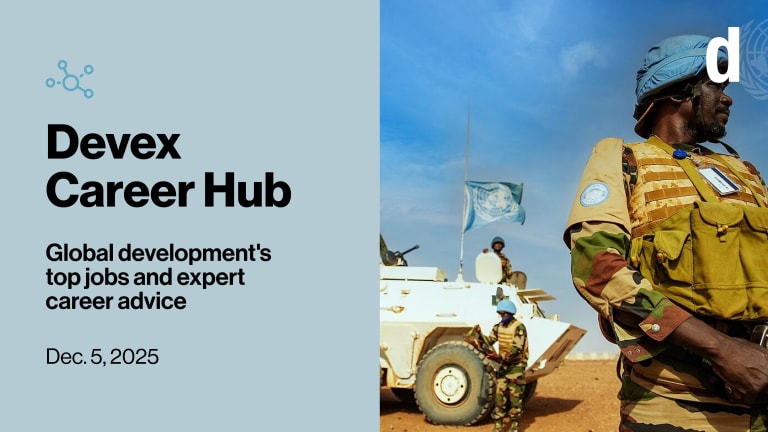
Peacekeepers typically have a military or police background and are deployed to overseas missions in an effort to reduce conflict, protect civilians, and create the conditions for political dialogue and peace. Known informally as the blue helmets — as a nod to their uniform — these professionals are currently deployed across 11 missions, including in India, Lebanon, and South Sudan. “Our peacekeepers, your peacekeepers, protect people — they make the difference between life and death for hundreds of thousands of civilians,” said Jean-Pierre Lacroix, the U.N. peacekeeping chief, in a statement.
This article is exclusively for Career Account members.
Unlock this article now with a 15-day free trial of a Devex Career Account. With a Career Account subscription you will get:
- Full access to our jobs board, including over 1,000 exclusive jobs
- Your Devex profile highlighted in recruiter search results
- Connections to recruiters and industry experts through online and live Devex events
Start my 15-day free trialAlready a user?
Printing articles to share with others is a breach of our terms and conditions and copyright policy. Please use the sharing options on the left side of the article. Devex Pro members may share up to 10 articles per month using the Pro share tool ( ).
Rebecca L. Root is a freelance reporter for Devex based in Bangkok. Previously senior associate & reporter, she produced news stories, video, and podcasts as well as partnership content. She has a background in finance, travel, and global development journalism and has written for a variety of publications while living and working in Bangkok, New York, London, and Barcelona.