• News
    • Latest news
    • News search
    • Health
    • Finance
    • Food
    • Career news
    • Content series
    • Focus areas
    • Try Devex Pro
  • Jobs
    • Job search
    • Post a job
    • Employer search
    • CV Writing
    • Upcoming career events
    • Try Career Account
  • Funding
    • Funding search
    • Funding news
  • Talent
    • Candidate search
    • Devex Talent Solutions
  • Events
    • Upcoming and past events
    • Partner on an event
  • Post a job
  • About
      • About us
      • Membership
      • Newsletters
      • Advertising partnerships
      • Devex Talent Solutions
      • Contact us
Join DevexSign in
Join DevexSign in

News

  • Latest news
  • News search
  • Health
  • Finance
  • Food
  • Career news
  • Content series
  • Focus areas
  • Try Devex Pro

Jobs

  • Job search
  • Post a job
  • Employer search
  • CV Writing
  • Upcoming career events
  • Try Career Account

Funding

  • Funding search
  • Funding news

Talent

  • Candidate search
  • Devex Talent Solutions

Events

  • Upcoming and past events
  • Partner on an event
Post a job

About

  • About us
  • Membership
  • Newsletters
  • Advertising partnerships
  • Devex Talent Solutions
  • Contact us
  • My Devex
  • Update my profile % complete
  • Account & privacy settings
  • My saved jobs
  • Manage newsletters
  • Support
  • Sign out
Latest newsNews searchHealthFinanceFoodCareer newsContent seriesFocus areasTry Devex Pro
    • News
    • UNGA 2025

    Danish Refugee Council chief decries the loss of humanitarian norms

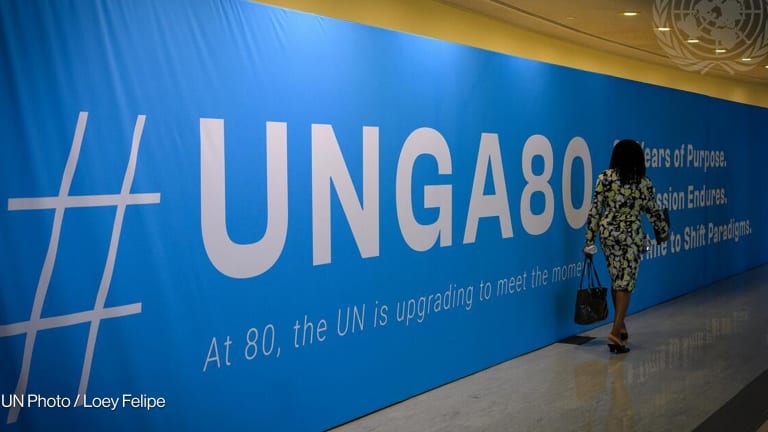
    “It is as if a barrier has been crossed where it’s … difficult to return to the respect for international humanitarian law,” Charlotte Slente, secretary-general of DRC, tells Devex on the sidelines of UNGA80.

    By Anna Gawel // 01 October 2025
    The Danish Refugee Council is one of the few international NGOs with specific expertise in forced displacement. With Israel’s military offensive in Gaza displacing an entire population multiple times — and a slew of other crises uprooting millions — that expertise is needed perhaps now more than ever. Charlotte Slente, secretary-general of DRC — which manages 37 sites on the ground in Gaza for internally displaced persons — calls it an “extremely dire situation.” “In Gaza City, which is being bombarded now quite heavily, we have around half a million people staying there, with no possibility of going anywhere, and that is because [humanitarian] sites are overcrowded,” Slente told Devex on the sidelines of the 80th U.N. General Assembly last week. “The other impediment is a financial one — that moving yourself and your stuff is extremely costly, and people have no resources, so financially, it’s not possible,” she added. “And then the third thing is that people are basically exhausted — I mean, to the degree that many people say, ‘Let us stay here and die.’ We hear the stories from our staff [that] the life in people’s eyes has been closed. … So basically a horrific place to be.” Slente said that while the humanitarian assistance Israel allows in is “extremely scarce,” her organization is “trying to help with whatever little we have there.” That includes cash assistance to combat skyrocketing prices for basic goods and educating people on the dangers of unexploded ordnance. As for the controversial Israel- and U.S.-backed Gaza Humanitarian Foundation, Slente calls it a humanitarian mechanism “that is not humanitarian, that is deeply politicized, deeply militarized.” “The Gaza Humanitarian Foundation is not a model that is impartial, neutral, and with full access to everyone. And we know of … people having been killed trying to get assistance at pickup points,” she said, arguing that GHF is not an approach the U.S. should replicate elsewhere. She called GHF one of many examples of international humanitarian law being flouted, with record numbers of humanitarian workers killed last year. “It is as if a barrier has been crossed where it’s … difficult to return to the respect for international humanitarian law … and the mechanisms to ensure that respect are also being severely challenged,” she said, noting that the U.N. Security Council is perpetually “stuck.” And while there has been some political progress in countries at the U.N. recognizing Palestine’s right to self-determination, that won’t help the people of Gaza right now. “We need humanitarian access, we need a ceasefire,” Slente said, noting that while recognizing Palestinian independence is symbolically important, “it will not, in itself, make a difference today for the people who are suffering in Gaza.” But Gaza is far from the only burning refugee crisis at the moment. Slente had just visited Afghanistan, where she tells us that over 2 million Afghan refugees have been forcibly returned this year because of mass deportations carried out by Iran and Pakistan. The result? An influx of people in a country that can’t afford them. She met a 25-year-old woman who had been born in Iran, and had never even been to Afghanistan, who now found herself the head of the household because her father was ill and her brother was young. Slente said she literally had nowhere to go. “This very young woman with a lot of strength and capacity, but basically in a state of desperation about what was she going to do with her life,” Slente said. For all the political backlash against refugees supposedly surging into the United States and Europe, Slente points out that nearly 75% of refugees are taken in by neighboring countries, many of which are impoverished themselves and now face the added strain of foreign aid cuts. “There’s solidarity, there’s Pan-Africanism … but we need the solidarity of the international community to financially support us in that,” she said, adding that there’s an “unwritten contract” that if the global north doesn’t want to take in refugees, it needs to help the global south absorb them — “and that contract is broken.” “So if the global north says we’re going to control our borders, we’re going to invest heavily in ensuring that no one penetrates our continents, and at the same time say we are going to reduce funding for you hosting [them], then I think there’s a risk that … people basically will have nowhere to go, so people will be knocking on closed doors.” To help predict displacement flows around the world, DRC has developed, along with IBM, a system that uses an algorithm derived from open-source data to give countries advance warning of refugees that could be arriving in the next one to three years. Anticipating such migration crises is far less costly than reacting to them after the fact, Slente said. “Let’s invest more in prevention, in anticipatory action, and maybe this financial crisis that we’re now seeing in the humanitarian sector could be the moment where we actually do try to make that shift more deliberate,” she said. “That requires a lot of diplomatic efforts because it’s visible what you fund, when you fund emergencies, and when you see people hit by crisis. It’s less visible if you fund something where you avoid a crisis from happening. So it’s a little bit counterintuitive,” she said. “But I think there’s a momentum now on the need for humanitarian reform that we could actually make an intentional push there.”

    Related Stories

    Devex Newswire: Crackdown on Soros sparks nonprofit sector backlash
    Devex Newswire: Crackdown on Soros sparks nonprofit sector backlash
    MSF demands Gaza Humanitarian Foundation close for ‘orchestrated killing’
    MSF demands Gaza Humanitarian Foundation close for ‘orchestrated killing’
    The split screen of the Gaza Humanitarian Foundation
    The split screen of the Gaza Humanitarian Foundation
    UNGA80 reporters' notebook: Day 3
    UNGA80 reporters' notebook: Day 3

    The Danish Refugee Council is one of the few international NGOs with specific expertise in forced displacement. With Israel’s military offensive in Gaza displacing an entire population multiple times — and a slew of other crises uprooting millions — that expertise is needed perhaps now more than ever.

    Charlotte Slente, secretary-general of DRC — which manages 37 sites on the ground in Gaza for internally displaced persons — calls it an “extremely dire situation.”

    “In Gaza City, which is being bombarded now quite heavily, we have around half a million people staying there, with no possibility of going anywhere, and that is because [humanitarian] sites are overcrowded,” Slente told Devex on the sidelines of the 80th U.N. General Assembly last week.

    This article is free to read - just register or sign in

    Access news, newsletters, events and more.

    Join usSign in

    Read more:

    ► The split screen of the Gaza Humanitarian Foundation

    ► Opinion: As seen in Gaza, aid delivery without trust is not possible

    ► NGOs say that new Gaza aid model is undermining lifesaving work

    • Humanitarian Aid
    • Democracy, Human Rights & Governance
    • Danish Refugee Council (DRC)
    • Gaza, West Bank
    Printing articles to share with others is a breach of our terms and conditions and copyright policy. Please use the sharing options on the left side of the article. Devex Pro members may share up to 10 articles per month using the Pro share tool ( ).

    About the author

    • Anna Gawel

      Anna Gawel

      Anna Gawel is the Managing Editor of Devex. She previously worked as the managing editor of The Washington Diplomat, the flagship publication of D.C.’s diplomatic community. She’s had hundreds of articles published on world affairs, U.S. foreign policy, politics, security, trade, travel and the arts on topics ranging from the impact of State Department budget cuts to Caribbean efforts to fight climate change. She was also a broadcast producer and digital editor at WTOP News and host of the Global 360 podcast. She holds a journalism degree from the University of Maryland in College Park.

    Search for articles

    Related Stories

    Devex NewswireRelated Stories - Devex Newswire: Crackdown on Soros sparks nonprofit sector backlash

    Devex Newswire: Crackdown on Soros sparks nonprofit sector backlash

    HumanitarianRelated Stories - MSF demands Gaza Humanitarian Foundation close for ‘orchestrated killing’

    MSF demands Gaza Humanitarian Foundation close for ‘orchestrated killing’

    HumanitarianRelated Stories - The split screen of the Gaza Humanitarian Foundation

    The split screen of the Gaza Humanitarian Foundation

    UNGA 2025Related Stories - UNGA80 reporters' notebook: Day 3

    UNGA80 reporters' notebook: Day 3

    Most Read

    • 1
      Innovation meets impact: Fighting malaria in a warming world
    • 2
      The silent, growing CKD epidemic signals action is needed today
    • 3
      Building hope to bridge the surgical access gap
    • 4
      Why capital without knowledge-sharing won't solve the NCD crisis
    • 5
      3 ways AI can support drug innovation and global research equity
    • News
    • Jobs
    • Funding
    • Talent
    • Events

    Devex is the media platform for the global development community.

    A social enterprise, we connect and inform over 1.3 million development, health, humanitarian, and sustainability professionals through news, business intelligence, and funding & career opportunities so you can do more good for more people. We invite you to join us.

    • About us
    • Membership
    • Newsletters
    • Advertising partnerships
    • Devex Talent Solutions
    • Post a job
    • Careers at Devex
    • Contact us
    © Copyright 2000 - 2026 Devex|User Agreement|Privacy Statement