

This is a preview of Newswire
Sign up to this newsletter for an inside look at the biggest stories in global development, in your inbox daily.
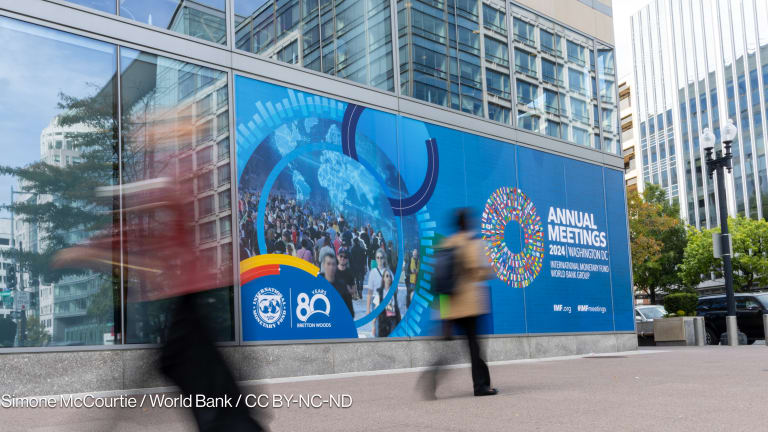
The World Bank and International Monetary Fund annual meetings kick off this week. The institutions have their hands full with a COVID-19 financing gap, global debt distress, and a big funding request for their shareholders — all of which could be overshadowed by a scandal at the top.
One month ago, it appeared the hybrid gathering of World Bank and IMF shareholders would be a fairly straightforward exercise in generating consensus and support for an unprecedented global health and economic crisis response touching every country in the world. Now, add to that a front-page data manipulation scandal that has jeopardized the leaders of both institutions.
IMF Managing Director Kristalina Georgieva enters the week fresh off a five-hour meeting with the board, where she fought to keep her job and denied allegations she ordered the alteration of country rankings in the World Bank’s Doing Business report to secure political support from a powerful Chinese constituency.
On Friday, Bloomberg reported that Georgieva also oversaw the softening of language on climate change risks posed to Brazil, in response to objections from President Jair Bolsonaro’s government.
My colleague Shabtai Gold will be keeping an eye on discussions around more financing for COVID-19 vaccination in lower-income countries, plans to reallocate Special Drawing Rights and the status of the International Development Association’s emergency replenishment.
The annual meetings are usually a well-scripted affair — most World Bank and IMF staff try to steer clear of the frenzy. But what is usually a moment for the World Bank and IMF to highlight their roles as multilateral leaders with big checkbooks and supposedly objective policy expertise, has now turned into a referendum on whether the institutions are driven by data or by politics.
Read: 5 things to watch at the World Bank-IMF annual meetings
ICYMI: For Pro subscribers, Shabtai dives into the possible future of the Doing Business report.
Behind the numbers
The World Bank’s monthly operational summary provides an overview of projects in the institution’s pipeline. For Pro subscribers, my colleagues Janadale Coralde and Miguel Tamonan have this overview of what the MOS includes and how to better navigate it with Devex’s funding search and interactive visualization.
Explore: The World Bank’s interactive funding pipeline
+ Devex Pro subscribers can learn more about the World Bank’s top contractors. Not yet a Pro subscriber? Sign up now and start your 15-day free trial.
Rules of engagement
European Union development ministers are meeting today for an informal videoconference to discuss the resumption of limited development work in Afghanistan. Their meeting will focus on a European Commission proposal titled “Towards a EU approach in support of the Afghan People,” which my colleague Vince Chadwick got hold of.
The proposal would allow the resumption of development programs under these conditions:
• Implemented by NGOs or international organizations.
• Directly benefiting the population, local CSOs [civil society organizations], and human rights defenders.
• Addressing basic needs of the population, livelihoods, displacement dynamics, human rights including women’s rights, and/or civil society empowerment.
• Remaining relevant and operationally feasible in the new context.
Learn more: EU weighs restarting development work in Afghanistan, avoiding Taliban
Writing in Foreign Affairs, former U.K. Secretary of State for International Development Rory Stewart — who famously walked across Afghanistan solo in 2002 — blames the failure of the United States-led reconstruction effort in Afghanistan on “an obsession with universal plans and extensive resources.”
+Explore our ongoing coverage on aid and development assistance for Afghanistan.
Change agents
The Ford Foundation is jumping into the vaccine equity fight with a plan to direct $16 million in grants to organizations providing direct COVID-19 relief and advocating for a global vaccination rate of 70% within the next 12 months. The foundation will also push for a COVID-19-related intellectual property waiver at the World Trade Organization, Stephanie Beasley reports.
Is your organization also providing rapid grants for COVID-19 response? If so, we'd love to hear about it. Email stephanie.beasley@devex.com to share what you’re doing.
Read: Ford Foundation commits $16M to promote global COVID-19 vaccine equity
ICYMI: Catch up on the recent Devex Newsmaker event — a conversation with former Inter-American Development Bank President Luis Alberto Moreno on shaping growth in Latin America post-pandemic, presented by Open Society Foundations.
Risk management
“I think physical risk is more real because people have experienced it before, they can see it and they can feel it.”
— Judith Munyurwa, CEO, Zebu InvestmentsA survey of investees of the United Kingdom's development finance institution, CDC Group, found that 78% of their businesses were taking or planning action to identify physical climate risks.
Read: Climate change is already impacting African businesses
+ For more content like this, sign up for Devex Invested, the weekly newsletter on how business, social enterprise, and development finance leaders are tackling global challenges.
In other news
The twice-postponed United Nations biodiversity summit — also known as COP 15 — opens today in China, as countries virtually meet to begin setting targets for protecting the world's ecosystems. [France 24]
The U.N. and the Bangladeshi government on Saturday inked an agreement to help the 19,000 Rohingya refugees that have been relocated to Bhasan Char, with 81,000 more to follow in the next three months. [VOA]
Only $6 million of the $363 million IMF-awarded funding for COVID-19 response in the Democratic Republic of Congo has been accounted for, according to a report by a research group. [BBC]
Sign up to Newswire for an inside look at the biggest stories in global development.
Printing articles to share with others is a breach of our terms and conditions and copyright policy. Please use the sharing options on the left side of the article. Devex Pro members may share up to 10 articles per month using the Pro share tool ( ).
About the author

Michael Igoe@AlterIgoe
Michael Igoe is a Senior Reporter with Devex, based in Washington, D.C. He covers U.S. foreign aid, global health, climate change, and development finance. Prior to joining Devex, Michael researched water management and climate change adaptation in post-Soviet Central Asia, where he also wrote for EurasiaNet. Michael earned his bachelor's degree from Bowdoin College, where he majored in Russian, and his master’s degree from the University of Montana, where he studied international conservation and development.