


Presented by Pivotal

Thailand has quietly allowed some long-term refugees to work as aid collapses and labor shortages bite. For refugees long confined to camps, wages — however imperfect — offer a path beyond waiting for aid.
Also in today’s edition: Somalia loses U.S. aid, upcoming global health leadership changes, and where is Lebanon’s aid?
+ On Monday, Jan. 12, we’ll have a Devex Pro Briefing with Dr. Sania Nishtar, CEO of Gavi, the Vaccine Alliance to discuss the Gavi Leap transformation and the lessons it offers for the hundreds of organizations now forced to downsize without the lead time. Register now to join us and submit your questions in advance.
From camps to work
As humanitarian aid dries up and labor shortages deepen, Thailand has taken a rare step: allowing some long-term refugees to work legally for the first time. The policy shift reflects a collision of crises — foreign aid cuts, workforce gaps, and decades of restrictions on refugees’ right to earn a living.
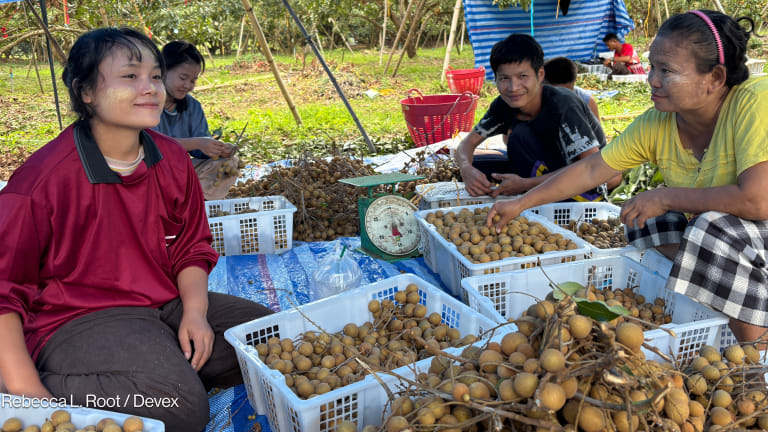
Devex contributor Rebecca Root traveled to Chanthaburi, Thailand, where she witnessed how Burmese refugees crouch under blue tarp picking longan — a lychee-like fruit — and stacking crates that determine their pay. Until recently, they were barred from legal work. For decades, Thailand confined more than 80,000 refugees to camps along the Thai-Myanmar border, leaving survival dependent on aid.
That system began unraveling in early 2025 after the Trump administration slashed U.S. humanitarian funding. Clinics closed, food supplies shrank, and refugees — still unable to work — were left without reliable access to basic needs.
At the same time, Thailand faced a labor crunch. A renewed border dispute triggered a mass departure of Cambodian migrant workers who power the country’s farms, factories, and restaurants.
Caught between crises, Thai authorities pivoted. The government granted limited permission for eligible refugees aged 18 to 59 to work, with the United Nations calling the move “landmark.”
“This will … ease the government’s financial burden, strengthen the country’s economic development, promote human rights, and address labor shortages,” says government spokesperson Jirayu Houngsub.
For refugees such as 26-year-old Pee Eh, born in the Ban Don Yang camp, the change meant leaving the camp for the first time. “I am extremely happy to be out,” she says. “The situation in the camp was the same, and we wanted to work outside. We didn’t like it there.”
Read: From camps to crops — US aid cuts reshape refugee life in Thailand
+ This story is part of The Aid Report, a Gates Foundation-funded, editorially independent initiative to track and document the on-the-ground impacts of the U.S. aid cuts with firsthand reporting and a verified, contributor-based data collection system. For more information, go to https://www.theaidreport.us.
Food aid standoff
The United States has frozen all assistance to Somalia, accusing officials of demolishing a U.S.-funded World Food Programme warehouse and seizing donor-funded food aid — even as the country slides deeper into crisis.
Nearly 4.4 million people are projected to face acute food insecurity as drought worsens, writes my colleague Ayenat Mersie. In announcing the freeze on Wednesday, the U.S. government said it was “deeply concerned by reports that Federal Government of Somalia officials have destroyed a US-funded World Food Programme (WFP) warehouse and illegally seized 76 metric tons of donor-funded food aid for vulnerable Somalis,” adding that the Trump administration has a “zero-tolerance policy for waste, theft, and diversion of life-saving assistance.”
The warehouse, inside the Mogadishu port, held roughly 76 metric tons of specialized food for malnourished girls, young children, and pregnant and breastfeeding women.
The U.S. has historically been Somalia’s largest bilateral humanitarian donor, obligating $1.2 billion in fiscal year 2023 and $420 million in FY 2024. But Somali authorities and WFP dispute the core allegation, saying the food was not looted.
“The Government wishes to clarify that the commodities referenced in recent reports remain under the custody and control of the World Food Programme, including assistance provided by the United States,” the Somali government says.
The demolition of the warehouse comes amid major expansion works at the Mogadishu port. Still, Washington says aid will remain frozen and that “any resumption of assistance will be dependent upon the Somali Federal Government taking accountability for its unacceptable actions and taking appropriate remedial steps.”
How Somalia responds could shape not only the future of U.S. food aid but broader diplomatic ties at a moment of rising political strain.
Read: US freezes aid to Somalia over dispute on destroyed WFP warehouse
Aid, unaccounted for
How much humanitarian aid actually reaches people who need it? In Lebanon, the answer is disturbingly unclear. After the 2024 ceasefire agreement between Israel and Hezbollah, Lebanon received more than 2.8 million units of in-kind aid from 24 countries. But a new investigation by the Gherbal Initiative found that 74% of aid distributed by official authorities was logged as going to an “unknown location,” while another 17% vanished entirely with no distribution records.
The problem, Gherbal finds, isn’t just missing aid — it’s broken tracking. “There is a difference in calculating units between different administrations,” says Carla Bou Gharios, programs manager at the Gherbal Initiative. “There is a complete lack of standardization in measurements and standards.” In one case, 42 tons of aid from Kuwait somehow turned into 93,206 distributed units. “The mathematics is impossible unless agencies counted the same aid multiple times using different measurement systems,” says Gherbal’s executive director, Assaad Thebian.
Independent monitors backed up the findings, writes Suzanne Abou Said for Devex. “It was not always possible to determine with certainty whether all aid reached its intended beneficiaries,” says Julien Courson, executive director of Transparency International Lebanon. Even with cross-checking, the missing data, unshared records, and inconsistent reporting made it impossible to trace much of the aid from arrival to recipient.
On the ground, the consequences were stark. Displaced families reported shortages, uneven distribution, and seeing aid reappear on supermarket shelves. “What came to Lebanon in various crises — whether the port explosion or war — was enough,” says Suad Gharious, who heads the We Are One association. “What we lack is crisis management.”
Read: What happened to aid sent to Lebanon? In many cases, nobody knows
At a crossroads
What’s coming next for global development in 2026? For our first episode of the year, the This Week in Global Development podcast digs into what’s ahead — from deeper foreign aid cuts and a more transactional approach to development, to the growing push from aid toward investment. We unpack who’s driving the shift, whether the private sector can really step in as official development assistance shrinks, and what that means for locally led development.
Will billionaires give more? Can investment fill the gap? Senior Editor Rumbi Chakamba is joined by President and Editor-in-Chief Raj Kumar and Managing Editor Anna Gawel for the latest episode of our weekly podcast.
Listen: What does 2026 hold for global development?
+ You can also listen on Spotify, Apple Podcasts, Soundcloud, YouTube, or search “Devex” in your favorite podcast app.
In transition
Global health is heading for a leadership shake-up just as funding tightens and reform pressure mounts. By the end of 2026, the heads of The Global Fund to Fight AIDS, Tuberculosis and Malaria; Unitaid; and the World Health Organization will be stepping down or entering their final year.
The timing matters, writes Senior Reporter Jenny Lei Ravelo. Foreign aid cuts, the Accra Reset’s push for country-led governance, and the U.S. “America First” global health strategy are reshaping how the sector works — and what future leaders will be expected to deliver.
At The Global Fund, Peter Sands will depart at the end of 2026 after raising more than $40 billion since 2019 and steering the fund through COVID-19. “I’ve witnessed Peter quickly win and maintain the trust of members of [the U.S.] Congress and two presidential administrations,” says Chris Collins, president and CEO of Friends of the Global Fight.
Unitaid’s executive director, Dr. Philippe Duneton, will retire toward the end of 2026 after leading major investments in COVID-19 tools, oxygen, and local manufacturing — even as looming donor cuts force tough choices. Robert Matiru, Unitaid’s director of program management, says the organization’s next chief will have to contend with how to make Unitaid more efficient and aligned with the evolving global health landscape. “How do we do that in a way that is meaningful and intentional, and positions us more closely to governments and their strategic priorities?” he asks.
At WHO, Tedros Adhanom Ghebreyesus is nearing the end of a tenure shaped by reform, controversy, and donor pullbacks, including the Trump administration’s decision to withdraw from the agency.
The next WHO election isn’t until 2027, but the jockeying has already started. Former adviser Peter Singer says the next leader should “revive the results agenda, make WHO neutral on Israel, and bring back the US.”
Read: 3 key global health leadership changes to watch (Pro)
+ Experience Devex Pro with a 15-day free trial and explore expert analyses, unlock hidden funding opportunities, connect with key players at exclusive events, and access a wealth of knowledge you won’t find anywhere else. Check out some of the content exclusive to Pro readers.
In other news
Bulgarian diplomat and former U.N. Middle East envoy Nickolay Mladenov will serve as the director-general of U.S. President Donald Trump’s Board of Peace to oversee the ceasefire in Gaza. [AP]
The U.N. Human Rights Council has elected Indonesian diplomat Sidharto Reza Suryodipuro as its next president, marking the first time the country will lead the world’s principal human rights body. [UN News]
A group of religious leaders and a member of Parliament in Gambia have launched efforts to overturn a ban on female genital mutilation at the country’s Supreme Court. [The Guardian]
Sign up to Newswire for an inside look at the biggest stories in global development.
About the author

Helen Murphy
Helen is an award-winning journalist and Senior Editor at Devex, where she edits coverage on global development in the Americas. Based in Colombia, she previously covered war, politics, financial markets, and general news for Reuters, where she headed the bureau, and for Bloomberg in Colombia and Argentina, where she witnessed the financial meltdown. She started her career in London as a reporter for Euromoney Publications before moving to Hong Kong to work for a daily newspaper.