
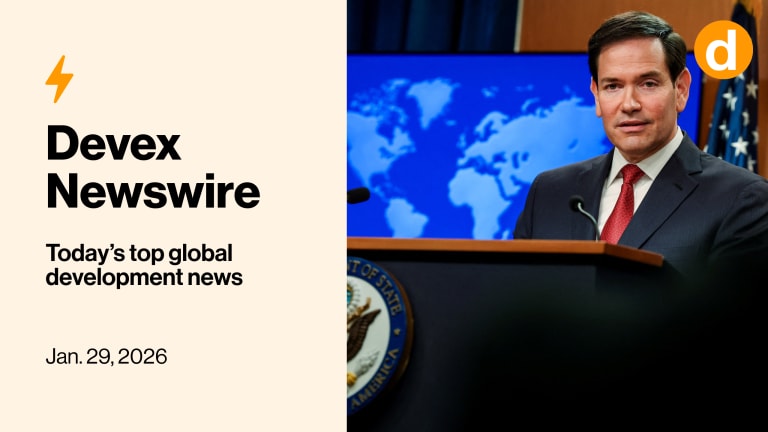
Devex Newswire: US tests UN aid overhaul with $2B humanitarian pledge




Presented by Operation Smile

The U.S. has pledged billions to the U.N. for humanitarian crises — but with major reforms attached.
Also in today’s edition: More money and potential staff reductions at the Gates Foundation.
+ Happening today: What’s at stake this year for private capital mobilization, debt, multilateral development banks, and impact investing’s role in development? At 10 a.m. ET (4 p.m. CET), we’ll sit down with a panel of experts to go through the major development finance trends to watch in 2026. You can still register for it here.
‘Better than zero’
In the final days of last year, the United States pledged $2 billion to the United Nations through 2026 to respond to humanitarian crises in 17 countries, including the Democratic Republic of Congo, Haiti, Syria, and Sudan. It’s a small slice of what the U.N. says it needs — but it will constitute a shift in the U.N.'s balance of power among its humanitarian agencies.
Under the deal, U.S. humanitarian funding would increasingly flow through pooled funds managed by the U.N.’s emergency relief coordinator, Tom Fletcher, giving U.N. humanitarian coordinators on the ground more say over how money is spent. Major agencies such as the World Food Programme, UNICEF, and the UN Refugee Agency would have to compete internally for shrinking resources.
“The US Government welcomes these ambitious reform efforts and aims to support them to ensure that a greater proportion of humanitarian funding is allocated to frontline life-saving work — and less is squandered on overhead, bloat, and non-core activities,” according to a confidential memorandum of understanding signed by Jeremy Lewin, senior U.S. official for foreign assistance, humanitarian affairs, and religious freedom, and Fletcher, who is also the undersecretary-general in the U.N. Office for the Coordination of Humanitarian Affairs.
“This $2 billion is, we hope, not the end, but only the beginning of what’s a partnership,” Lewin says. “This is not our full year budget, and it is not the entirety of our humanitarian assistance budget.”
In a release from the U.S. State Department, the message to the U.N. was explicit: “Adapt, shrink, or die.” Some advocates were cautiously relieved, while others warn of the risks, writes Senior Global Reporter Colum Lynch. “It’s better than zero, and I’m generally a fan of pooled funds,” says Jeremy Konyndyk, president of Refugees International. But he warns: “If this is it, it’s a catastrophe.”
For now, the money is a test — of whether the U.N. can deliver reform, and whether the U.S. is serious about rebuilding a humanitarian system it has already taken apart.
Exclusive: Inside US-UN plan to remake funding for humanitarian crises
ICYMI: Inside the UN's budget showdown (Pro)
Further reading: Trump and the future of the UN (Pro)
+ Not yet gone Pro? Experience unlimited access to expert analyses, hidden funding opportunities, and career resources with recruiters’ insights, and connect with key sector players and influencers at exclusive events when you start your 15-day free trial of Pro today.
A rare reprieve
The U.S. House of Representatives yesterday approved a $50 billion foreign assistance bill for fiscal year 2026. The bill provided a rare bright spot for the global health community — to the tune of $9.4 billion in funding — but also exposed a clear split between Congress and the Trump administration.
While both back funding for HIV, polio, malaria, and tuberculosis, Congress rejects proposed cuts to family planning; reproductive health; Gavi, the Vaccine Alliance; and U.N. agencies such as the U.N. Population Fund, UNICEF, and UNAIDS.
“Almost a year since the US administration decimated the U.S. Agency for International Development ... Congress is coming back with a bill that rejects the administration’s shortsighted decisions last year,” says Mitchell Warren, executive director of AVAC — while warning the outcome still hinges on congressional votes and whether the president signs and spends the money.
Read: Unexpected global health wins in the US foreign aid bill
ICYMI: US lawmakers strike $50B foreign assistance deal, surpassing Trump’s plan
+ For the latest insider reporting on global health, be sure to sign up for Devex CheckUp, a free, Thursday newsletter — and get today’s edition in your inbox soon.
New home
Food for Peace, USAID’s flagship food aid program, has found a temporary home at the U.S. Department of Agriculture following the signing of an interagency agreement between the State Department and USDA, U.S. lawmakers say.
Several industry sources tell Devex the agreement was finalized just before the holidays.
“Allowing USDA to administer the Food for Peace program equips American producers to serve hungry people while providing more transparency and efficiency as to how taxpayer dollars are stewarded,” says Rep. Tracey Mann, a Republican from Kansas, in a statement applauding the agreement.
Food for Peace has long enjoyed bipartisan support — many of the U.S. farmers the program buys from are in red states and districts.
Under the previous setup, USAID oversaw Food for Peace, USDA purchased commodities from U.S. farmers, and distribution was handled through partners such as WFP. That long-standing role has made USDA a natural landing place in the eyes of many Republicans.
Indeed, Mann and other lawmakers introduced legislation in February 2025 to formally move the program to USDA.
Still, there are significant questions about institutional capacity, and Dina Esposito, the program’s former director, warns the move could be “disastrous.”
For now, the move is temporary, but it could soon become permanent: “I will continue to fight for Food for Peace to be permanently placed under USDA so that America can continue to be the beacon of hope and freedom we are to the rest of the world,” Mann says.
Related op-ed: The US is breaking a lifesaving global food aid system
Big spend, tight focus
The Gates Foundation’s governing board has endorsed a “historic” $9 billion annual payout, locking in a steady-state budget as the foundation accelerates spending ahead of its planned 2045 closure. That follows Bill Gates’ announcement last year that the foundation will invest an additional $200 billion before shutting its doors — double what it spent in its first 25 years.
About 70% of the budget will continue to flow to global health, with the rest focused on U.S. education and agriculture in low- and middle-income countries. “The foundation’s 2045 closure deadline gives us a once-in-a-generation opportunity to make transformative progress,” says Mark Suzman, CEO of the Gates Foundation, in a statement, adding that “ensuring as much of every dollar as possible flows toward impact is critical.”
To make that math work, the board also approved a cap on operating expenditures, limiting it to about 14% of the total budget — and setting the stage for a reduction of up to 500 positions by 2030.
Wiki-versary
“I’ve spent a lot of time in the last four years talking about why Wikipedia can be a model for doing AI differently, having models that are more open, giving attribution … so we all know where the answers that we’re getting are coming from.”
— Maryana Iskander, CEO of the Wikimedia FoundationToday is the 25th anniversary of Wikipedia’s founding — and in that quarter-century, the site, once a punch line, has withstood plenty of technological slings and arrows. Still, some worry that artificial intelligence could be the final blow to the crowd-sourced online encyclopedia. Not particularly worried is Iskander, who’s stepping down from her role but who notes that while AI is eating into Wikipedia’s share of visitors, it still struggles to offer transparency.
“Probably the most important thing is that there are humans in the loop on all of our uses of AI,” she says. “So machines are there to help humans.”
Read: Amid AI, Wikipedia stakes out its value, including in the global south
See also: Is artificial intelligence a superpower or a weapon? (Pro)
In other news
Global unemployment remains steady at 4.9%, but the International Labour Organization warns that decent work is in short supply, with young people, women, and workers in the informal sector disproportionately affected amid AI, automation, and trade uncertainties. [UN News]
The U.S. has launched phase two of President Donald Trump’s Gaza peace plan, establishing a technocratic Palestinian government and beginning reconstruction and demilitarization, which includes Hamas disarmament. [BBC]
Peace talks in Cairo have resumed as Sudan’s war nears its third year, with Egypt, the U.N., and the U.S. pushing for a nationwide humanitarian truce amid continued clashes that have caused mass displacement and alleged war crimes. [AP]
Sign up to Newswire for an inside look at the biggest stories in global development.
About the author

Helen Murphy
Helen is an award-winning journalist and Senior Editor at Devex, where she edits coverage on global development in the Americas. Based in Colombia, she previously covered war, politics, financial markets, and general news for Reuters, where she headed the bureau, and for Bloomberg in Colombia and Argentina, where she witnessed the financial meltdown. She started her career in London as a reporter for Euromoney Publications before moving to Hong Kong to work for a daily newspaper.
Search for articles



Most Read
- 1
- 2
- 3
- 4
- 5