
Food — and other kinds of aid — gets diverted to line the pockets of corrupt officials more often than we know. We take you behind the scenes in Ethiopia, where food theft led to aid being stalled while many went hungry. Also in today’s edition: Aid and development need a reputational boost, civil society steps up at the World Health Organization, and the British prime minister wants to give another crucial conflab a miss. + Join us today at 10 a.m. ET (4 p.m. CET) for an “ask me anything” session about the ins and outs of USAID contracting. Can’t attend live? Register anyway, and we’ll send you a recording. Ethiopia food fight The food aid scam in Ethiopia is as embarrassing as it is tragic. A country where 20 million people rely on overseas help to feed their families must ensure aid reaches those in need and isn’t pilfered behind the scenes for profit or political gain. Unfortunately, that’s what seemingly happened. Investigations are ongoing, but we can exclusively reveal that Tigray’s regional police have sought to interrogate at least three local staff members of the World Food Programme, triggering a diplomatic standoff with the Rome-based food agency. The United Nations food outfit — whose workers enjoy immunity for official activities — hasn’t complied with the request yet and has asked for clarification from the Ethiopian government. But the move comes after food aid was cut off in Ethiopia earlier this year. The stoppage began after WFP and USAID uncovered widespread theft of its food assistance across Tigray — a region battered by two years of civil war and debilitating hunger. It soon became evident how wide the racket spanned, and by early June, the food aid suspension was nationwide. It’s not yet clear whether the U.N. aid workers are suspected of involvement in the diversion — the diplomatic way of describing theft — that resulted in the shutdown of the agency’s massive Ethiopian food aid operations this year, or whether they are simply believed to have knowledge of the scandal. The Tigrayan investigation, which has already resulted in the arrest of suspects, is one of several probes into the illegal diversion of aid, write Devex contributor Elissa Miolene and Devex Senior Global Reporter Colum Lynch. USAID, the Ethiopian government, and WFP all have ongoing inquiries into the transgressions. It all began when WFP and USAID found more than 7,000 metric tons of stolen wheat and 215,000 liters of food oil in commercial markets in Tigray. USAID visited refugee camps, village markets, and 63 flour mills throughout Ethiopia and also found various levels of theft at each location. Though assistance began to trickle back to Tigray late last month, there is a scramble to figure out who’s to blame. But for many, the answer is obvious. Everyone is to blame. And that’s nothing new. Exclusive: 'Rot is so much deeper' — decades of Ethiopia aid manipulation Better WHO-CSO collaboration There has been considerable frustration from civil society in recent years over their participation — or lack of — in WHO member state meetings and processes, including the development of a pandemic accord and a new platform for medical countermeasures. At the World Health Assembly, they are given just one minute to deliver individual statements. So following the launch last week of the WHO Civil Society Commission, my colleague Jenny Lei Ravelo raised the question of how much will this really change civil society organizations’ engagement with WHO. The commission provides “the ability to channel advice and recommendations in a more structured and systematic manner from civil society to WHO on health priorities and related issues,” WHO said in a news release. It takes WHO-CSO collaboration “to a new level.” While members of civil society have long proposed the idea of a WHO Civil Society Commission, and welcome the move, some remain frustrated. Thomas Schwarz from Medicus Mundi International expressed cautious optimism about the commission but says frustrations relate to how it was established. Its mandate, setup, and modalities of work, for example, are based on terms of reference “drafted and published by WHO, with only sporadic consultation of civil society,” he says. Fifa Rahman, the CSO representative of the platform’s working group, who voiced concerns over CSO exclusion from meetings, says she finds “valuable” the concept of recognizing civil society as official WHO partners. But its effectiveness depends on several things, she says, including recognition of CSO technical expertise when it comes to health interventions and decisions. They should also be allowed to choose their representatives. During consultations, one concern raised by CSO — in a letter seen by Devex — is about governance. They want the commission to comprise members nominated by CSOs, rather than appointed by WHO. But the final terms of reference maintain that WHO makes that decision. WHO responded by saying that it so far did not have an overall mechanism to engage with civil society to ensure a representative group, but that “for later terms, the Steering Committee or a group of network participants will be involved in the selection as we now have this overarching mechanism.” From the archives: The case of the missing civil society at the World Health Summit (Pro) Stage fright? Rishi Sunak tried to skip the 27th U.N. Climate Change Conference, he snubbed Emmanuel Macron’s global financing conference in Paris, and now he’s turning his back on next month’s U.N. Sustainable Development Goals gathering. The U.K. prime minister has raised eyebrows by sending his deputy, Oliver Dowden, to New York for the annual U.N. General Assembly, which means a no-show for its centerpiece — the midpoint review of the 2030 SDGs. It’s been a decade since a U.K. leader missed UNGA, Devex U.K. Correspondent Rob Merrick tells me. Even Liz Truss, Sunak’s predecessor, managed to make the trip last year, during her blink-and-you-missed-it 49-day premiership. A letter signed by more than 100 U.K. NGOs pleaded with Sunak to attend, to display “serious intention to advance progress on the SDGs” and to “rebuild the U.K.'s reputation as a trusted partner to lower-income countries.” But Downing Street pointed to the prime minister’s busy schedule in the coming months, “including at the G20 Summit in New Delhi and the COP28 Summit in the UAE.” Labour’s shadow foreign secretary, David Lammy, warned a failure to attend the SDG summit “would mark a low ebb of the Conservatives’ isolationist foreign policy.” Related: ‘No show Sunak’ criticized for skipping Macron’s financing summit Doubters vs. believers Using government money for overseas aid isn’t all that popular, it seems. Andrew Mitchell, the U.K. minister for international development, has pledged to boost the population’s support for its commitment to development work to 70% from 50%. “I am determined that we shall win over the doubters and drive-up support to the 70/30 mark over the next 10 years,” he said back in April. It might be a tough call, though. Aid and development work is a contentious topic, writes Devex contributing reporter Rebecca Root. Some say it’s not useful while others question why a country is spending overseas rather than at home, explained Hector Ulloa, the president of the Norwegian Students’ and Academics’ International Assistance Fund. There are “doubters” elsewhere too, writes Rebecca. In Germany, 41% of people don’t support aid. In Australia, 26% believe the country spends too much on aid, and 45% in the U.S. don’t believe in maintaining or increasing the country’s foreign aid budget. Those in the know say that, historically, poor communication from the sector is partly to blame for the public’s resistance. On top of that comes some rather nasty public incidents that have cast a shadow of mistrust and skepticism — such as sexual misconduct and racism, among other not-great issues. In the U.K. that has translated to just 5% of Brits considering themselves “true believers” in the value of aid and development. Read: Has the development sector been bad at talking to the public about aid? (Pro) + Not a Pro member yet? Start your 15-day free trial now to unlock the piece and all our exclusive reporting and analysis. In other news A 20-year-old man has become the first to be charged with "aggravated homosexuality" in Uganda, a crime carrying the death penalty under the country's newly implemented anti-gay law. [Reuters] Japan and the Association of Southeast Asian Nations are poised to reaffirm their commitment to enhancing food security during emergencies at a special summit in December. [The Japan Times] The U.N. Committee on the Rights of the Child has released new guidelines urging governments to take action to safeguard children in the face of the deepening climate crisis. [UN News] Sign up to Newswire for an inside look at the biggest stories in global development.


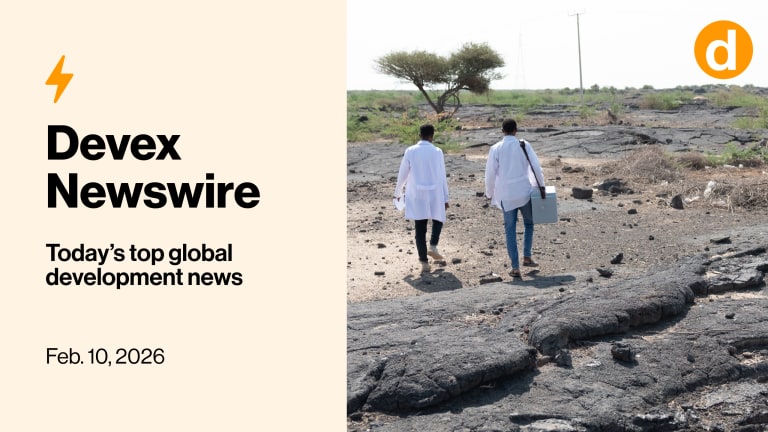
Food — and other kinds of aid — gets diverted to line the pockets of corrupt officials more often than we know. We take you behind the scenes in Ethiopia, where food theft led to aid being stalled while many went hungry.
Also in today’s edition: Aid and development need a reputational boost, civil society steps up at the World Health Organization, and the British prime minister wants to give another crucial conflab a miss.
+ Join us today at 10 a.m. ET (4 p.m. CET) for an “ask me anything” session about the ins and outs of USAID contracting. Can’t attend live? Register anyway, and we’ll send you a recording.
Printing articles to share with others is a breach of our terms and conditions and copyright policy. Please use the sharing options on the left side of the article. Devex Pro members may share up to 10 articles per month using the Pro share tool ( ).
About the author

Helen Murphy
Helen is an award-winning journalist and Senior Editor at Devex, where she edits coverage on global development in the Americas. Based in Colombia, she previously covered war, politics, financial markets, and general news for Reuters, where she headed the bureau, and for Bloomberg in Colombia and Argentina, where she witnessed the financial meltdown. She started her career in London as a reporter for Euromoney Publications before moving to Hong Kong to work for a daily newspaper.
Search for articles


Most Read
- 1
- 2
- 3
- 4
- 5