Presented by Gates Foundation

The foreign affairs spending bill is now law after weeks of delay, approving funding well above White House plans but still leaving humanitarian funding sharply lower than it has been.
Also in today’s edition: The conservative push to defund the National Endowment for Democracy, and a health experiment in Mozambique.
+ Employers now expect AI literacy across all programs, policy, operations, and communications. Master these essential skills and position yourself competitively by joining our Devex Career Briefing happening today. Can’t attend live? Register anyway, and we’ll send you a recording.
C’est law vie
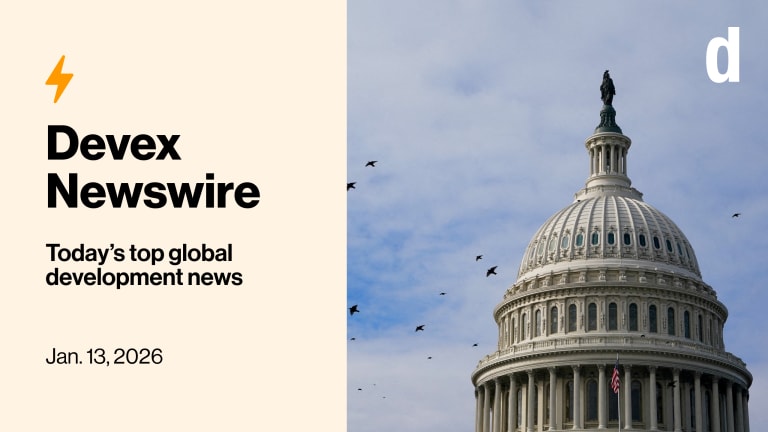
The $50 billion compromise foreign affairs spending bill is finally law, ending a brief partial government shutdown after weeks of procedural drama on Capitol Hill. The measure, which includes billions for foreign assistance, was delayed after getting tied up with a contentious Department of Homeland Security funding fight, but ultimately cleared both chambers and was signed by U.S. President Donald Trump.
“This bill is the culmination of thousands of hours of tireless advocacy and bipartisan negotiation and a major win for U.S. humanitarian assistance — and the people it serves,” said Rev. Eugene Cho, president and CEO of Bread for the World, in a statement.
While the package came in nearly $20 billion above the president’s budget request, it still represents a sharp pullback from last year, writes Devex Senior Reporter Adva Saldinger. Humanitarian funding is roughly 37% lower, said Save the Children in a press release. “For families facing hunger, displacement or conflict, these investments can mean the difference between surviving a crisis and being left behind,” Christy Gleason, chief policy officer at Save the Children US, said in a statement.
Even with passage secured, questions loom over whether the administration will spend the funds as Congress intended. “It’s one thing to pass the bill. It’s one thing to set the funding levels, but after its performance in the last year, is the Congress really going to insist that the U.S. foreign aid program looks like what’s in the bill?” said Jim Kunder, principal at the international development consulting firm Kunder/Reali Associates, during a recent Devex Pro Briefing. “To me, that’s the big operative question.”
Read: US Congress passes $50 billion foreign affairs bill
ICYMI: The $50B US aid budget — what’s in it for development? (Pro)
Related: Congress may pass a $50B foreign aid bill. Will Trump spend the money? (Pro)
+ Not yet a Devex Pro member? Start your 15-day free trial today to access all our expert analyses, insider insights, funding data, events, and more. Check out all the exclusive content available to Pro members.
Funding fight fails
When lawmakers agreed to that $50 billion foreign affairs spending bill last month, they rejected two conservative attempts to defund the National Endowment for Democracy.
The votes capped a growing Republican backlash against NED, a democracy-promotion NGO founded more than 40 years ago under Ronald Reagan. Critics have increasingly portrayed it as part of a so-called censorship industrial complex allegedly working to suppress conservative voices, writes Devex Senior Reporter Michael Igoe.
“Although its name suggests a force for good, its mission has drifted far from its Cold War origins,” said Rep. Eli Crane, a Republican from Arizona, while introducing an amendment to cut off funding. “This is a classic tactic of the swamp, where bad policy and corruption hide behind a noble title,” he added.
The House amendment failed 291-127. A similar effort in the Senate, led by Missouri Republican Eric Schmitt, collapsed without a recorded vote. “None of these lines of attack against NED are new. What’s new is it’s being repeated on the House floor,” says Elizabeth Hoffman, executive director for North America at ONE and a former NED staff member.
As the attacks escalate, NED has moved to highlight its bipartisan bona fides: hiring a Republican foreign aid veteran who served in Trump’s first administration as vice president for policy and government relations and adding two former Trump officials to its board. Still, Hoffman doubts persuasion is the point.
“A lot of these members that are offering amendments like this — they’re doing it to send a political message. I doubt they’re asking serious questions,” she says, calling the attacks “political theater.”
Read: Conservative push to defund US democracy org falls flat — for now
Beyond the park
In Gorongosa, Mozambique, getting to lifesaving care can come down to something painfully basic: fuel. An ambulance might be available, but without gas, a medical emergency still turns into a three-hour journey. “It’s not strategic … it’s not feasible,” says Pio Vitorino, associate director of health at the Gorongosa Restoration Project.
That reality jars with Gorongosa’s global image, my colleague Kelli Rogers writes. The area is famous for its conservation comeback, wildlife restoration, and ecotourism. Less visible is the human side: high maternal deaths, chronic malnutrition, HIV and malaria, few jobs, and frequent floods.
For years, the Gorongosa Restoration Project has tried to tackle both worlds at once — conservation plus community health, farming, education, and livelihoods. Mobile clinics and “model mother” peer-counseling programs helped close some gaps, but leaders say there’s a limit to what outreach alone can do.
So the project is going bigger. Alongside Mozambique’s Ministry of Health and the University of Pittsburgh, it’s planning a 100-bed public teaching hospital and health campus in rural Gorongosa. Mozambique’s health minister, Ussene Isse, calls it part of a broader rethink that includes faster, task-specific medical education and digital systems built for low-resource settings.
Paying for it may be the boldest twist. Gorongosa Restoration Project’s founder, Greg Carr, wants the hospital backed by what he calls “community-based capitalism,” using nature-based businesses tied to the park.
Read: In Mozambique, conservation meets care in a bold health experiment
Miss American spy
Amaryllis Fox Kennedy is a former CIA case officer turned budget power player with a résumé that reads like a spy thriller and a perch that now shapes the fate of U.S. foreign aid. She currently holds a rare dual role as U.S. deputy director of national intelligence for policy and capabilities and associate director for intelligence and international affairs at the Office of Management and Budget, giving her oversight of which aid programs live or die amid deep cuts from Trump’s White House. She holds an even rarer position in the new Devex Power 50 list, which pinpoints the individuals who are transforming development in 2026.
Fox Kennedy, who once focused on stopping terrorist groups from acquiring weapons of mass destruction, doesn’t come from the global development world — but she now has one of the final words on foreign aid spending as OMB, under Russell Vought, asserts unprecedented control over individual funding decisions. She’s also a political insider — daughter-in-law of Robert F. Kennedy Jr. and manager of his presidential campaign — and the author of a controversial 2019 memoir about her undercover CIA years, including posing as an international art dealer in Shanghai.
Read the rest: Devex Power 50
+ This is just a small selection. We will feature an essential figure every day this week — a person who is influencing this significant new era of global development.
A tone problem
Public opinion experts gave U.K. members of Parliament a stark warning last week: The aid sector’s focus on decolonization, reparations, and power dynamics is alienating large parts of the British public and risks backfiring.
Speaking to the House of Commons’ International Development Committee, Luke Tryl, executive director at More in Common, said debates around decolonization are often seen as a distraction from whether aid actually works. “The introspection that has dominated the U.K. aid sector, particularly in the early 2020s, has actually been quite harmful,” he said.
That language, Tryl argued, can leave donors feeling accused rather than engaged. “It can come across in a way that makes people say, ‘I put in money. I pay. Are you calling me a colonialist because I want to help people in another part of the world?’”
Despite that, witnesses stressed that support for aid remains intact but fragile, writes Devex contributor Susannah Birkwood. Tryl said polling shows 47% of the public still support overseas aid, compared with 28% opposed — even as half of respondents say spending should fall. Jennifer Hudson, director at Development Engagement Lab, noted that skepticism is fueled by wildly inflated perceptions of aid spending, often assumed to be around a quarter of the national budget rather than 0.3% of gross national income.
Read: Decolonization language risks alienating the public, UK MPs warned
Related read: Did the aid sector really screw up its communications strategy? (Pro)
In other news
The World Health Organization launched on Tuesday a $1 billion appeal to respond to health crises in 36 emergencies worldwide, including those in Afghanistan, Gaza, Haiti, and Sudan in 2026. [France 24]
The United Arab Emirates and U.S. pledged a combined $700 million at a Washington-led donor summit on Tuesday, aimed at raising $1.5 billion to address Sudan’s escalating famine and secure a humanitarian truce ahead of Ramadan. [Reuters]
Norway has launched a sweeping review of its development policy called Project Turning Point amid global aid turmoil, pledging to keep its 1% aid spending target while weighing reforms to the aid system and maintaining strong support for Ukraine. [The New Humanitarian]
Sign up to Newswire for an inside look at the biggest stories in global development.
About the author

Helen Murphy
Helen is an award-winning journalist and Senior Editor at Devex, where she edits coverage on global development in the Americas. Based in Colombia, she previously covered war, politics, financial markets, and general news for Reuters, where she headed the bureau, and for Bloomberg in Colombia and Argentina, where she witnessed the financial meltdown. She started her career in London as a reporter for Euromoney Publications before moving to Hong Kong to work for a daily newspaper.