
Devex Newswire: The agencies and people still fighting Trump’s aid shutdown




Presented by Operation Smile

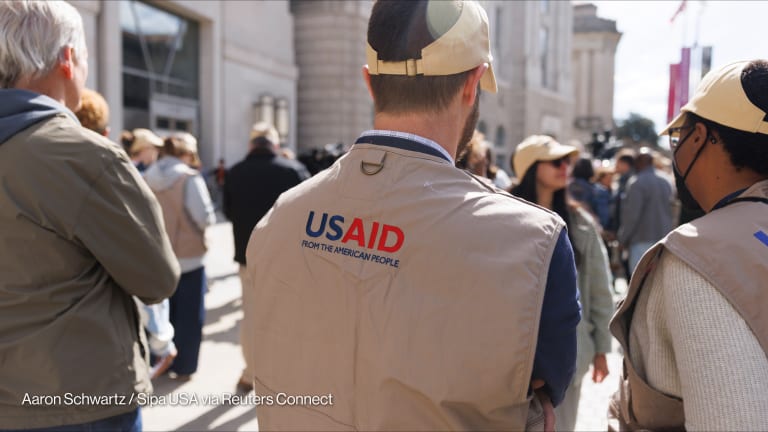
While the legal headlines have subsided, foreign aid groups, employees, and small agencies are still battling the Trump administration in court after sweeping moves to dismantle USAID. Key cases now sit in appeals proceedings — and even before the Supreme Court.
Also in today’s edition: What’s happening at UNEA-7, and the career pivot of one former USAID staffer.
+ Next week, join us for a series of Devex Pro briefings and hear from Evidence Action, Gavi, and the Millennium Challenge Corporation on tackling some of this year’s challenges and how to adapt and find new pathways for development. Head over to our events page to register for these exclusive events.
Not a Pro member? You can upgrade or sign up for a free trial when registering for the events.
Courting controversy
When President Donald Trump moved to shutter USAID at the beginning of 2025, most of the global development world stayed quiet, afraid that speaking out could cost them the little funding left. But by February, a handful of groups broke ranks — and their filings quickly ballooned into a sprawling legal fight over the administration’s foreign assistance agenda.
Ten months later, courts from district benches to the Supreme Court are wrestling with cases over aid funding, agency firings, and the legality of the Department of Government Efficiency, or DOGE. Together, they sketch a sector in crisis and a coalition of partners, employees, and grantees trying to steady it, writes reporter Elissa Miolene.
USAID partners were among the first to sue, launching a case that pinballed through the courts and twice reached the Supreme Court. After early orders requiring the government to pay partners, the highest court ultimately allowed billions to expire on Sept. 30 — a decision one attorney called the “unconstitutional, humanitarian disaster of the Trump administration’s foreign assistance cancellation policy.” The case is now back in the appeals court, which is weighing whether a lower court judge had “erred.” The government is still processing 1,500 overdue payments.
USAID employees and contractors also sued. Cases led by the American Foreign Service Association and the Personal Services Contractor Association reached the Court of Appeals for the D.C. Circuit in August. A separate case targeting DOGE and Elon Musk took another path: A judge ruled DOGE’s actions were “likely” unconstitutional and allowed a class action against Musk. Efforts to depose him — along with former State Department foreign aid head Peter Marocco, and the next official who took that role, Jeremy Lewin — prompted a government motion for a protective order that remains undecided.
Smaller agencies faced their own turmoil after a February executive order labeled the U.S. Institute of Peace, U.S. African Development Foundation, and Inter-American Foundation “unnecessary.” Only IAF has secured a clear win: A judge ruled Sara Aviel’s firing unlawful, reinstated her as chief executive, and barred Marocco from serving on the board.
Across all of these fights, one thread stands out: A foreign aid system pushed into courtroom survival mode — and testing how far the administration’s power reaches, and how far the aid community can push back.
Read: Where do the USAID legal battles stand?
For more details on the progress of these cases and others, check out our tracker.
Pivoting under pressure
When Kevin Melton learned in March that his division at USAID was being cut — and his job with it — he realized that “USAID was going down completely [and] ... they weren’t going to save anything.” During his children’s naptime that weekend, he drafted the plan for Pax Strategies, drawing on two decades of experience in conflict zones. “We used to have USAID people sit next to four-star commanders. … That’s gone now [and] pretty much why Pax exists.”
Pax quickly became a home for laid-off security talent. More than 80 experts now cover 125 countries to offer strategic advisory support to governments, companies, and international organizations. It was, Melton says, “an unprecedented moment … an unprecedented amount of talent that had just been told you don't matter to the U.S. government anymore.”
Since launching in July, he’s been working through dozens of leads, including unexpected openings in climate finance, writes Natalie Donback for Devex. Pax is also building a data-driven platform to measure risk across 71 commodities using machine learning, climate models, macroeconomic data, and satellite imagery.
Pax isn’t the only consultancy to emerge from the shutdown. Firms such as The Meridian Guild, The Solarium Group, and Veridicor meet monthly to explore collaboration rather than competition. “What we’re seeing in Washington is a consolidation. … So why don’t we find ways where we can do it together?” Melton says.
Read: How a former USAID staffer created a network of security experts (Career)
📧 Do you know someone who took development layoff lemons and made lemonade? We’re profiling those in our community who’ve pivoted in a post-USAID world. Send tips to editor@devex.com.
And if you aren’t yet a Devex Career Account member, sign up now with a free trial period and unlock the article and other exclusive career content and events as well as the full job board for regularly updated opportunities and recruiter insights.
Putting the green back in greenbacks
The world is hurtling into massive environmental and economic shocks unless governments move much faster on climate change, warns a major new assessment from the United Nations Environment Programme. The seventh Global Environment Outlook report shows how biodiversity loss, land degradation, and pollution are already reshaping societies and draining trillions from the global economy. As the report’s co-chair Robert Watson puts it: “We can no longer view these environmental issues as simply environmental issues. They're economic issues.”
The numbers are stark — $143 billion in annual climate losses, 3 billion people affected by degraded land, 24 billion metric tons of soil lost each year, 9 million pollution-related deaths, and 1 million species at risk. Watson stresses the crises cut across everything: “They're also development issues … social issues … security issues,” and fall hardest on low- and middle-income countries because “it’s largely the industrialized countries that have caused the problem.”
Still, the report says the world can change course, writes reporter Ayenat Mersie. Redirecting investment toward clean energy, healthy ecosystems, and sustainable economies could save millions of lives and lift hundreds of millions out of poverty — though it will take trillions annually through mid-century.
But politics are a major obstacle. Countries couldn’t even agree on the report’s summary for policymakers, with talks breaking down over “issues around fossil fuels, issues around plastics, a circular economy, conflict.”
“I have to say at this moment in time, multilateralism does seem to be in trouble,” Watson warns.
Read: UN Environment Programme warns world is off course as cooperation falters
Carbon capture
The report’s release aligned with the UNEA-7 environmental talks that opened in Nairobi, Kenya, this week, with more than 6,000 delegates from 170 countries debating 15 draft resolutions on everything from sargassum blooms and AI in conservation to environmental crime and critical minerals.
Tensions there are already simmering — some delegates have accused negotiators of pushing a corporate agenda. UNEA-7 President Abdullah Bin Ali Al-Amri promised “every voice is heard” and a process driven by “trust, transparency, the spirit of compromise, and inclusiveness.”
But frustration is mounting, Devex contributor David Njagi, who’s attending the event, tells me. Delegates flagged the strong presence of fossil fuel and chemical lobbyists, while the Africa group said talks were slow, uneven, and underfunded. The BRICS bloc raised concerns about alignment with multilateral agreements, and labor groups warned business interests were gaining too much influence. “We welcome the business community. … But we don’t want the process to be captured by business,” said Bert De Wel, representing the workers and trade union group.
In other news
The Trump administration is considering filing terrorism-related sanctions against UNRWA, raising deep legal and humanitarian concerns among U.S. officials as the U.N agency for Palestinian refugees already faces a severe funding crisis. [Reuters]
People who were affected by Typhoon Rai in the Philippines have filed a lawsuit in the U.K. accusing Shell of contributing to the storm’s devastation through its historic emissions, a charge the company rejects as baseless. [BBC]
More than 500,000 people have been evacuated from the Thai-Cambodian border amid the deadliest clashes in months, as U.S. President Donald Trump pledges to intervene to halt the conflict that has already killed at least 15 people. [The Guardian]
Sign up to Newswire for an inside look at the biggest stories in global development.
About the author

Helen Murphy
Helen is an award-winning journalist and Senior Editor at Devex, where she edits coverage on global development in the Americas. Based in Colombia, she previously covered war, politics, financial markets, and general news for Reuters, where she headed the bureau, and for Bloomberg in Colombia and Argentina, where she witnessed the financial meltdown. She started her career in London as a reporter for Euromoney Publications before moving to Hong Kong to work for a daily newspaper.
Search for articles


Most Read
- 1
- 2
- 3
- 4
- 5